
Astronomers debate whether Webb's 'little red dots' are black hole stars
This digest was compiled by AI from multiple sources — links to the originals are below.
Astronomers are divided over the nature of 'little red dots' seen by the James Webb Space Telescope. Two teams propose these objects are 'black hole stars'—colossal hydrogen masses hiding black holes. Other researchers dispute this interpretation, reigniting debate over the mysterious pinpricks of light.
Key Facts
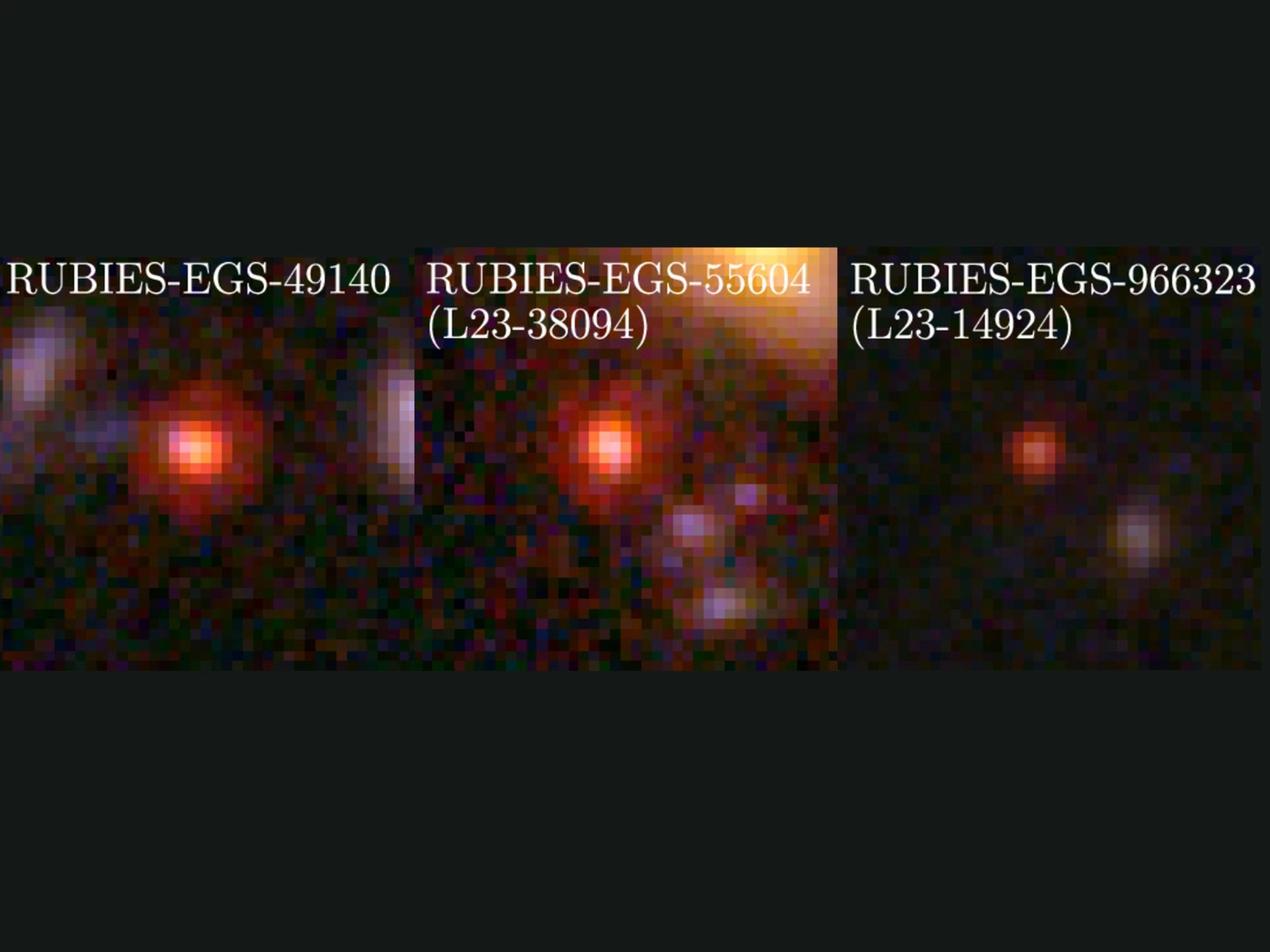
- The James Webb Space Telescope has detected 'little red dots' that glow as brightly as entire galaxies but span just one pixel.
- In spring 2025, two teams announced observations of two little red dots unlike any object ever seen, proposing they are 'black hole stars'—hydrogen masses hiding black holes.
- A paper posted last week argues Webb is witnessing the births of supermassive black holes inside colossal stars, with Rohan Naidu of the University of Hawai‘i calling it 'a fundamentally new phenomenon'.
- The interpretation has sparked fierce debate, with MIT astrophysicist Anna-Christina Eilers saying 'the field has gotten very polarized'.
The Little Red Dots
Astronomers built the James Webb Space Telescope to capture faint light from the first billion years after the Big Bang. In its first images, Webb revealed mysterious smears of light, including objects that glowed blindingly bright with long-wavelength red light and shone as brilliantly as a whole galaxy. These objects were tiny, spanning just a pixel, and appeared in almost every Webb image, leading researchers in 2023 to call them 'little red dots'. Initially thought to resemble galaxies, later analysis suggested they look more like supermassive black holes at the centers of galaxies, whose gravity vacuums up gas and creates rings of hot, swirling detritus.
The Black Hole Star Proposal
In spring 2025, two teams of astronomers simultaneously announced observations of a pair of little red dots unlike all the rest, and unlike any object ever seen. Anna de Graaff of the Max Planck Institute for Astronomy in Heidelberg, Germany, head of one group, said, 'In all the millions of [observations] we’ve taken with ground-based telescopes, there’s nothing that looks like these sources.' The two teams propose these are a new astronomical object: a topsy-turvy lump of hydrogen that shines with the light of billions of suns while hiding a black hole deep in its core, which they call a black hole star. In a paper posted last week, astronomers argued that Webb is witnessing the births of supermassive black holes inside the cores of colossal stars, with Rohan Naidu of the University of Hawai‘i stating, 'There is a fundamentally new phenomenon afoot.'
Debate and Polarization
Not everyone agrees with this bold interpretation, which has sparked a flurry of follow-up research and reignited a fierce debate over the nature of these peculiar pinpricks of light. Anna-Christina Eilers, an astrophysicist at the Massachusetts Institute of Technology who studies little red dots, said, 'The field has gotten very polarized.' Astronomers first argued that little red dots were distant galaxies on the cosmic horizon, mainly because of their brightness, but the new observations challenge that view.
1 source
Time · lag behind first