
James Webb Telescope identifies black hole star MoM-BH*-1 from early universe
This digest was compiled by AI from multiple sources — links to the originals are below.
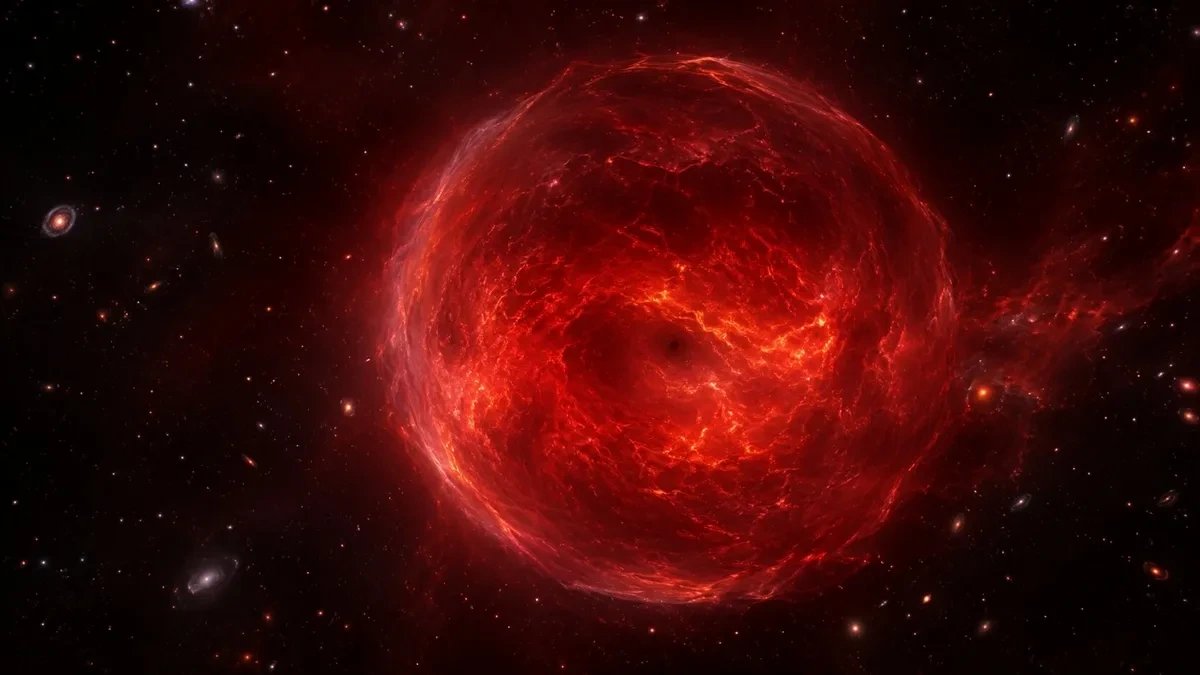
The James Webb Space Telescope has identified a bright red object named MoM-BH*-1 in images of the early universe. The object, thought to have formed 13 billion years ago, emits 100 billion times more energy than known stars can produce. MIT researchers say its center holds a black hole with about 100,000 times the Sun's mass, surrounded by a hydrogen gas envelope the size of the Solar System.
Key Facts
- MoM-BH*-1 was identified as a bright red dot in James Webb Space Telescope images of the early universe.
- The object formed about 13 billion years ago, only 660 million years after the Big Bang.
- MoM-BH*-1 emits 100 billion times more energy than known stars can produce.
- MIT researchers found a black hole of about 100,000 solar masses at the object's center.
- The research was published in the journal Nature.
The Discovery
The James Webb Space Telescope identified MoM-BH*-1 as a bright red dot in images of the early universe. The object is thought to have formed about 13 billion years ago, only 660 million years after the Big Bang. It emits 100 billion times more energy than known stars can produce.
Black Hole Star Structure
MIT researchers' analysis indicates a black hole with about 100,000 times the Sun's mass at the object's center. A dense hydrogen gas envelope the size of the Solar System surrounds the black hole. In normal stars, nuclear fusion produces energy, but in a black hole star the central black hole consuming surrounding matter is the power source. The gas layer makes the object appear as a giant star.
Implications for Early Universe
The research published in Nature suggests that the 'little red dots' frequently seen in James Webb images but with unidentified sources could be black hole stars. The discovery may help understand how supermassive black holes grew rapidly in the early universe.
1 source
Time · lag behind first