
Astronomers Present Case for Black Hole Star MoM-BH*-1
This digest was compiled by AI from multiple sources — links to the originals are below.
Astronomers using James Webb Space Telescope observations describe MoM-BH*-1, an object from an era 660 million years after the Big Bang, as a candidate black hole star in a paper published Wednesday in Nature. The object emits about 100 billion times more energy than nuclear fusion can explain and shows light absorption stronger than an ordinary star can produce.
Key Facts
- MoM-BH*-1 emits about 100 billion times more energy than any star can produce through nuclear fusion.
- Part of MoM-BH*-1's light abruptly disappears, and researchers attribute the effect to a gas envelope far denser than a normal stellar atmosphere.
- The central signal comes from the universe at age 660 million years, nearly 14 billion years ago.
- The study, published Wednesday in Nature, is based on observations by the James Webb Space Telescope.
Candidate Object MoM-BH*-1
The James Webb Space Telescope images show MoM-BH*-1 as one of many bright, reddish spots in the early universe. Researchers focused on some of the most distant observable phenomena, which share characteristics with giant stars based on the light they emit. From a distance of billions of light-years, the object appears as large as a star and is bright even for its era. The central signal comes from a time when the universe was just 660 million years old.
Energy and Absorption Signature
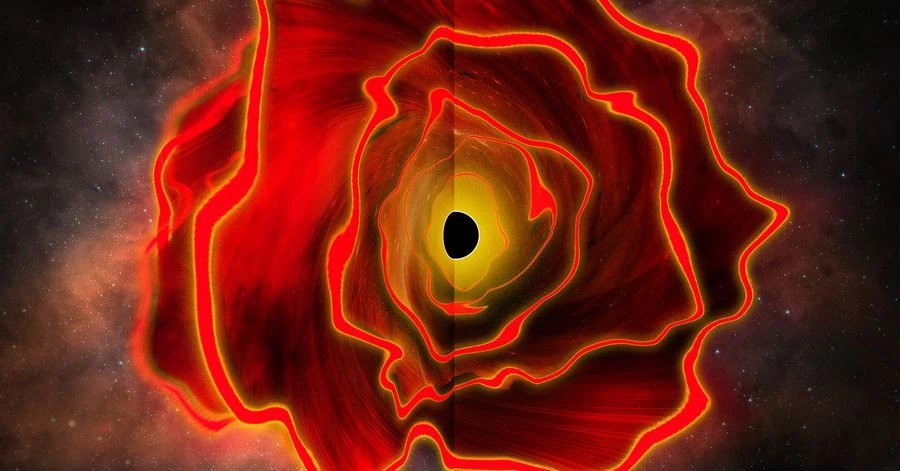
MoM-BH*-1 emits about 100 billion times more energy than any star could produce through nuclear fusion, according to the team. Part of its light abruptly disappears, a signal stars can produce when their atmospheres absorb certain wavelengths. In MoM-BH*-1, the effect is stronger than can be explained as normal star behavior. Researchers believe the light is absorbed by a gas envelope far denser than a normal stellar atmosphere. These clues led scientists to the black hole star hypothesis, with a central black hole surrounded by a gas envelope.
Publication and Red Spots
The paper appears Wednesday in Nature and is based on James Webb Space Telescope observations. The telescope finds small red spots in the early universe more often than expected, and these spots do not fit neatly into the usual categories of objects in deep space. Scientists have put forward several explanations, including compact galaxies teeming with stars and black holes hidden by dust. The black hole star hypothesis is among the explanations advanced for the population of small red spots.
1 source
Time · lag behind first