
JWST little red dots may be rapidly growing black holes, simulations suggest
This digest was compiled by AI from multiple sources — links to the originals are below.
New simulations on Japan's ATERUI III supercomputer suggest the James Webb Space Telescope's mysterious Little Red Dots may be black holes growing at extraordinary rates in the early Universe. The findings, led by Sunmyon Chon of the Max Planck Institute for Astrophysics, indicate these objects could arise naturally from conditions that no longer exist today. The results do not require unusual physics or highly unlikely events.
Key Facts
- The simulations were performed on the ATERUI III supercomputer at the National Astronomical Observatory of Japan.
- The research was led by Sunmyon Chon of the Max Planck Institute for Astrophysics.
- Intense far-ultraviolet radiation from nearby galaxies can prevent ordinary stars from forming inside some gas clouds, leading to the collapse of a single supermassive star.
- The simulated black holes can grow dozens of times faster than black holes in the modern Universe.
- Some supermassive black holes with millions or billions of solar masses already existed less than 600 million years after the Big Bang.
Simulation Approach
The team used the ATERUI III supercomputer at the National Astronomical Observatory of Japan to carry out some of the most detailed cosmological simulations yet of the early Universe. The simulations began on the scale of a young galaxy and then progressively focused on smaller regions, eventually reaching individual clouds of gas. This demanding approach required the high-resolution computing power of ATERUI III. The results suggest that intense far-ultraviolet (FUV) radiation from nearby galaxies can prevent ordinary stars from forming inside some gas clouds. Instead of breaking apart into many smaller stars, the gas can collapse into a single supermassive star that then collapses to create a black hole seed.
Black Hole Growth
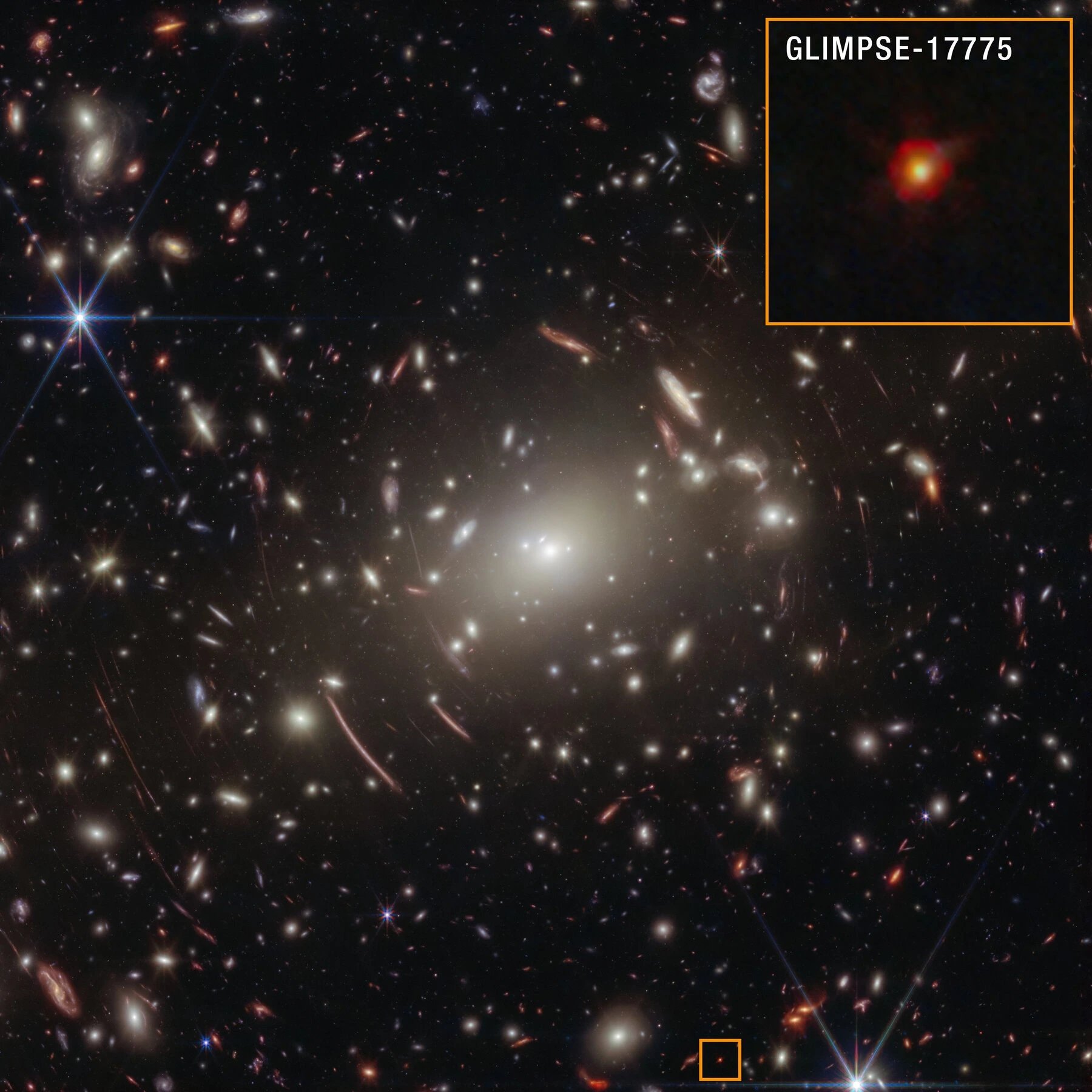
Once these black hole seeds form, the simulations show that they can become surrounded by thick disks of dense gas. These gas-rich environments trap radiation and allow the black holes to consume material much more efficiently than black holes can in the modern Universe. Under these conditions, the black holes can grow dozens of times faster than would be possible today. The properties of these simulated black holes closely resemble the Little Red Dots observed by the James Webb Space Telescope. That similarity suggests the mysterious red objects could represent an early stage of extremely rapid black hole growth.
Early Universe Mystery
Astronomers have struggled for years to explain how supermassive black holes appeared so early in cosmic history. Some of these black holes contain millions or even billions of times the mass of the Sun, yet they already existed less than 600 million years after the Big Bang. JWST was expected to help solve this puzzle by detecting fainter and more distant galaxies than previous telescopes could see. Because light moves at a finite speed, observing very distant objects also means looking into the past. If a galaxy is 11 billion light-years away, its light has traveled for 11 billion years before reaching Earth, so we see the galaxy as it appeared 11 billion years ago.
1 source
Time · lag behind first