
University of Arizona-led study suggests Webb's little red dots are bright cores of galaxies
This digest was compiled by AI from multiple sources — links to the originals are below.
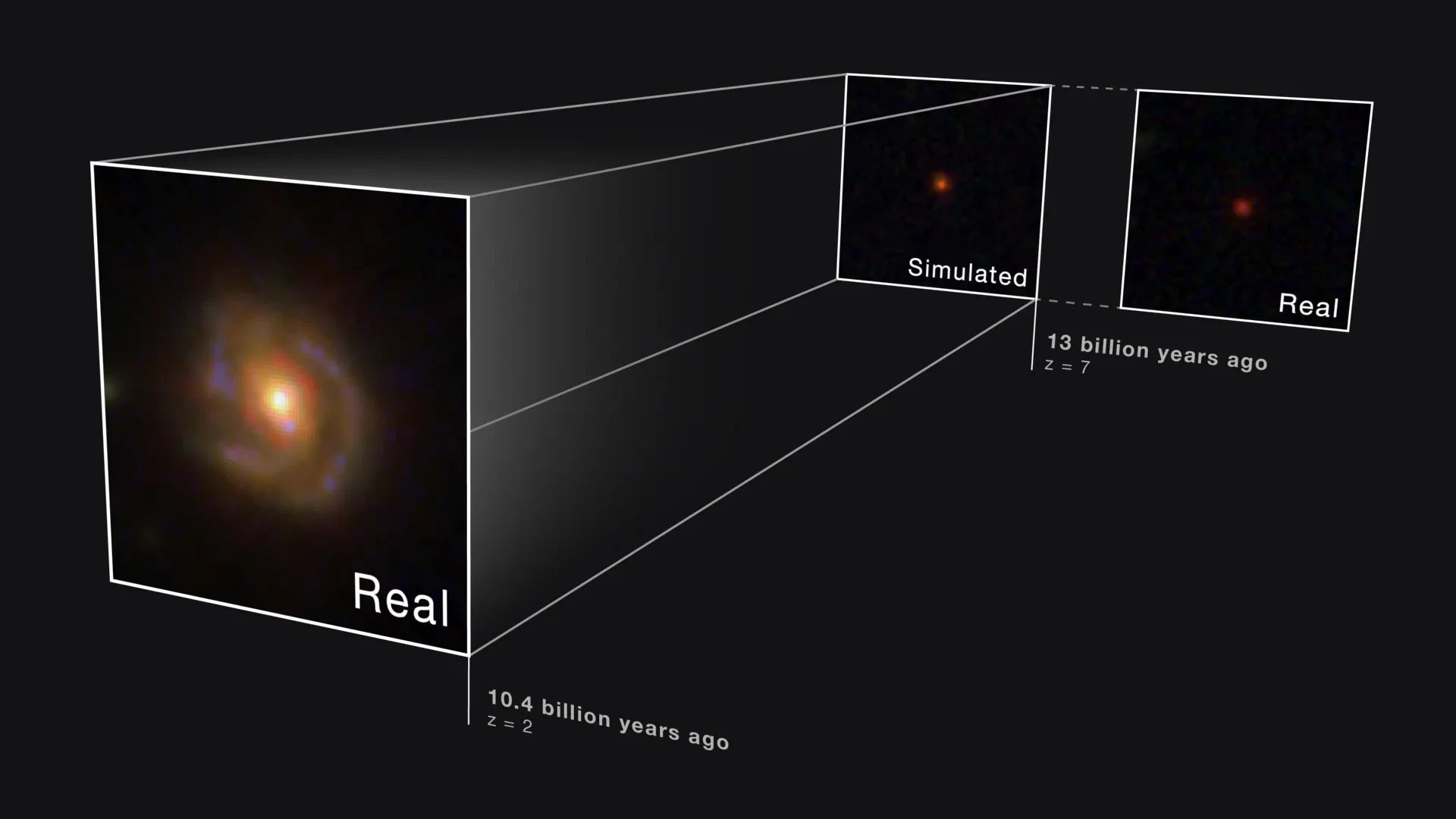
A University of Arizona-led study published July 29 in The Astrophysical Journal suggests that Webb's little red dots are the bright centers of galaxies whose outer structures are too faint to detect at extreme distances. The team identified a lower-redshift spiral galaxy, WISEA J123635.56+621424.2, nicknamed Saguaro, whose compact red core resembles those distant objects.
Key Facts
- The study, published July 29 in The Astrophysical Journal, suggests that the unusual appearance of little red dots partly reflects observational bias rather than a separate galaxy population.
- The team identified a lower-redshift spiral galaxy, WISEA J123635.56+621424.2, nicknamed Saguaro, at redshift 2, seen as it appeared 3.3 billion years after the Big Bang.
- NASA's James Webb Space Telescope first revealed little red dots in 2022.
- Little red dots are common at high redshift, but their numbers fall sharply at lower redshifts.
- One leading idea is that little red dots are supermassive black holes known as active galactic nuclei, but they do not behave like active galactic nuclei observed in the nearby universe.
The Saguaro Galaxy
The team studied a lower-redshift spiral galaxy designated WISEA J123635.56+621424.2 and nicknamed Saguaro because its prominent spiral arms resemble the Sonoran Desert cactus. The galaxy sits at redshift 2, meaning astronomers see it as it appeared roughly 3.3 billion years after the Big Bang. At its center is a compact red source that closely resembles a little red dot and evokes the ruby red fruit of the desert cactus. Earlier observations from NASA's retired Spitzer Space Telescope provided an early glimpse of this dust-obscured, compact galaxy population.
Observational Bias
The new results attribute the unusual appearance of little red dots partly to observational bias. At extreme distances, surrounding structures become too faint for current telescopes to detect, leaving only the bright central source visible. The researchers reached this conclusion by finding that Saguaro's compact red core resembles a little red dot at lower redshift. Co-author George Rieke of the University of Arizona said the results finally show how to find the progeny of little red dots.
Research Context
NASA's James Webb Space Telescope first revealed little red dots in 2022. The compact, extremely distant red sources appear throughout the early universe, but their true nature has remained difficult to explain. One leading idea is that little red dots are supermassive black holes known as active galactic nuclei, but they do not behave quite like active galactic nuclei observed in the nearby universe. Little red dots are common at high redshift, but their numbers fall sharply at lower redshifts, prompting astronomers to investigate what they become as the universe ages.
1 source
Time · lag behind first