
Voyager 1's 1977 launch set stage for 2012 interstellar crossing
This digest was compiled by AI from multiple sources — links to the originals are below.
NASA's Voyager 1, launched from Cape Canaveral on September 5, 1977, became the first human-made object to enter interstellar space on August 25, 2012. The 721.9 kg spacecraft, powered by three radioisotope thermoelectric generators, continues to return data from 164.7 astronomical units away as of August 21, 2024. Its Saturn encounter in 1980 bent its trajectory out of the ecliptic plane, sacrificing visits to Uranus and Neptune for a path toward interstellar space.
Key Facts
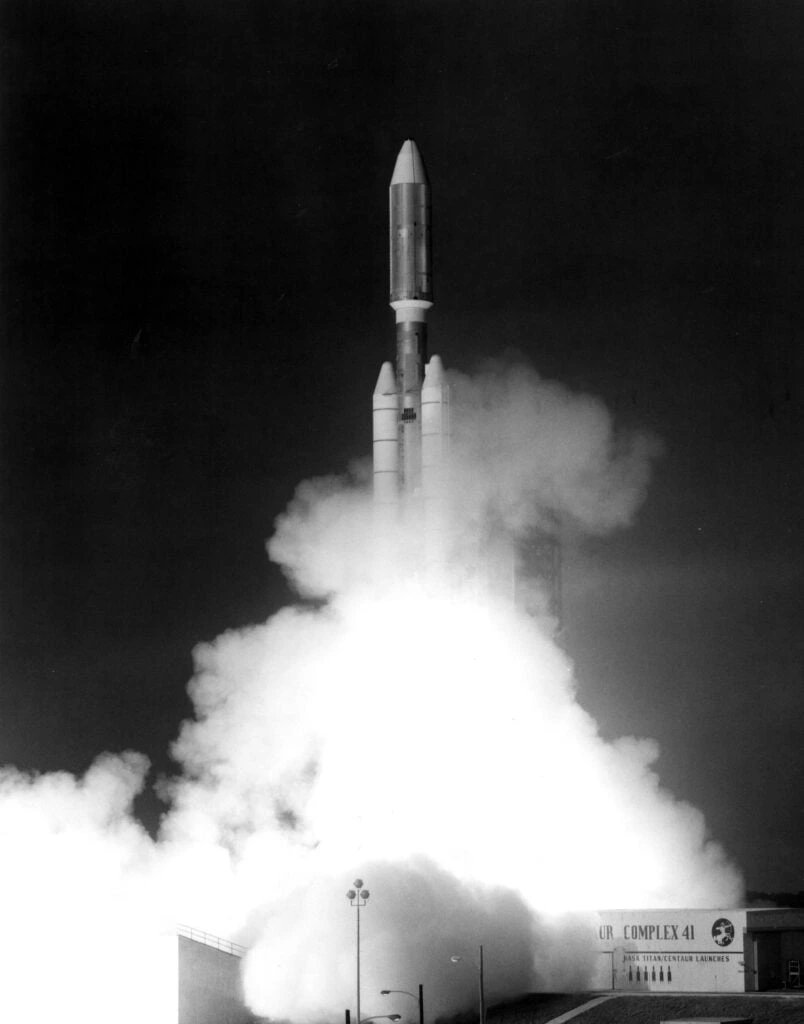
- Voyager 1 lifted off from Launch Complex 41 at Cape Canaveral, Florida, on September 5, 1977, at 12:56:01 UT aboard a Titan IIIE-Centaur designated TC-6.
- The spacecraft entered interstellar space on August 25, 2012, becoming the first human-made object to leave the heliosphere.
- As of August 21, 2024, Voyager 1 was 164.7 astronomical units from Earth and still communicating with NASA's Deep Space Network.
- Voyager 1 discovered a thin ring around Jupiter and two new moons, Thebe and Metis, during its closest approach on March 5, 1979.
- The spacecraft's closest approach to Saturn on November 12, 1980, yielded five new moons and the faint G-ring.
Launch and Early Trajectory
Voyager 1, managed by NASA's Jet Propulsion Laboratory, launched second after Voyager 2 but overtook its twin on December 15, 1977, due to a faster trajectory. The spacecraft's closest approach to Jupiter occurred on March 5, 1979, revealing a thin ring and the moons Thebe and Metis. On November 12, 1980, Voyager 1 made its closest pass by Saturn, discovering five additional moons and the G-ring. The Saturn encounter's close pass by Titan bent the spacecraft's trajectory northward out of the ecliptic plane, precluding visits to Uranus and Neptune.
Power and Interstellar Mission
Three Multi-Hundred Watt radioisotope thermoelectric generators, converting heat from decaying plutonium into electricity, power the spacecraft. The Voyager Interstellar Mission officially began on January 1, 1990, after the planetary work concluded. Voyager 1 crossed into interstellar space on August 25, 2012, and as of August 21, 2024, was 164.7 astronomical units from Earth. A 30-centimeter gold-plated copper disc, the Golden Record, carries greetings, sounds, music, and images as a message from Earth.
1 source
Time · lag behind first