
Voyager probes encounter 50,000-degree plasma wall at solar system's edge
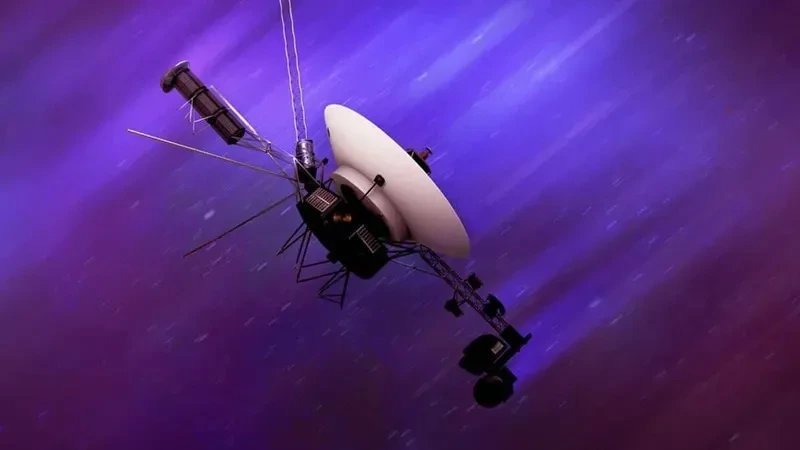
This digest was compiled by AI from multiple sources — links to the originals are below.
NASA's Voyager 1 and Voyager 2 probes have encountered a boundary region at the edge of the solar system where plasma temperatures reach 30,000 to 50,000 degrees Celsius. The probes crossed the heliopause in 2012 and 2018 respectively, becoming the first spacecraft to enter interstellar space. The boundary is not a solid wall but a dynamic plasma layer that expands and contracts with solar activity.
Key Facts
- Voyager 1 crossed the heliopause in 2012 and Voyager 2 in 2018, becoming the first spacecraft to enter interstellar space.
- Instruments on the probes recorded temperatures between 30,000 and 50,000 degrees Celsius in the boundary zone.
- Voyager 2 detected a transition region 1.5 astronomical units wide just before the heliopause, where plasma slows, heats, and doubles in density.
- The heliopause is not a fixed sphere; it expands and contracts with changes in solar activity, which explains why the two probes encountered it at different distances.
The Heliopause Encounter
Voyager 1 and Voyager 2, launched in 1977, are now exploring a region that was only vaguely understood a few decades ago. The boundary of the solar system is not a sharp line but a vast bubble called the heliosphere, created by the solar wind. At the outer edge of this bubble, the solar wind yields to interstellar matter, forming a transition zone known as the heliopause. Voyager 1 passed through the heliopause in 2012, and Voyager 2 followed in 2018.
Plasma Wall Structure
The so-called 'wall' is not a solid barrier but a plasma of extremely rarefied, electrically charged particles where solar and interstellar matter interact. Measurements by Voyager 2 revealed that the heliopause is more complex than a simple boundary. Researchers identified a transition region 1.5 astronomical units wide immediately before the heliopause. In this region, plasma slows down, heats up, and its density doubles. At the heliopause itself, plasma density changes significantly in less than a day.
Dynamic Boundary
The two Voyager spacecraft explored the same boundary region at different times and in different locations. The heliopause is not a stationary sphere; it can expand and contract depending on changes in solar activity. This variability helps explain why the probes encountered the boundary at different distances.
1 source
Time · lag behind first