
James Webb Telescope finds 10-km moon of Uranus missed by Voyager 2 in 1986
This digest was compiled by AI from multiple sources — links to the originals are below.
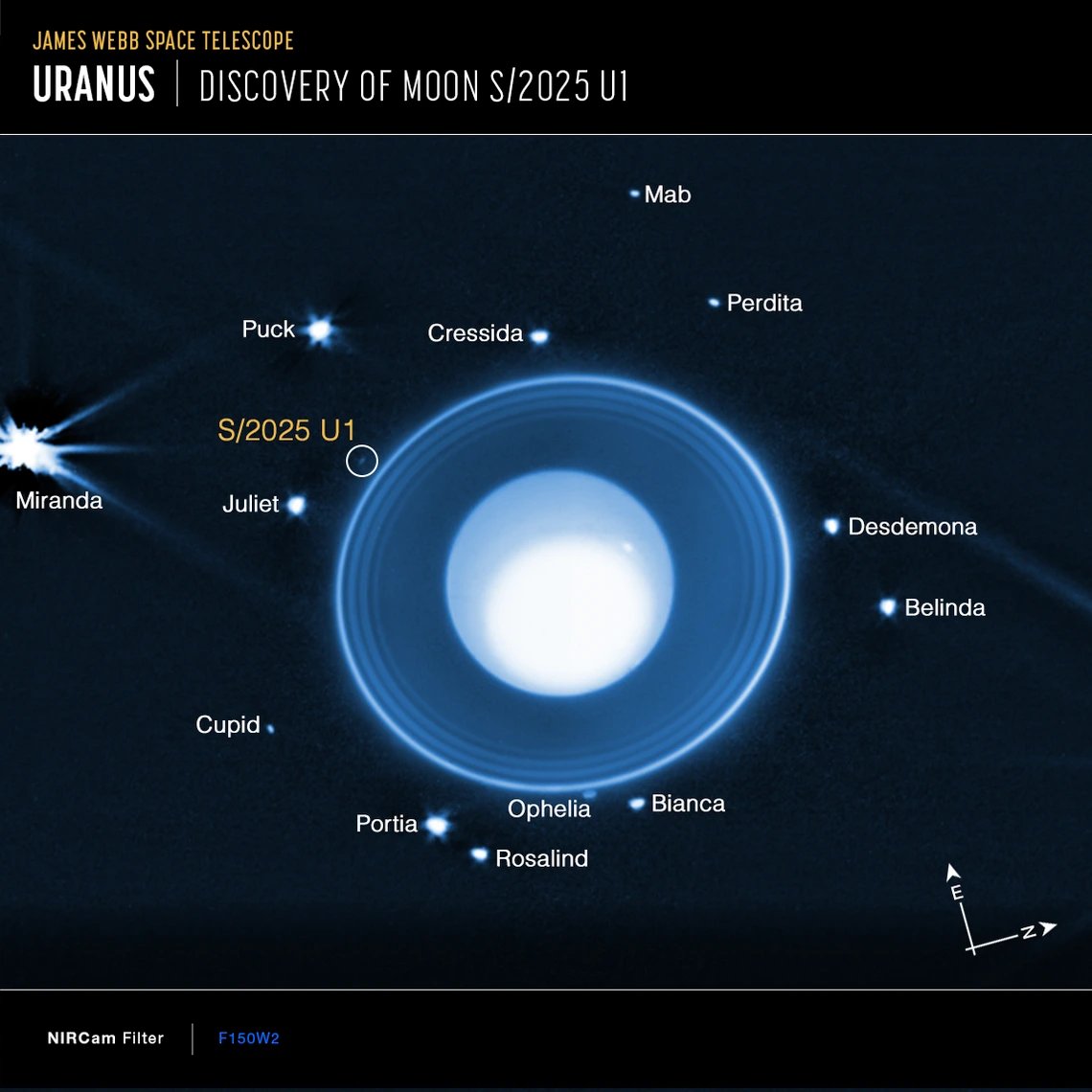
The James Webb Space Telescope detected a faint moving object between the orbits of Ophelia and Bianca on 2 February 2025, raising the known Uranian moon count to 29. The object, provisionally designated S/2025 U1, is estimated at about 10 kilometres across. The discovery comes 39 years and nine days after Voyager 2's 1986 flyby, which found ten moons but missed this one.
Key Facts
- The James Webb Space Telescope observed Uranus for roughly six hours on 2 February 2025 and recorded a faint moving point between the orbits of Ophelia and Bianca.
- The new moon, provisionally designated S/2025 U1, is estimated to be about 10 kilometres across and raises the total of known Uranian moons to 29.
- Voyager 2 discovered ten moons during its 24 January 1986 flyby, including Juliet, Puck, Cordelia, Ophelia, Bianca, Desdemona, Portia, Rosalind, Cressida and Belinda.
- Perdita was identified in 1999 by Erich Karkoschka from archived Voyager 2 frames taken in 1986, and confirmed by Hubble in 2003.
The Webb Detection
On 2 February 2025, the James Webb Space Telescope watched Uranus for roughly six hours and recorded a faint moving point between the orbits of Ophelia and Bianca. The object is probably only about 10 kilometres across and received the provisional designation S/2025 U1. The discovery raised the current total to 29 known Uranian moons. The interval between the Voyager 2 encounter and the Webb detection was 39 years and nine days.
Voyager 2's 1986 Flyby
Voyager 2 crossed the Uranian system on 24 January 1986 and found ten moons that had never been seen before. The NASA Uranus moon catalogue names the ten discoveries as Juliet, Puck, Cordelia, Ophelia, Bianca, Desdemona, Portia, Rosalind, Cressida and Belinda. Their estimated diameters range from about 26 to 154 kilometres, with Puck the largest of the group. Voyager 2 came within 81,500 kilometres of Uranus's cloud tops and returned the first close observations of the planet, rings and moons.
The Perdita Complication
The spacecraft's 1986 photographs contained another moon, but nobody recognised it during the encounter. In 1999, Erich Karkoschka compared archived Voyager frames and identified the object now called Perdita. Hubble recovered an object at the predicted position in 2003 and confirmed the moon. Perdita's provisional designation, S/1986 U10, preserves the year of the images.
1 source
Time · lag behind first