
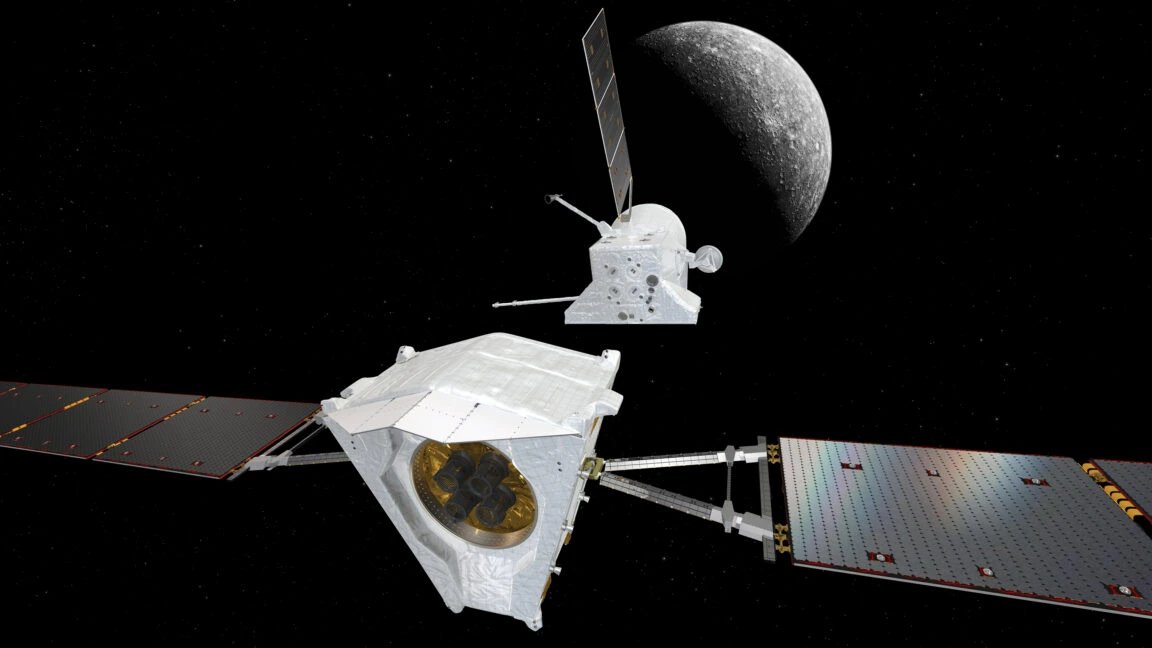
BepiColombo jettisons propulsion module ahead of Mercury orbit insertion
This digest was compiled by AI from multiple sources — links to the originals are below.
The European-Japanese BepiColombo spacecraft jettisoned its Mercury Transfer Module on Thursday, clearing the way for orbit insertion around Mercury in November. The $2 billion mission has traveled eight years and performed nine planetary flybys to reach the innermost planet. The two science orbiters remain attached and will separate in December after arrival.
Key Facts
- BepiColombo launched in 2018 and has performed nine planetary flybys of Earth, Venus, and Mercury.
- The mission cost nearly $2 billion and is led by the European Space Agency with contributions from Japan and the United States.
- The Mercury Transfer Module was jettisoned on Thursday because it was no longer needed for propulsion.
- The European Mercury Planetary Orbiter and Japan's Mio orbiter will separate in December after arriving in orbit around Mercury in November.
- BepiColombo used the most powerful electric propulsion system ever sent into deep space, with four gridded ion thrusters.
Propulsion Module Separation
On Thursday, BepiColombo jettisoned the Mercury Transfer Module, the section containing its four gridded ion thrusters. The module had provided power and propulsion throughout the eight-year cruise from Earth. Separation was required before the spacecraft slips into orbit around Mercury in November. The European and Japanese orbiters remain attached and will travel together until December.
Mission Trajectory and Cost
BepiColombo launched in 2018 and used a combination of plasma propulsion and nine planetary flybys to reach Mercury. The trajectory required more energy than sending a probe to fly by Pluto, according to mission scientists. The mission cost nearly $2 billion and is led by the European Space Agency with contributions from Japan and the United States. The spacecraft's electric propulsion system was the most powerful ever put into deep space.
Science Orbiters
BepiColombo consists of the Mercury Planetary Orbiter built by Europe and the Mercury Magnetospheric Orbiter nicknamed Mio from Japan. Each orbiter carries its own instruments for scientific observations at Mercury. The two spacecraft will release from one another in December, soon after arriving in their initial orbit around Mercury.
1 source
Time · lag behind first