
Europa Clipper travels 1.8 billion miles toward Jupiter, aims for April 2030 arrival
This digest was compiled by AI from multiple sources — links to the originals are below.
NASA’s Europa Clipper, launched in October 2024, is traversing a 2.9-billion-kilometre route toward Jupiter after using Mars for a gravity assist in March 2025. The probe will study Europa’s hidden global ocean, which likely holds more water than all of Earth’s seas combined. An Earth flyby in December 2026 will propel it to a 2030 arrival at Jupiter, where 49 close Europa flybys are planned.
Gravity-Assist Trajectory
NASA launched Europa Clipper on 14 October 2024 on a 2.9-billion-kilometre journey to Jupiter. The spacecraft used a Mars gravity assist on 1 March 2025 to adjust its speed and direction. A second gravity assist at Earth is planned for 3 December 2026, which will send it toward Jupiter orbit insertion in April 2030. Clipper will not land on Europa but will perform 49 close flybys starting in 2031.
Europa’s Subsurface Ocean
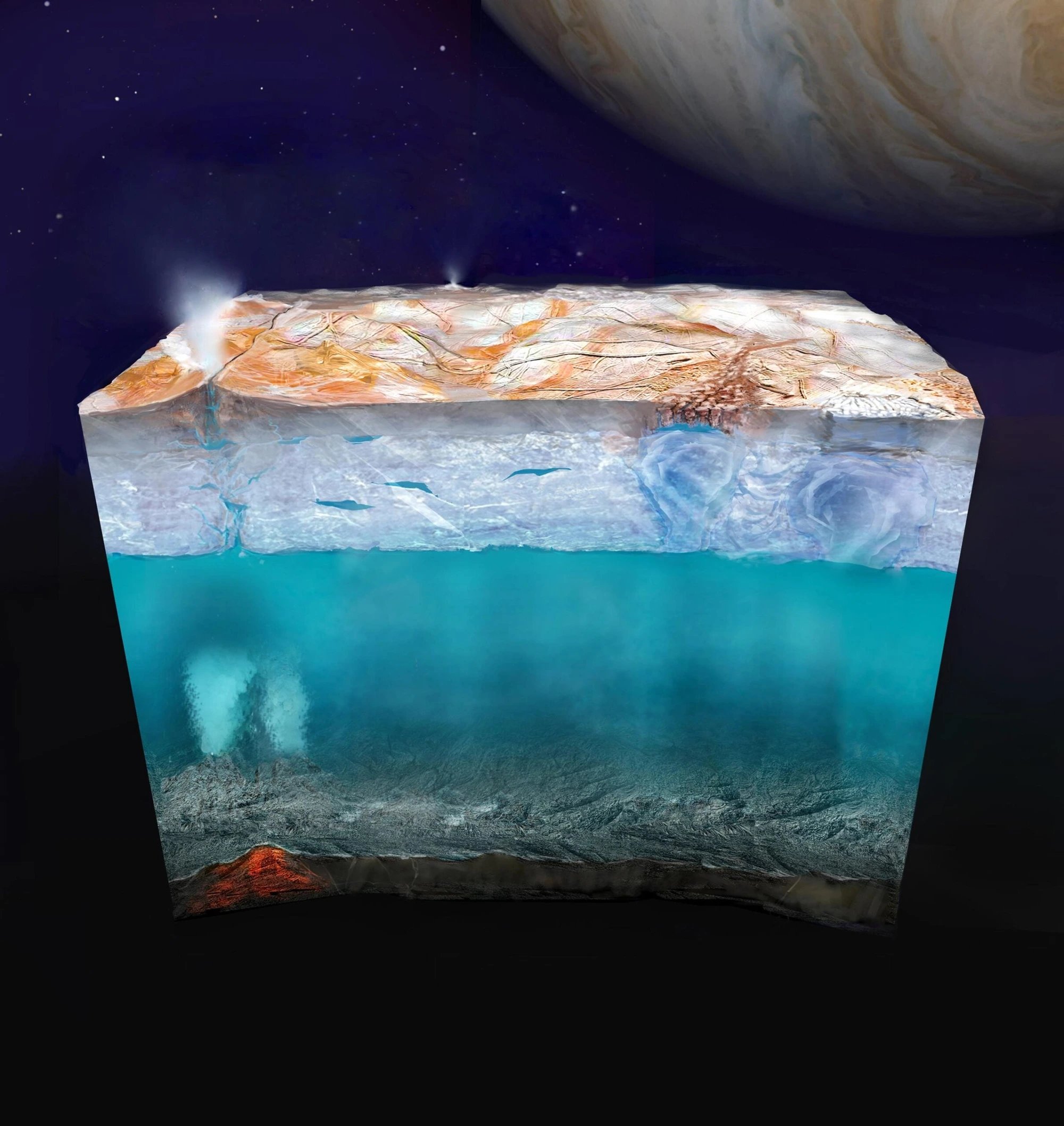
Europa, slightly smaller than Earth’s Moon at 3,100 kilometres in diameter, is believed to harbour a global saltwater ocean beneath its icy crust. NASA estimates the ocean could be 60 to 150 kilometres deep, potentially holding more than twice the water of all Earth’s oceans. Recent Juno measurements suggest the conductive portion of the ice shell averages 29 kilometres thick in one region, though global mapping is incomplete. No mission has directly sampled the ocean.
Flyby Science Campaign
Europa Clipper carries nine science instruments and a gravity-radio science investigation to study the moon’s ice shell and subsurface ocean. Ice-penetrating radar will probe the shell’s structure, while other instruments analyze surface composition and magnetic field data. The mission’s 49 planned flybys will gather data from different altitudes to build a comprehensive picture of Europa’s potential habitability. NASA highlights that the spacecraft cannot drill through the ice or detect organisms.
1 source
Time · lag behind first