
BepiColombo Probe Begins Final Descent to Mercury Orbit After 8-Year Journey
This digest was compiled by AI from multiple sources — links to the originals are below.
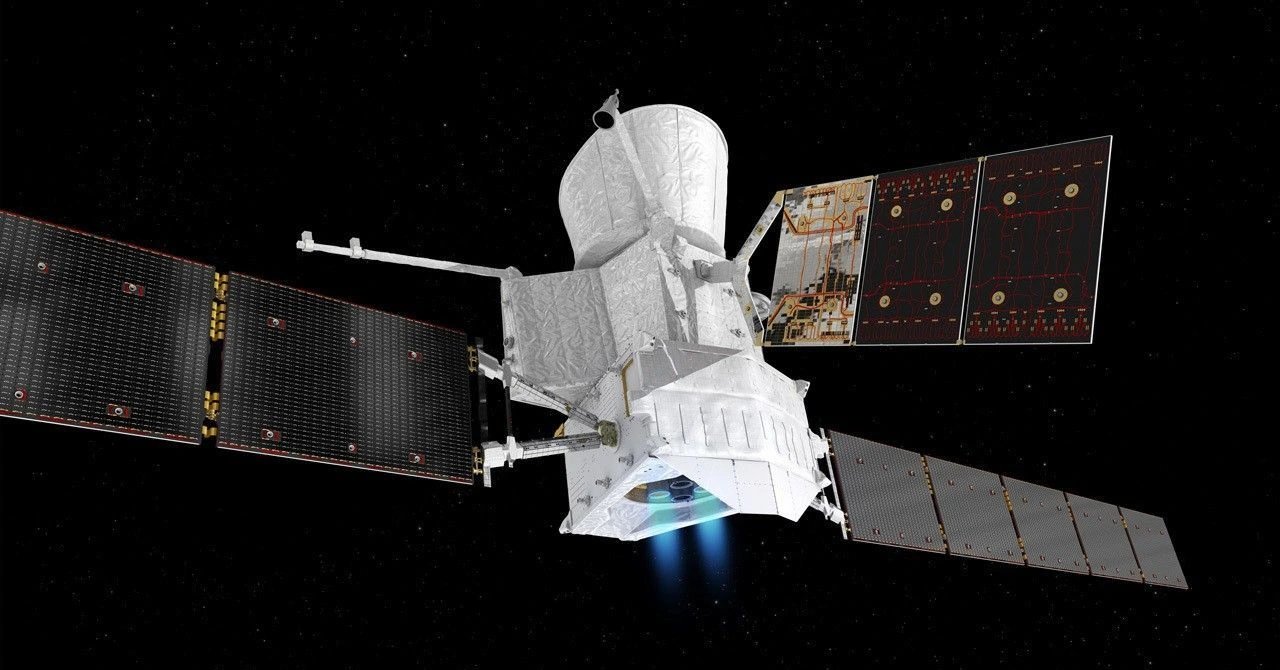
The BepiColombo spacecraft has begun its final descent to low orbit around Mercury after an eight-year journey. Ground control confirmed on September 3 that the propulsion module separated successfully, marking the final phase of the joint ESA-JAXA mission. The probe is scheduled to begin full scientific observations in April 2027.
Key Facts
- BepiColombo's propulsion module separated from the spacecraft on September 3, confirmed by ground control.
- The mission is a joint project of the European Space Agency (ESA) and the Japan Aerospace Exploration Agency (JAXA).
- BepiColombo has traveled approximately 9.9 billion kilometers, using nine gravity assist maneuvers around Earth, Venus, and Mercury.
- Full-scale scientific observations are scheduled to begin in April 2027.
Final Descent
On September 3, ground control confirmed that the propulsion module had successfully separated from the rest of the craft. The separation marks the final phase of the joint mission between the European Space Agency (ESA) and the Japan Aerospace Exploration Agency (JAXA). Transmissions from the probe indicated all went smoothly after a journey that reached more than 200 million kilometers from Earth.
Mission Challenges
Mercury is especially challenging to reach because it is the closest planet to the Sun. A spacecraft traveling toward the inner solar system is essentially falling from Earth toward the much greater gravity of the Sun. Getting to Mercury requires a lot of fuel not to travel there but to engage rockets to put on the brakes. BepiColombo has traveled approximately 6 billion miles (9.9 billion kilometers), swinging around Earth once, Venus twice, and Mercury six times for a total of nine gravity assist maneuvers. Mercury's surface can be intensely hot—over 800 degrees Fahrenheit (about 430 degrees Celsius)—and temperatures drop to -290 degrees Fahrenheit (-180 Celsius) at night.
Scientific Orbit
Once in position, BepiColombo will break into two separate spacecraft: the Mercury Planetary Orbiter (MPO) and the Mercury Magnetospheric Orbiter (Mio). The MPO will study Mercury's surface and internal structure, while Mio will investigate the planet's magnetic field and tenuous atmosphere. This is the first time multiple probes will orbit Mercury simultaneously, with the goal of gaining a more comprehensive picture than any single probe could capture on its own. Full-scale observations are scheduled to begin in April 2027.
1 source
Time · lag behind first