
BepiColombo nears Mercury after eight-year, 10 billion km journey
This digest was compiled by AI from multiple sources — links to the originals are below.
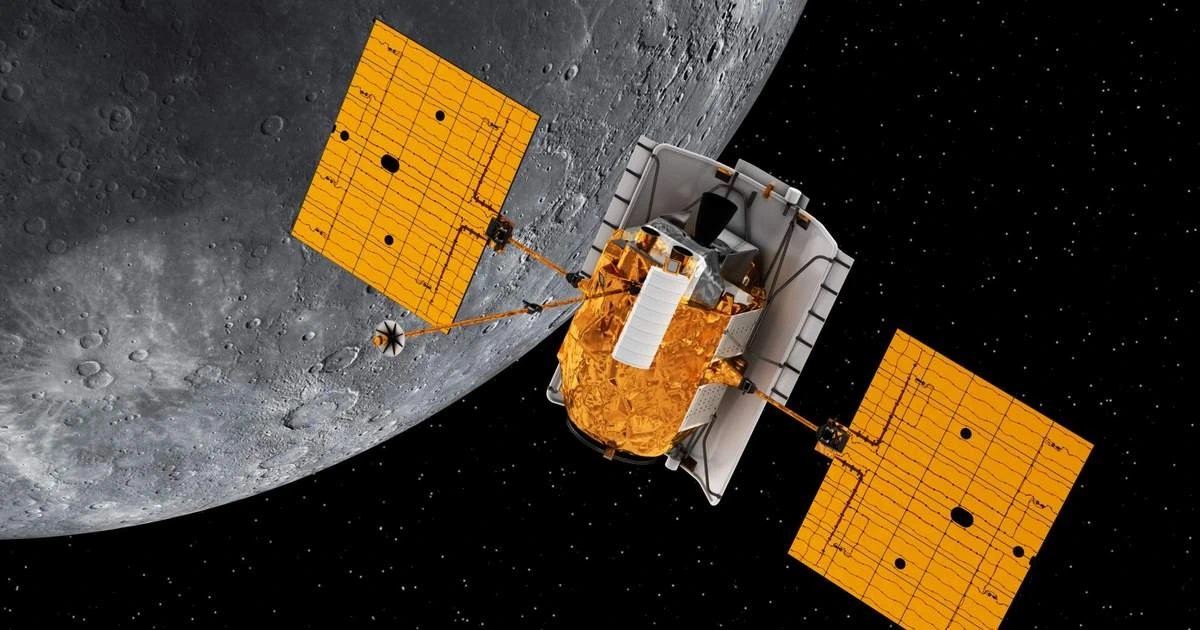
The BepiColombo spacecraft has approached Mercury after nearly eight years and over 10 billion kilometers of travel. The joint ESA-JAXA mission launched in October 2018 aboard an Ariane 5 rocket. It is set to become the first mission to operate two independent spacecraft simultaneously around another planet.
Key Facts
- BepiColombo launched in October 2018 aboard an Ariane 5 rocket.
- The spacecraft has traveled over 10 billion kilometers through the Solar System.
- Mercury has been studied by only two NASA missions, in 1973 and 2011.
- Daytime temperatures on Mercury reach 430 degrees Celsius, yet ice may exist in polar craters.
- Mercury orbits the Sun at an average distance of 58 million kilometers, completing one orbit in 88 Earth days.
Mission Profile
BepiColombo is a joint mission of the European Space Agency and the Japan Aerospace Exploration Agency. The spacecraft launched in October 2018 on an Ariane 5 rocket. It has traveled more than 10 billion kilometers across the Solar System. BepiColombo will be the first mission to operate two fully independent spacecraft simultaneously around another planet.
Scientific Objectives
The mission aims to obtain new data on the formation and evolution of Mercury, one of the least studied planets in the inner Solar System. Mercury has been studied by only two NASA missions, conducted in 1973 and 2011. Scientists seek to determine the origin of mysterious depressions on Mercury's surface and the presence of ice in polar craters despite daytime temperatures reaching 430 degrees Celsius. Mercury orbits the Sun at an average distance of 58 million kilometers and completes one orbit in 88 Earth days. The BepiColombo spacecraft are specially adapted to operate under extremely high temperature conditions.
1 source
Time · lag behind first