
Scientists obtain most detailed images of Sun's surface, revealing 20-km structures
This digest was compiled by AI from multiple sources — links to the originals are below.
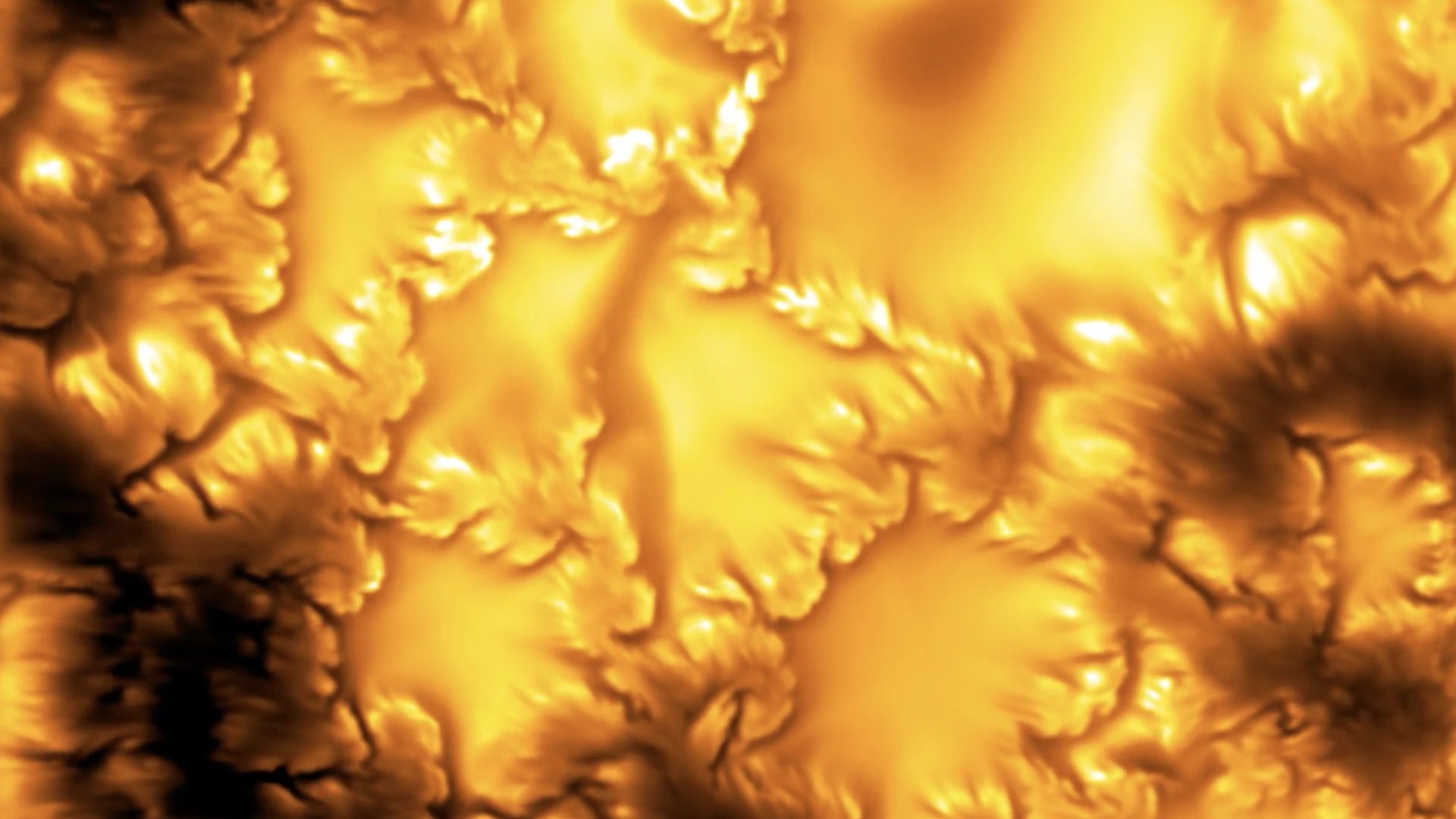
Scientists have obtained the highest-resolution images of the solar surface to date, resolving structures as small as 20 kilometres and capturing plasma vortices for the first time. The observations, made with the Daniel K. Inouye Solar Telescope in Hawaii, detail 47 vortices ranging from 25 to 170 km on the edges of magnetic regions. The discovery confirms long-suspected Kelvin-Helmholtz instability in the Sun's photosphere, offering new insights into energy and magnetic field transport.
Record-Breaking Imagery
The Daniel K. Inouye Solar Telescope on Haleakalā, Hawaii — the world's largest solar telescope — captured images of an active region near a sunspot with a resolution of approximately 19 kilometres. This allowed scientists to see details previously unobservable, turning the solar surface into a much more complex and dynamic landscape than earlier images suggested. The telescope's 4-metre mirror enabled the team to resolve structures far smaller than those seen by typical solar instruments.
Evidence of Kelvin-Helmholtz Instability
Researchers analysed 47 distinct plasma vortices on the boundaries of strong magnetic fields, ranging in size from 25 to 170 kilometres. These vortices are manifestations of Kelvin-Helmholtz instability, which occurs when adjacent flows of fluid or gas move at different speeds — a phenomenon commonly observed in Earth's atmosphere and oceans. Until now, such instability had been theorised for the Sun but never directly observed in the photosphere due to insufficient resolution. The observed vortices appeared not as smooth edges but as constantly forming swirls and streaks, matching computer simulations of the solar atmosphere.
Implications for Solar Physics
The discovery extends beyond the record-breaking detail. The vortices likely play a role in transporting mass, energy, and magnetic field across the Sun's surface. Understanding these processes could improve knowledge of magnetically active regions and their evolution. The findings, published in Nature, mark a significant advance in solar observation, complementing other missions like the European Space Agency’s Solar Orbiter.
1 source
Time · lag behind first