
Inouye Solar Telescope reveals first-ever images of sun's Kelvin-Helmholtz vortices
This digest was compiled by AI from multiple sources — links to the originals are below.
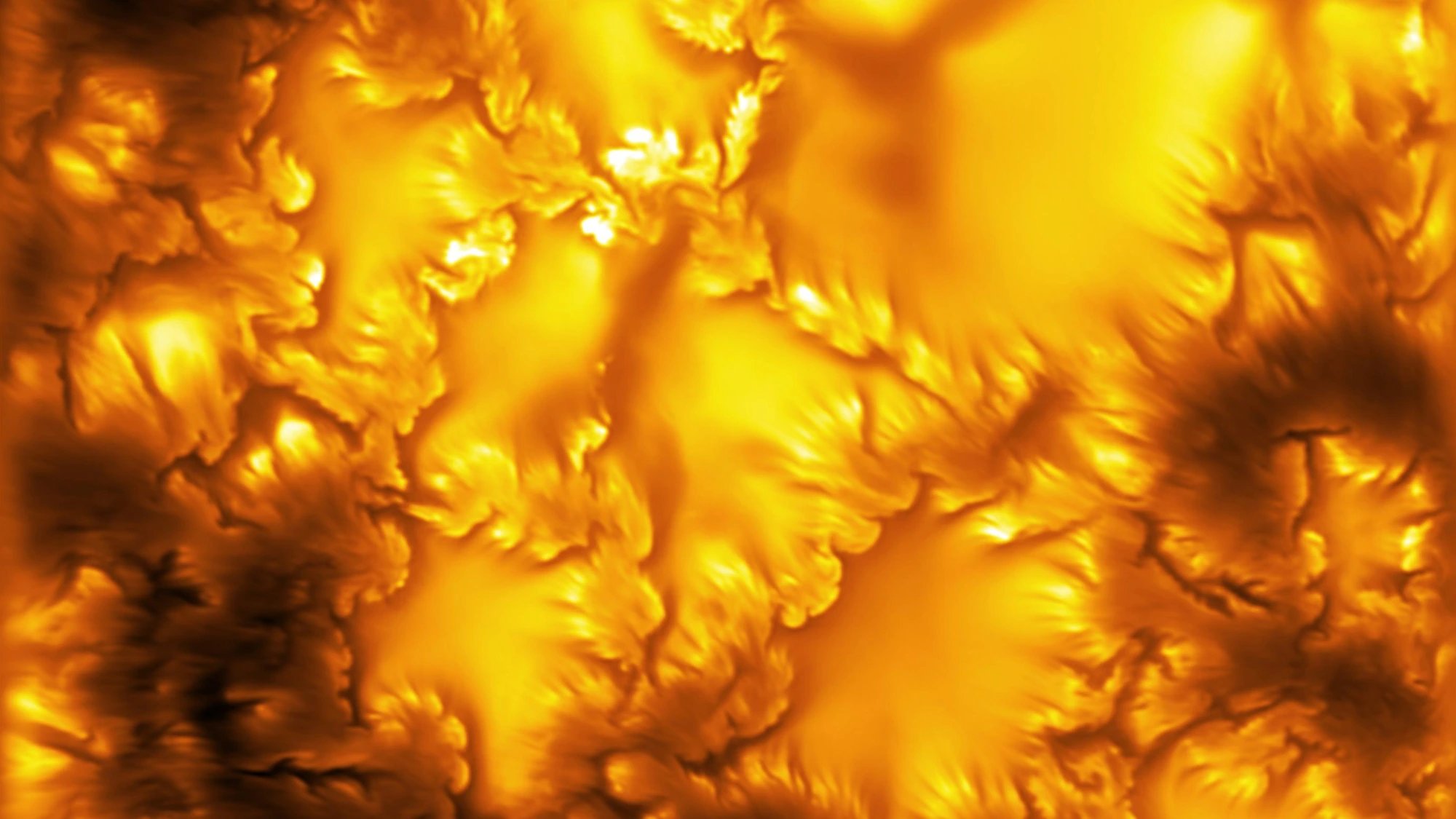
The Daniel K. Inouye Solar Telescope in Hawaii has captured the first direct images of Kelvin-Helmholtz instabilities on the sun’s visible surface, revealing thousands of tiny whirlpools. The findings, published Aug. 5 in Nature, confirm a 150-year-old fluid dynamics prediction for the first time on our star. Researchers say these vortices may help solve the mystery of why the sun’s outer atmosphere is hundreds of times hotter than its surface.
The Kelvin-Helmholtz Instability
The time-lapse footage from the Inouye telescope provides the first observational proof of Kelvin-Helmholtz instability on the sun, a phenomenon described by Lord Kelvin and Hermann von Helmholtz in the 19th century. Dozens of tiny vortices were seen clustering along the edges of magnetic regions, some accompanied by dark striations. The observed swirls form where neighboring plasma streams slide past each other at different speeds, creating shear that rolls into spiraling patterns. Computer simulations of the photosphere matched the images closely, even reproducing the average spacing between vortices.
Coronal Heating and Solar Eruptions
Researchers suspect the vortices constantly twist and mix the sun’s magnetic field lines, building up energy that powers solar flares and coronal mass ejections. Space Daily noted the long-standing coronal heating paradox: while the visible surface averages 5,500°C, the corona reaches 1–2 million°C, a puzzle known since 1939. Thomas Rimmele of the National Solar Observatory said in a statement that these small-scale instabilities could contribute to transferring energy upward into the corona.
Unprecedented Resolution
The Inouye telescope, operated by the U.S. National Science Foundation, can discern structures just tens of miles across—a scale fine enough to reveal vortices that remained hidden for more than a century. By comparing observations with simulations, the researchers confirmed the match to within the average distance between individual swirls. The telescope’s 4-meter mirror and advanced adaptive optics enable views of the solar photosphere with a sharpness no previous instrument has achieved.
2 sources
Time · lag behind first