
DESI releases largest 3D map of universe with 4 billion objects
This digest was compiled by AI from multiple sources — links to the originals are below.
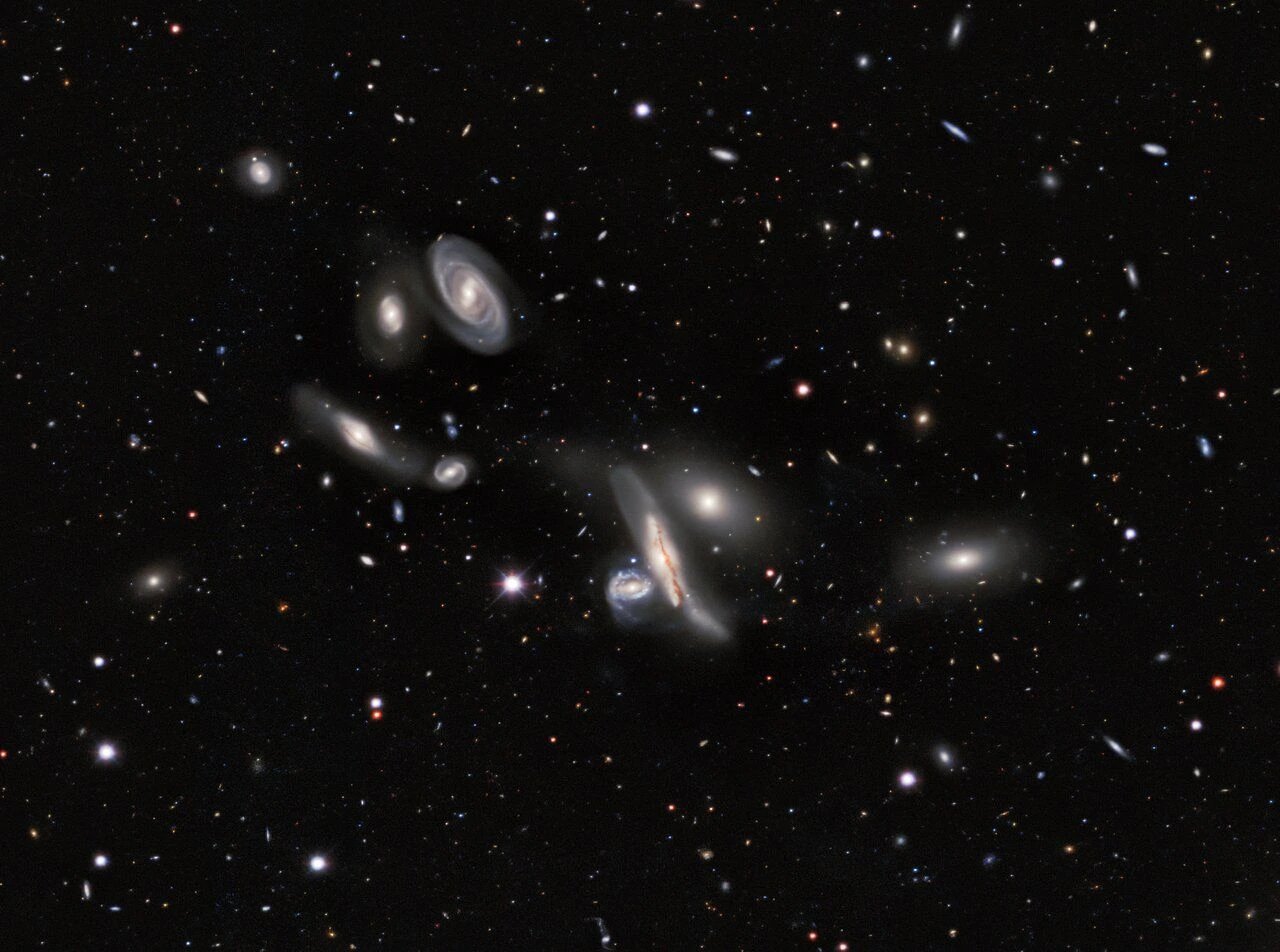
The Dark Energy Spectroscopic Instrument (DESI) has released the largest three-dimensional map of the universe, containing 5.6 trillion pixels and approximately 4 billion celestial objects. The map covers about 75 percent of the sky and is available through a free online tool, the DESI Legacy Imaging Surveys. The release follows five years of data collection and builds on 13 years of groundwork.
Key Facts
- The map contains 5.6 trillion pixels and approximately 4 billion celestial objects, including stars, galaxies, black holes, and asteroids.
- It covers about 75 percent of the entire sky, recording both visible light and near-infrared wavelengths.
- More than 160 scientists were involved in data collection, and over 1,800 scientific papers referencing the data have been published.
- Earlier in 2026, DESI researchers released a map projecting the distances of 47 million galaxies and quasars, reconstructing 11 billion years of cosmic history.
- Data from the first three years of DESI's survey, combined with supernovae observations and cosmic microwave background radiation, suggest dark energy may be weakening over time.
The Survey
The Dark Energy Spectroscopic Instrument (DESI) is located on a remote mountain in Arizona's Sonoran Desert and has spent the past five years mapping the cosmos. The survey built on another 13 years of groundwork, with more than 160 scientists involved in data collection. Researchers have published upwards of 1,800 scientific papers referencing the data. David Schlegel, a researcher at Lawrence Berkeley National Laboratory and co-lead of the Legacy Surveys, said the data is part of the fabric of astronomy research now.
Map Coverage
The map covers approximately 75 percent of the entire sky, recording both visible light and near-infrared wavelengths. Missing pieces include deeper parts of space blocked by stars, space dust, and other matter in the Milky Way. DESI's 5,000 mechanical eyes are aimed out of the top or bottom of the galaxy to capture clearer images of distant space. The map contains 5.6 trillion pixels and approximately 4 billion celestial objects, including stars, galaxies, black holes, and asteroids.
Dark Energy Findings
Earlier in 2026, DESI researchers released a map projecting the distances of 47 million galaxies and quasars, reconstructing 11 billion years of cosmic history. Dark energy is thought to be responsible for the universe's accelerated expansion, and astronomers track it by analyzing the rates at which celestial objects move away from us. Data from the first three years of DESI's survey, combined with supernovae observations and cosmic microwave background radiation, have hinted that dark energy may not be constant but is gradually weakening over time.
1 source
Time · lag behind first