
University of Bayreuth researchers develop synthetic fibers that self-protect through bundling
This digest was compiled by AI from multiple sources — links to the originals are below.
University of Bayreuth researchers, with colleagues from Berlin and Dresden, have created synthetic fibers that bundle to self-protect, inspired by the cytoskeleton. The system, reported in Advanced Materials, is fully reversible and triggered by temperature, salt, or solvent changes.
Cytoskeleton-Inspired Hierarchy
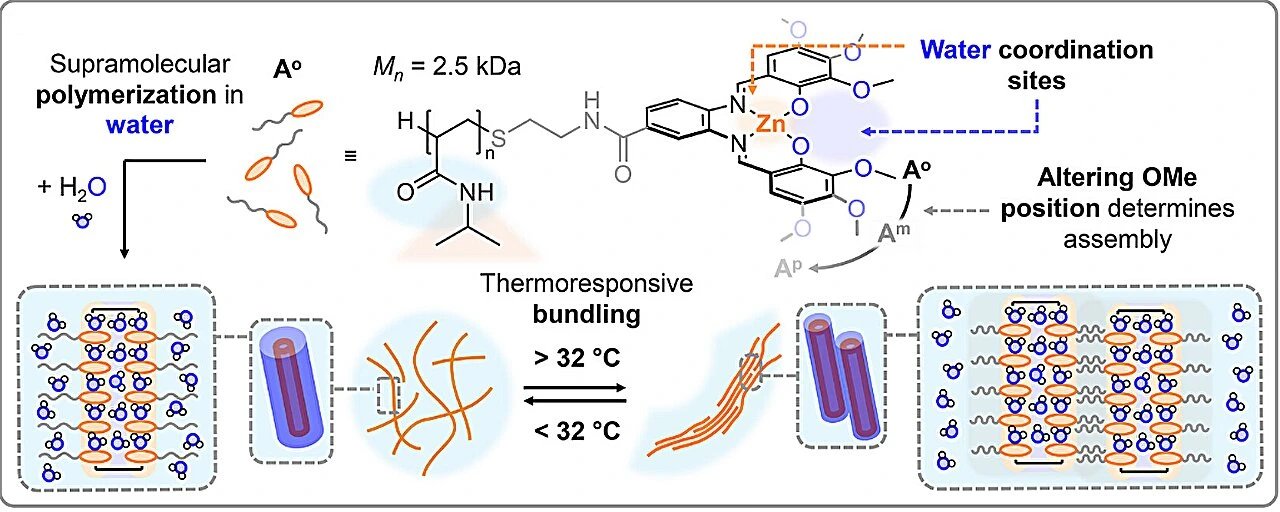
Living cells maintain ultrastructures via weak interactions through hierarchical organization, with proteins forming filaments that bundle with crosslinkers. The Bayreuth team, led by Dr. Alex Plajer, applied this principle to synthetic polymers using zinc-containing planar molecules linked to temperature-responsive polymers. In aqueous solution, these building blocks spontaneously assemble into nanofibers, incorporating water molecules as structural components.
Reversible Bundling
The nanofibers bundle into microscale structures when the temperature exceeds 32°C, or upon changes in salt concentration or solvent composition. This bundling is fully reversible—lowering the temperature or adjusting the salt/solvent conditions causes bundles to disassociate back into individual nanofibers. The process protects the otherwise fragile fibers, which would quickly disassemble under dilution or chemical attack if unbundled.
Selective Fiber Survival
The researchers demonstrated selective protection: in a mixture of bundled and unprotected fibers, only the bundle-forming ones survive chemical attack while others disintegrate. “This behavior resembles the selective compartmentalization observed in cells, where distinct regions or organelles are formed,” said Merlin Stühler, first author and doctoral researcher in Plajer’s group. The findings appear in the journal Advanced Materials.
1 source
Time · lag behind first