
Nanopore memristor uses self-heating for brain-like memory
This digest was compiled by AI from multiple sources — links to the originals are below.
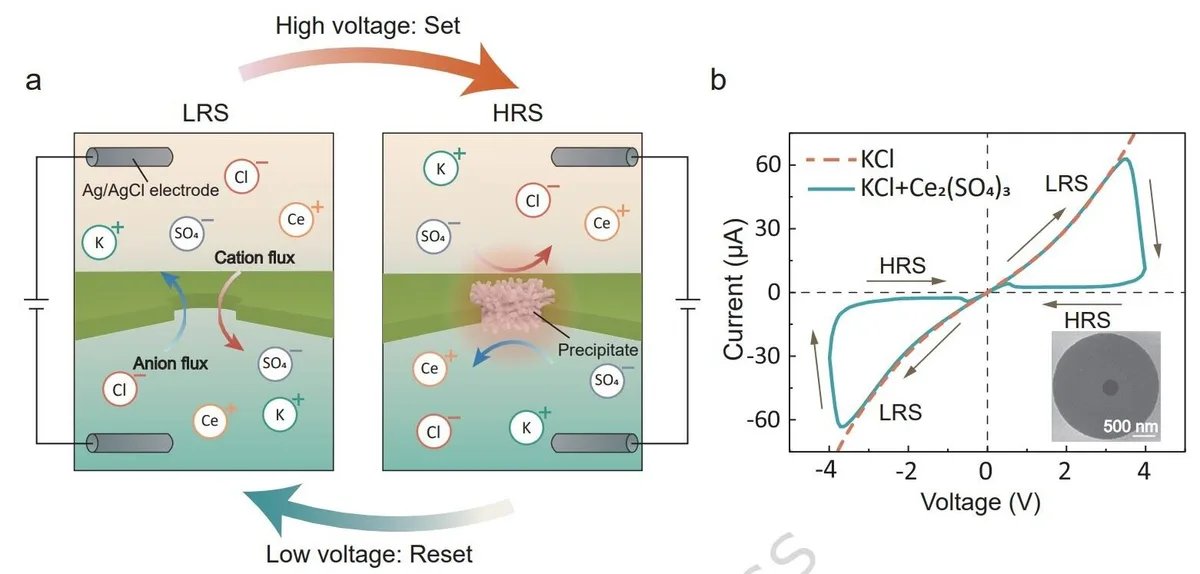
A new study in Nature Communications describes a fluidic memristor that uses current-induced self-heating to create a history-dependent memory effect, mimicking biological synapses. The device, developed by an international research team, operates by controlling ionic flow through a nanopore, with temperature changes modulating conductance. This approach could enable more efficient neuromorphic computing hardware.
The Device Design
The fluidic memristor consists of a nanopore filled with an electrolyte solution, with electrodes on either side. When a voltage is applied, current flow heats the nanopore region, altering the solution's viscosity and ion mobility. This self-heating creates a memory effect where the device's conductance depends on the history of applied voltages, similar to synaptic plasticity. The study reports that the device can switch between high- and low-conductance states with a ratio of about 10.
Neuromorphic Potential
Unlike conventional memristors that rely on solid-state mechanisms, this fluidic design mimics the aqueous environment of biological neurons. The researchers demonstrated that the device can emulate short-term and long-term plasticity, key features of learning and memory. They also showed that multiple devices could be integrated into a crossbar array, a common architecture for neuromorphic chips. The energy consumption per switching event is estimated at around 100 picojoules.
1 source
Time · lag behind first