
Manchester researchers develop AI method to find 2D quantum materials
This digest was compiled by AI from multiple sources — links to the originals are below.
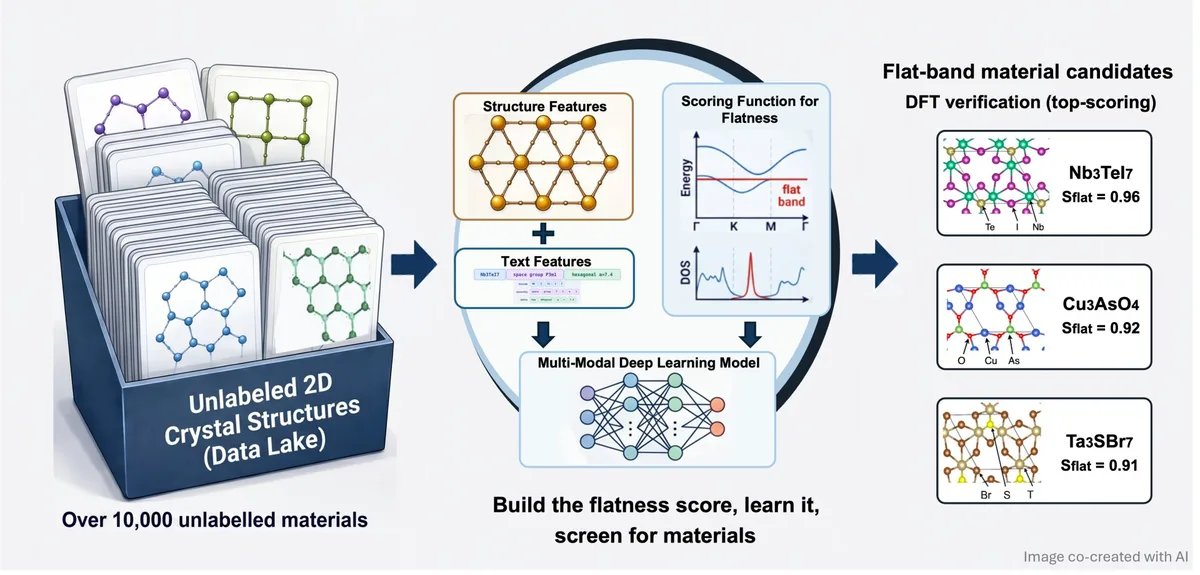
Researchers at the University of Manchester have developed a physics-based machine-learning method to identify two-dimensional materials with flat bands, which may host unusual quantum behavior. The work, published in Science Advances, targets materials where electrons have low kinetic energy, enabling strong interactions linked to magnetism and superconductivity.
The Computational Method
The team, led by Professor Vladimir Fal'ko and Dr. Elton Santos, combined density functional theory with machine learning to screen thousands of potential 2D materials. The algorithm identifies flat-band candidates by analyzing electronic structure data, reducing the search time from months to days. The study screened over 100,000 materials, narrowing down to 150 promising candidates.
Flat Bands and Quantum Phenomena
Flat bands occur when electrons have nearly zero kinetic energy, making electron-electron interactions dominant. This regime can give rise to exotic states such as unconventional superconductivity, topological phases, and correlated magnetism. The method successfully predicted known flat-band materials like twisted bilayer graphene and identified new candidates, including certain transition metal dichalcogenides.
Environmental Monitoring Instruments
Dr Stephen Boult and his team at the University of Manchester developed new instruments for monitoring water and gas quality in the environment. Their spin-out company Salamander licensed the products to Siemens and Ion Science, generating royalties equivalent to £7 million in sales.
Energy-Harvesting Flags
Researchers at the University of Manchester developed flags that generate electricity from wind and solar power. The study is the first to simultaneously harvest both energy sources using inverted flags.
3 sources
Time · lag behind first