
Twisted ultrathin magnet retains magnetization after field changes
This digest was compiled by AI from multiple sources — links to the originals are below.
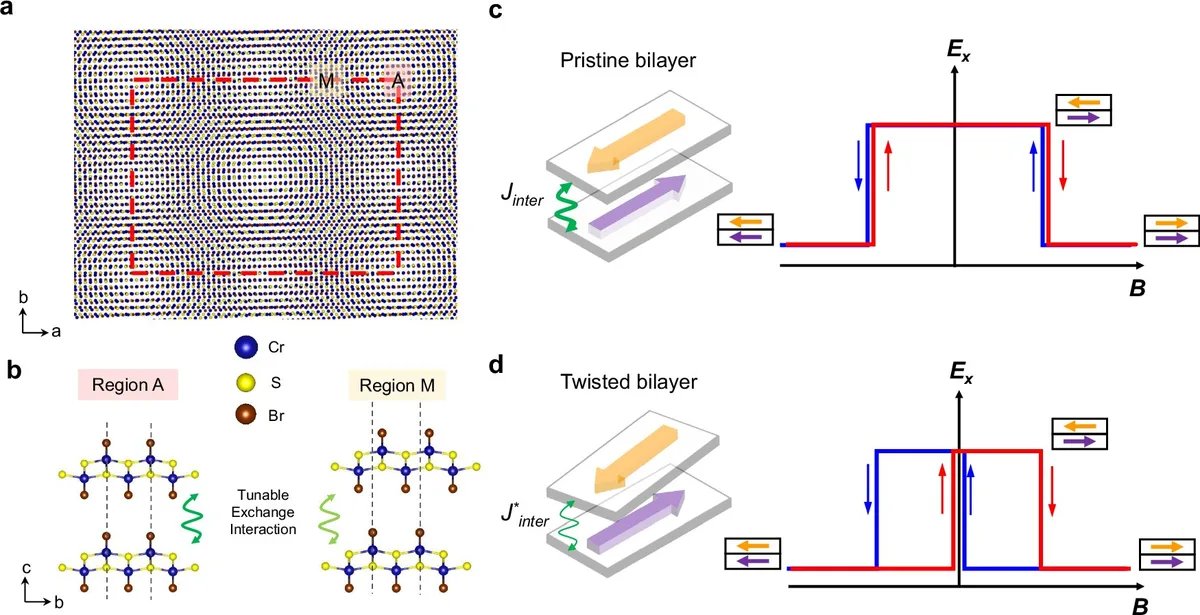
An international team led by TU Darmstadt found that twisting two atomic monolayers alters ultrathin magnet properties, allowing retention of magnetization after external field changes. The study, published in Nature Communications, opens prospects for future memory devices. The effect could enable more stable data storage with lower energy consumption.
The Discovery
Researchers twisted two atomic monolayers by a small angle, creating a moiré pattern that stabilized magnetic domains. The ultrathin magnet retained its magnetization even after the external magnetic field was removed or reversed. This behavior contrasts with conventional magnets that lose magnetization without an external field.
Implications for Memory Devices
The findings suggest a new mechanism for non-volatile memory, where data is stored in magnetic states without continuous power. The twisted structure could allow denser and more energy-efficient storage compared to current technologies. The team demonstrated the effect at room temperature, a key requirement for practical applications.
Superconducting Contacts on Semiconductors
University of Basel researchers equipped an ultrathin semiconductor with superconducting contacts for the first time. This combination of extremely thin materials with superconductors could enable novel electronic and optical applications.
2 sources
Time · lag behind first