
Chang'e-6 samples show Earth's magnetosphere shapes Moon's solar wind exposure
This digest was compiled by AI from multiple sources — links to the originals are below.
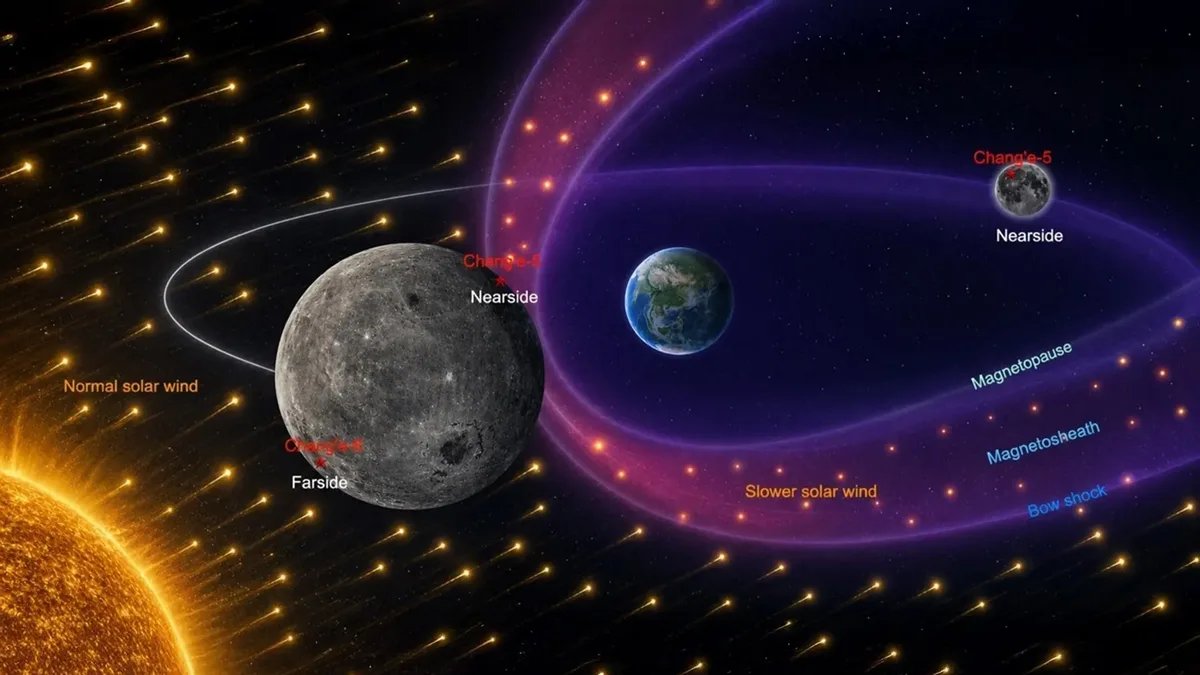
Analysis of lunar regolith returned by China's Chang'e-6 mission reveals that solar wind particles penetrated deeper into the Moon's far-side soil than the near side. The difference is attributed to Earth's magnetosphere, which slows particles reaching the near side. Noble gases in the samples provide a record of this uneven bombardment.
The Solar Wind Archive
The Moon lacks a thick atmosphere and global magnetic field, so solar wind particles strike its surface directly. Over billions of years, the lunar regolith has accumulated volatile materials, including noble gases (He, Ne, Ar, Kr, Xe), which act as markers of solar wind implantation. Until recently, only near-side samples were available, preventing direct comparison between hemispheres.
Chang'e-6 Findings
China's Chang'e-6 mission returned 1.935 grams of regolith from the South Pole-Aitken basin on the lunar far side. A team led by the Institute of Geology and Geophysics (IGG) of the Chinese Academy of Sciences (CAS) analyzed the concentrations and isotopic ratios of five noble gases. The study, published in Nature Geoscience, found that the far-side regolith had an average 20Ne/22Ne ratio of 11.34 ± 0.22, indicating deeper penetration of solar wind particles.
Earth's Magnetosphere Role
The researchers concluded that Earth's magnetosphere is responsible for the hemispheric difference. The magnetosphere slows and deflects solar wind particles approaching the near side, reducing their energy and penetration depth. On the far side, particles arrive at higher speeds, embedding deeper into the soil. The noble gas signatures may help reconstruct the ancient history of Earth's magnetic shield.
1 source
Time · lag behind first