
Mars' southern interior found 200-400°C hotter than north
This digest was compiled by AI from multiple sources — links to the originals are below.
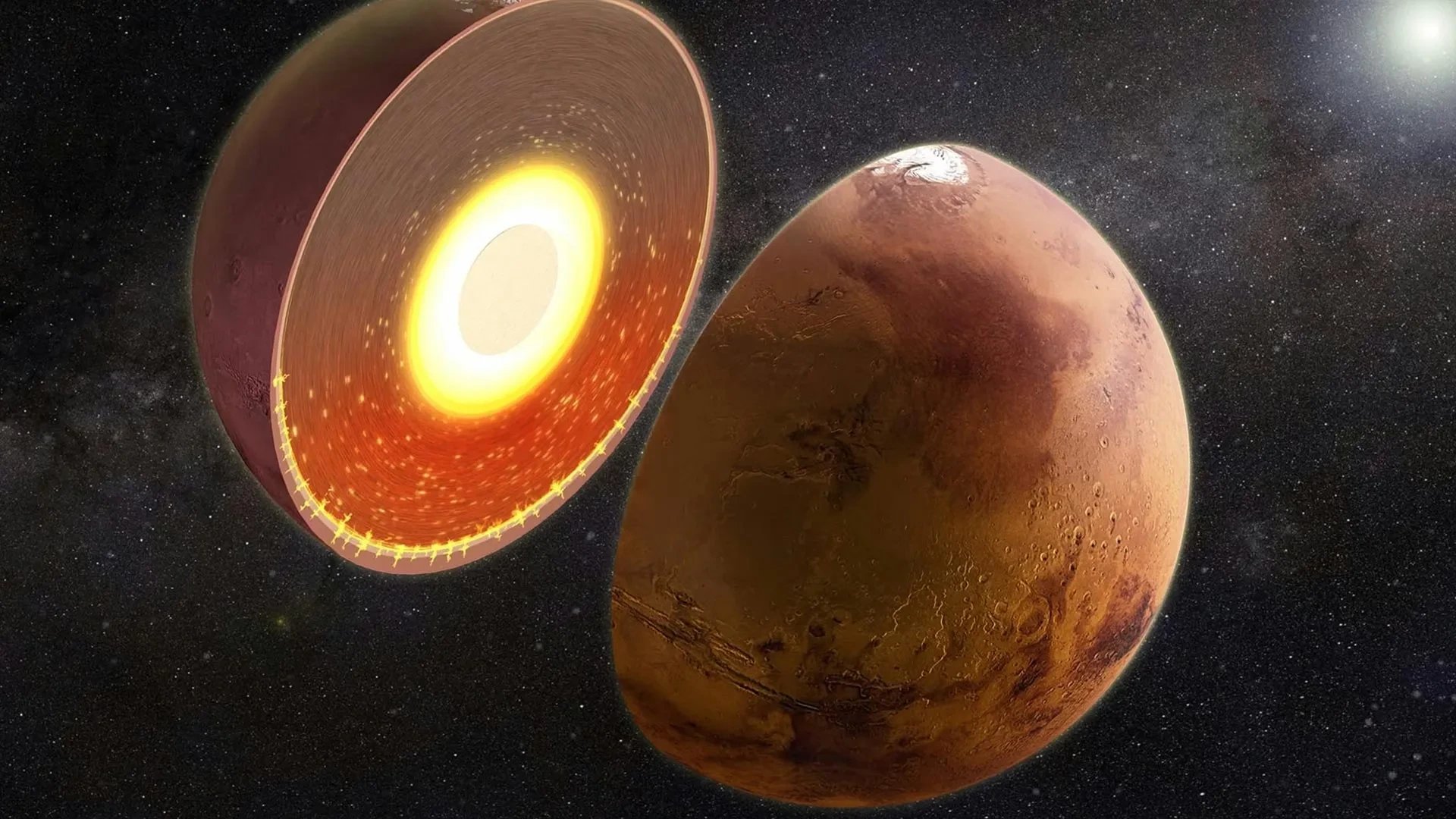
Researchers have found that Mars' southern interior is 200 to 400 degrees Celsius hotter than its northern half, according to a study published August 27 in Nature. The discovery, based on gravity data from three NASA orbiters, suggests the southern mantle may be partially molten. The thermal divide could help explain Mars' hemispheric differences in magnetism and seismic energy loss.
Key Facts
- The study was led by Alexander Berne, a Caltech alumnus now at the University of Arizona, and published August 27 in Nature.
- Gravity data from Mars Global Surveyor, Mars Odyssey, and Mars Reconnaissance Orbiter were analyzed using tidal tomography.
- The southern interior is 200–400°C warmer than the north and may be partially molten.
- NASA's InSight mission previously found that seismic waves lose energy more quickly in the southern hemisphere.
- Unusual magnetic signatures in iron-rich minerals in the southern hemisphere may be explained by a hotter southern mantle.
Gravity Mapping Method
Alexander Berne developed a model that uses subtle variations in gravity to estimate the internal structure of a planetary body while at Caltech. The team analyzed decades of observations from Mars Global Surveyor, Mars Odyssey, and Mars Reconnaissance Orbiter. By tracking extremely small changes in the spacecrafts' velocities, the researchers reconstructed the gravitational field surrounding Mars. The Sun's gravitational pull on Mars changes with the seasons because Mars travels along a slightly elliptical orbit and rotates on a tilted axis. The researchers used a method known as tidal tomography to study how these gravitational signatures change over time and to build a model of the planet's interior.
Hemispheric Thermal Divide
Mars has long been known to look very different across its two hemispheres, with the southern surface dominated by tall mountains and heavily cratered terrain, while the northern hemisphere consists largely of broad, low-lying plains. The new results show that this contrast may extend far below the surface, with the southern interior hundreds of degrees hotter than the north. Scientists have detected unusual magnetic signatures in iron-rich minerals in the southern hemisphere. A hotter southern mantle could indicate that Mars once had a magnetic field strong enough to produce differences in magnetism between the two hemispheres. NASA's InSight mission also previously found that seismic waves lose energy more quickly in the south.
1 source
Time · lag behind first