
Study links Little Red Dots to globular cluster origins
This digest was compiled by AI from multiple sources — links to the originals are below.
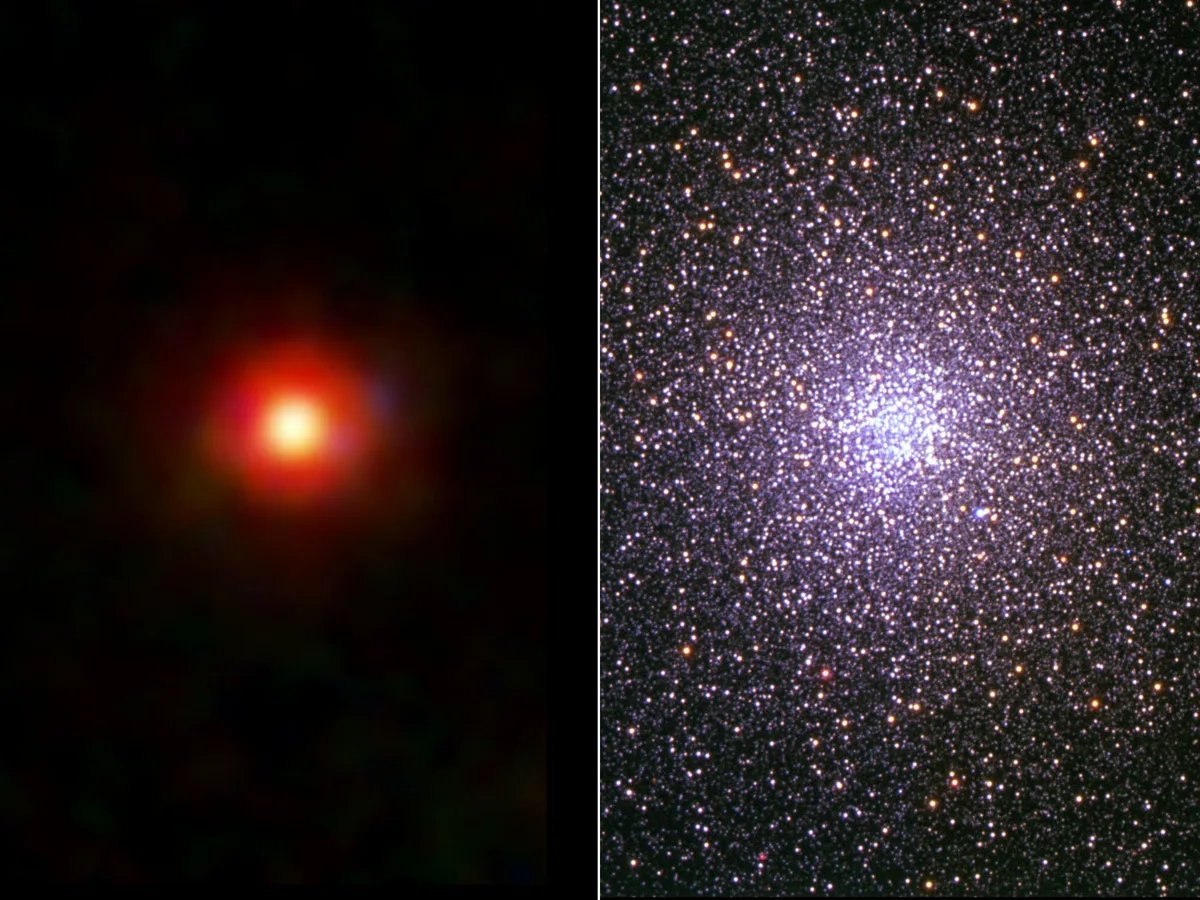
A new study led by astronomers at the University of Texas at Austin proposes that Little Red Dots, mysterious objects detected by the James Webb Space Telescope, may be early forms of globular clusters. The theory, published in The Astrophysical Journal Letters, could solve two cosmic puzzles simultaneously: the nature of Little Red Dots and the origin of globular clusters.
The Little Red Dot Mystery
First detected by JWST in 2022, Little Red Dots appear 600 million years after the Big Bang and vanish 1.5 billion years later. These compact, luminous objects shine with a distinctive red and ultraviolet light. One existing theory suggests they are supermassive black holes enshrouded in dense gas clouds, pulling young stars into dramatic deaths.
The Globular Cluster Puzzle
Globular clusters are dense collections of ancient stars orbiting galaxies; the Milky Way alone contains about 150. Their stars are roughly the same age but show unexpected chemical patterns: high helium, nitrogen, sodium, and aluminum, but low carbon, oxygen, and magnesium. This pattern indicates nuclear fusion at temperatures much higher than in normal massive stars, according to UT Austin's Mike Boylan-Kolchin.
A Unified Theory
The study proposes that Little Red Dots are early globular clusters with a supermassive star at their center, explaining both the objects' signatures and the clusters' chemical anomalies. 'These may not be just a strange new JWST population with no connection to the universe around us today,' said lead author John Chisholm. 'Instead, Little Red Dots may persist past the early universe, evolving into something relatively familiar.'
2 sources
Time · lag behind first