
RPTU researchers observe magnon coherence at room temperature
This digest was compiled by AI from multiple sources — links to the originals are below.
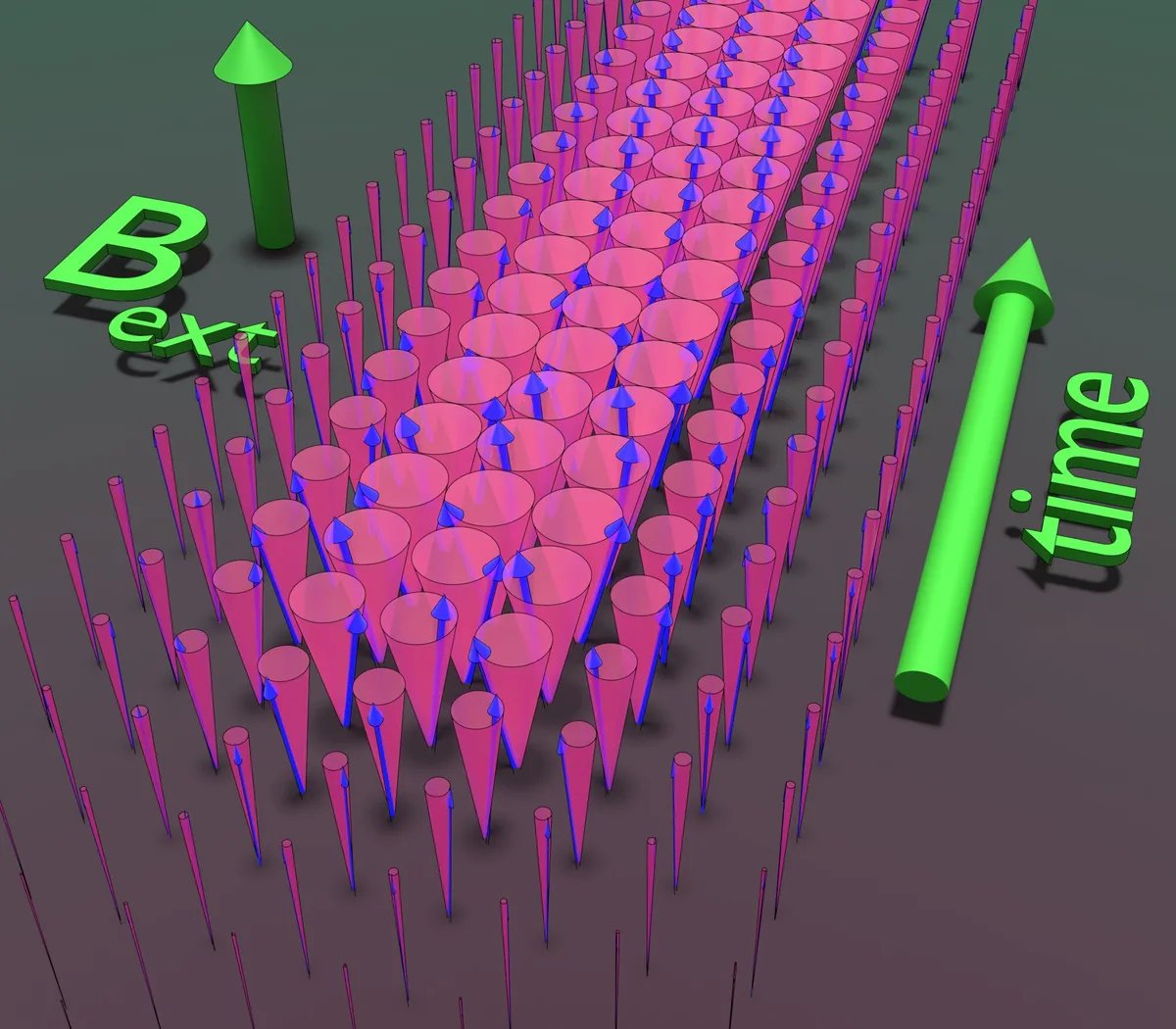
Researchers at RPTU University Kaiserslautern-Landau directly observed spontaneous macroscopic coherence of magnons at room temperature for the first time. The experiment confirms a central prediction of magnon Bose-Einstein condensate theory. The findings could advance signal processing, sensing, and information technologies.
The Observation
The team at RPTU University Kaiserslautern-Landau directly observed spontaneous macroscopic coherence of magnons—quantized excitations in magnetic materials—at room temperature. This marks the first experimental confirmation of a key prediction from magnon Bose-Einstein condensate theory. The study was published in Nature Physics.
Implications for Technology
The findings could enable new approaches in signal processing, sensing, and information processing. Magnon-based devices might operate at room temperature without the need for extreme cooling. This could lead to more efficient and compact components for future electronics.
Magnon-Polaron Hybrids for 6G
The video describes magnon-polarons, hybrid spin-sound waves in quantum superposition, created by combining surface acoustic waves with spin states in yttrium iron garnet. This system achieves strong coupling and enables agile signal processing for next-generation 6G wireless networks.
2 sources
Time · lag behind first