
Molecules synchronize in leaky gold nanocavities at room temperature, Cambridge researchers report
This digest was compiled by AI from multiple sources — links to the originals are below.
Researchers at the University of Cambridge have observed molecules inside gold nanostructures synchronizing their behavior at room temperature, a finding published in Nature Nanotechnology. The discovery overturns the assumption that optical coherence requires long-lived optical cavities, opening avenues for sensors, molecular photonics, and quantum devices. The coordination arises primarily among the molecules themselves rather than through the light field.
The Discovery
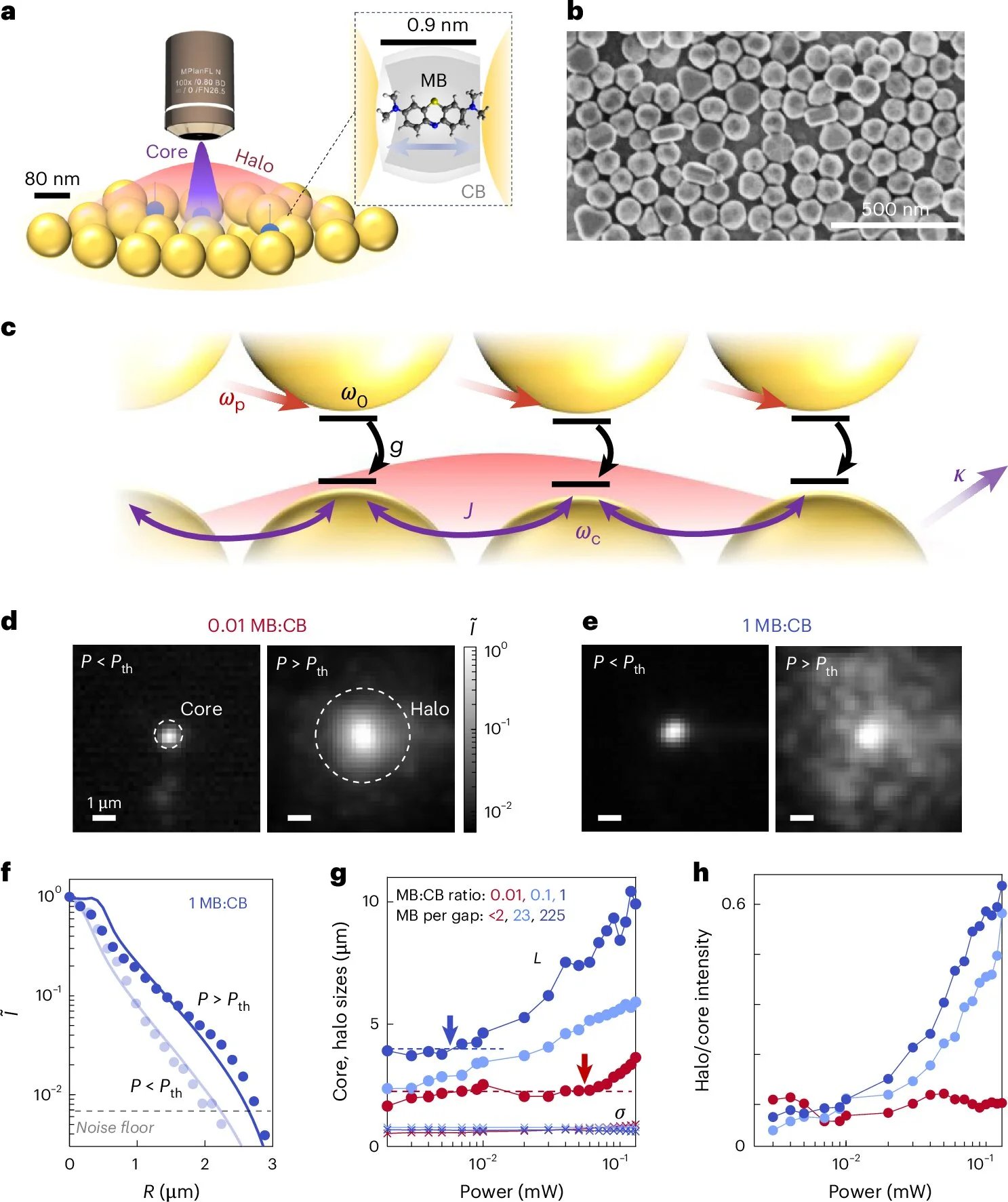
Researchers placed luminescent molecules inside sub-nanometer gaps between gold nanoparticles and illuminated them with a continuous laser. As laser power increased, emission spread from the illuminated spot into a glowing halo, indicating synchronized behavior across the sample. Lead author Dr. Rakesh Arul, a research fellow at the Cavendish Laboratory, said the molecules switched from independent to collective action. Measurements confirmed a synchronized dipole state despite photons escaping the system in femtoseconds.
Collective Behavior in Leaky Cavities
Conventional optical coherence requires cavities that trap light for long periods. The study, published in Nature Nanotechnology, shows plasmonic cavities—where light lifetime is extremely short—can support synchronized molecular states. The molecules oscillate together as a single system, but emitted light quickly loses coherence after leaving the nanostructures. This challenges the long-held view that long photon lifetimes are essential for such coordination.
Potential Applications
Room-temperature molecular synchronization could enable ultra-sensitive quantum sensors, new molecular photonic devices, and quantum technologies that avoid costly cryogenic cooling. The findings also point toward a possible route to room-temperature superfluids. The research was conducted at the University of Cambridge's Cavendish Laboratory.
1 source
Time · lag behind first