
International team produces dual-species Bose-Einstein condensate in Einstein Elevator
This digest was compiled by AI from multiple sources — links to the originals are below.
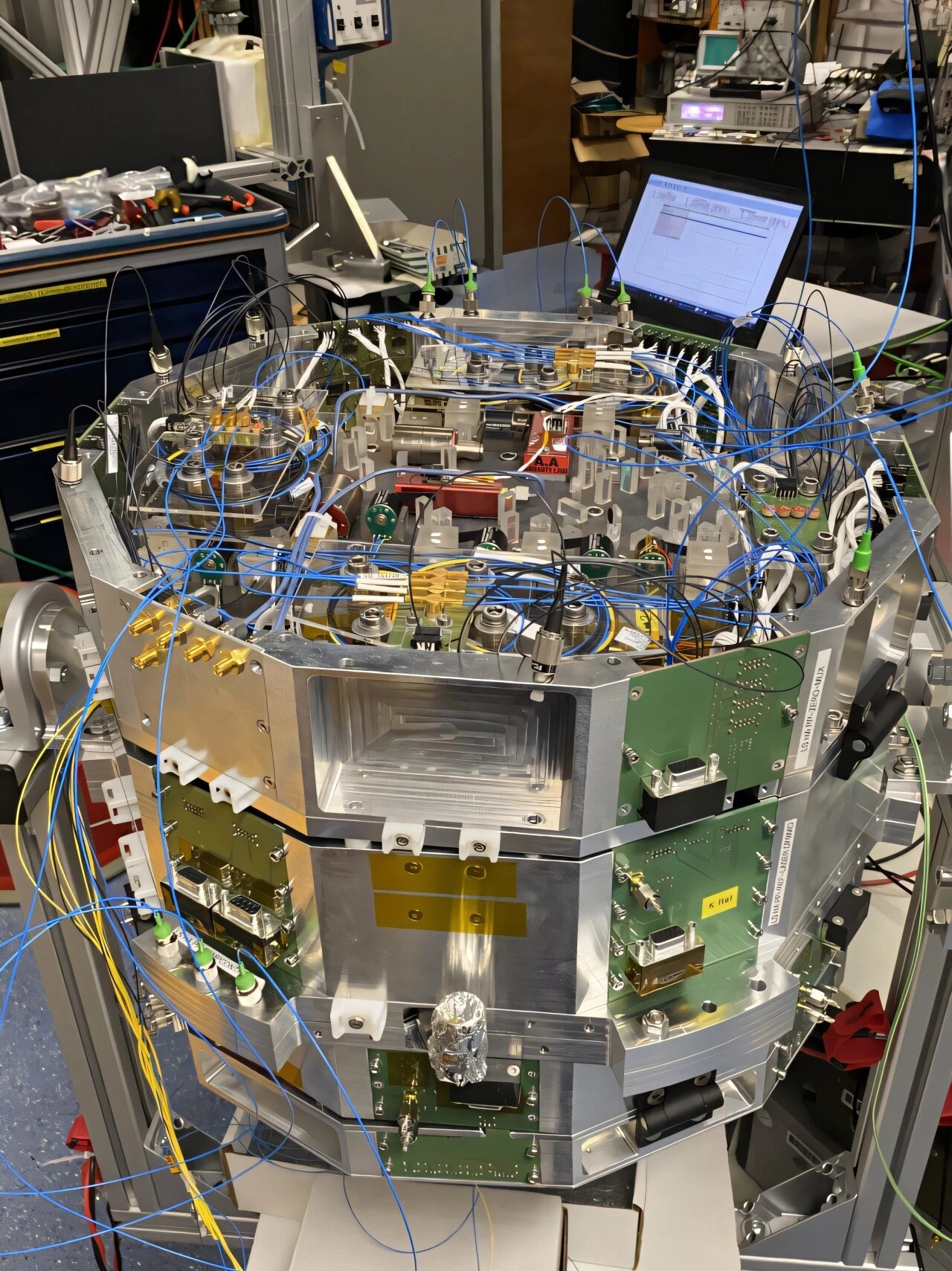
An international research team generated a dual-species Bose-Einstein condensate of rubidium and potassium atoms under microgravity in the Einstein Elevator at Leibniz University Hannover. The MAIUS-B experiment, reported in Nature Communications, achieved a record particle flux for such a mixture, surpassing previous mobile systems by an order of magnitude. The achievement was enabled by a miniaturized laser system from Johannes Gutenberg University Mainz, designed to withstand extreme mechanical and thermal stresses.
Dual-Species Condensate
An international team of researchers has generated a Bose-Einstein condensate containing two atomic species—rubidium and potassium—under microgravity conditions. The experiment used the MAIUS-B apparatus inside the Einstein Elevator at Leibniz University Hannover in Germany. The setup achieved a particle flux that is an order of magnitude higher than any previously reported for a mobile dual-species BEC system. This success followed the first single-species space-based BEC produced by the MAIUS-1 mission in 2017. The results are detailed in Nature Communications.
Compact Laser System
A key enabler was a miniaturized laser system developed at Johannes Gutenberg University Mainz (JGU) in collaboration with Humboldt-Universität zu Berlin and the Ferdinand-Braun-Institut. The system, which interfaces between laser modules and the vacuum chamber, uses optical benches made of Zerodur glass-ceramic with an exceptionally low thermal expansion coefficient. This design maintains stability under the extreme mechanical loads of a rocket launch and varying temperatures. Despite requiring twice as many lasers plus extra components, the payload volume and mass remained nearly unchanged from previous missions. The optical benches were co-developed by JGU and the University of Hamburg.
Validation in Drop Tests
Long-term operation in the Einstein Elevator and laboratory environments validated the technological concept. The elevator provides microgravity by repeated drops, simulating space conditions. The system demonstrated reliable performance over multiple test campaigns, confirming the robustness needed for future space missions. The reported particle flux sets a benchmark for quantum gas mixtures in mobile platforms.
1 source
Time · lag behind first