
Argonne and University of Illinois team synchronizes magnons with external signals at room temperature
This digest was compiled by AI from multiple sources — links to the originals are below.
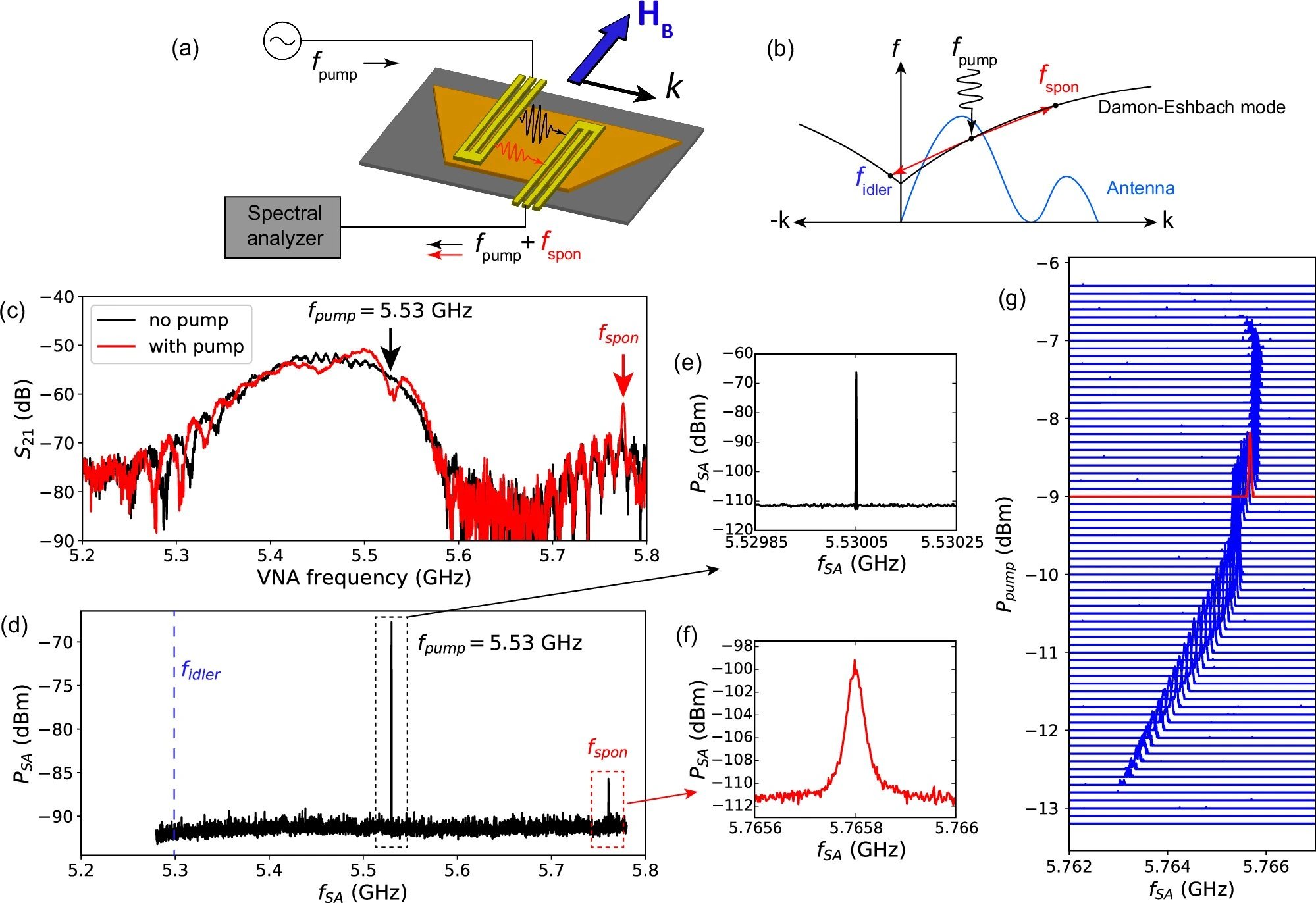
Researchers at Argonne National Laboratory and the University of Illinois Urbana-Champaign report a method to generate spontaneous magnons in yttrium iron garnet that synchronize with an external signal at room temperature. The results, published in Nature Communications, use parametric pumping through microwave antennas on a film a few hundred nanometers thick to create ultrasharp, controllable oscillations.
Phase-Locked Magnon Generation
Researchers from Argonne National Laboratory and the University of Illinois Urbana-Champaign generated spontaneous magnons in yttrium iron garnet and phase-locked them to an external signal at room temperature. The result, published in Nature Communications, moves from chaotic wave motions to tightly controlled, in-sync oscillations. Lead authors Yi Li and Argonne Distinguished Fellow Valentine Novosad said the method creates ultrasharp waves that are highly controllable.
Parametric Pumping Method
The team used parametric pumping, analogous to a person timing their motion to a swing's natural rhythm to add energy. Two microwave antennas patterned on a yttrium iron garnet thin film a few hundred nanometers thick — a fraction of the width of a human hair — delivered the pumping. The small antenna dimensions allowed precise control of spontaneous oscillations, which were then matched to an outside signal through phase-locking.
Microelectronics and Quantum Relevance
Stable, externally tunable magnons could support next-generation microelectronics, wireless communication and quantum information processing. The work connects to Argonne's hybrid quantum magnonics research, where controlled magnon signals may be used in quantum circuits on chips. Yi Li noted that parametric pumping usually creates chaotic wave motions that are hard to use, but the new method produces controllable ultrasharp waves.
1 source
Time · lag behind first