
Mars North Pole Ice Far Cleaner Than Models Estimated, Study Finds
This digest was compiled by AI from multiple sources — links to the originals are below.
Researchers from the University of Washington and the University of Edinburgh reanalyzed spectral data from Mars orbiters and the Phoenix lander, finding that the top layer of water ice near the Martian north pole contains about 3 percent dust by mass, compared with previous estimates of 25 percent. The finding suggests the ice is far cleaner than long-standing models predicted, with implications for future human missions and understanding past Martian climates.
Key Facts
- The new estimate puts dust by mass in the top layer of north polar water ice at about 3 percent, down from the previous 25 percent.
- The study was led by Pari Mohan of the University of Edinburgh and Aditya Khuller of the University of Washington.
- Researchers used data from the OMEGA spectrometer on Mars Express, CRISM on the Mars Reconnaissance Orbiter, the Phoenix lander, and a radiative transfer model.
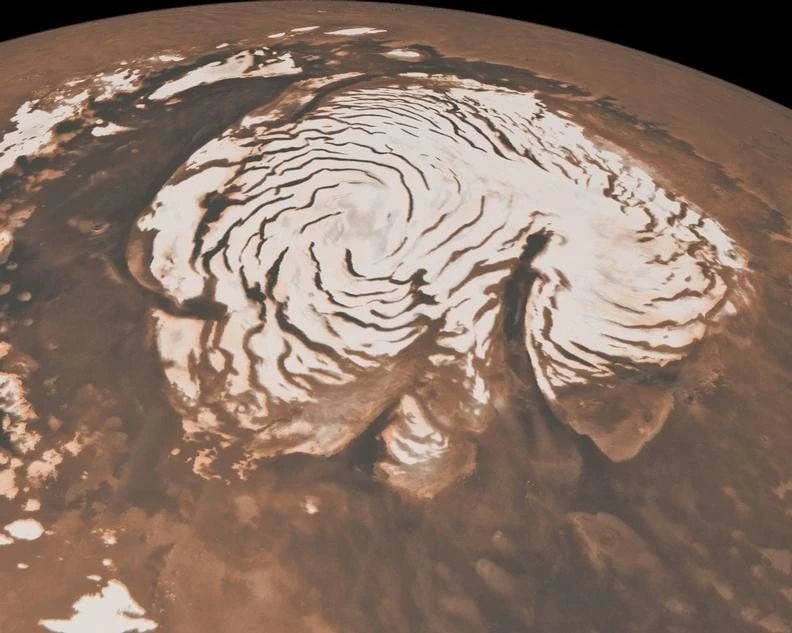
- The north polar region contains a multilayered mixture of cleaner ice on top, thinner dust layers just beneath, and ice below that.
- The study was published in npj Space Exploration.
Revised Ice-Dust Ratio
Previous models estimated that the top layer of water ice near the Martian north pole contained about 25 percent dust by mass. The new analysis, based on Earth-based ice-dust research and layered modeling, reduces that figure to about 3 percent. The researchers attribute the discrepancy to the north pole's multilayered structure: cleaner ice on top, thin dust layers just beneath, and ice below that. The study used measurements from the OMEGA spectrometer on Mars Express, CRISM on the Mars Reconnaissance Orbiter, the Surface Stereo Imager on the Phoenix lander, and known compositions of water ice and Martian dust.
Seasonal Frost Dynamics
Aditya Khuller, a senior research scientist at the University of Washington's Applied Physics Laboratory, explained that winter frost is dustier and disappears in summer, exposing cleaner, older ice. The study examined spectral observations of the north polar region, Korolev crater, Louth crater, Chasma Boreale, and the Phoenix landing site. The north polar region holds the largest reserves of water ice on Mars, with a nearly 1.5-kilometer-thick layered deposit beneath the seasonal carbon dioxide cap.
Climate History Implications
The ice-dust ratio in the layered deposits helps researchers reconstruct past climate changes on Mars and how water moved between the poles and lower latitudes. Unlike Earth, whose tilt is stabilized by the Moon, Mars experiences large climate shifts due to its unstable axial tilt. The cleaner ice could be a more accessible water resource for future human missions to the Red Planet.
2 sources
Time · lag behind first