
Mars mantle under southern highlands 200-400°C hotter than north, study finds
This digest was compiled by AI from multiple sources — links to the originals are below.
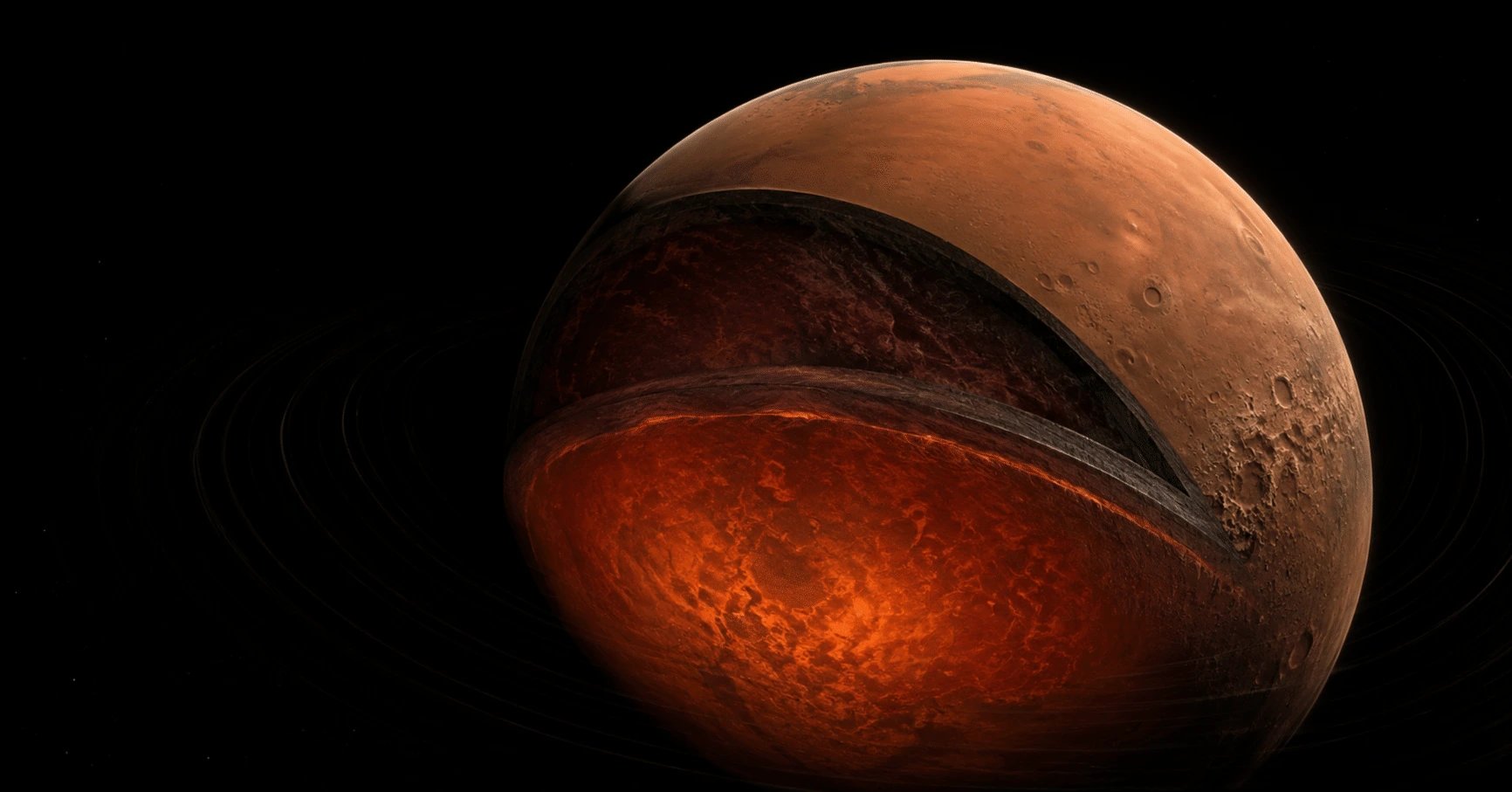
A Nature analysis of Mars's changing gravity indicates the mantle beneath the southern highlands is 200 to 400 degrees Celsius warmer than beneath the northern lowlands. The result comes from a team led by Alexander Berne, who developed the method at Caltech and is now at the University of Arizona. The researchers inferred the temperature difference from tiny seasonal gravity variations recorded by spacecraft, without direct heat measurements.
Key Facts
- The mantle beneath Mars's southern highlands is 200 to 400 degrees Celsius warmer than beneath the northern lowlands, according to a Nature analysis of the planet's changing gravity.
- The study was led by Alexander Berne, who developed the method during his doctoral work at Caltech and is now at the University of Arizona.
- Researchers detected degree-three components in the time-variable gravity field that differed by as much as 300 percent from the symmetrical prediction.
- Mars completes one orbit of the Sun in about 687 Earth days, and its eccentric orbit and spin-axis tilt vary the solar gravitational forcing over that cycle.
Thermal Asymmetry
The crustal dichotomy is among the largest and oldest features on a rocky world, with southern crust thicker and generally standing several kilometres above the north. The southern highlands preserve older surfaces, more impact craters, and much stronger remanent magnetic fields than the northern lowlands. The boundary between the two provinces is not a neat equator but an irregular outline separating a lower, younger-looking northern province from the rough highlands that dominate much of the south. Competing explanations for the dichotomy have invoked internal convection, crustal production, and an enormous early collision.
Tidal Tomography Method
The approach is known as tidal tomography, which recovers lateral structure from a world's response to a known, changing pull rather than sending waves through a body as a medical scanner does. A body made of perfectly concentric, laterally uniform layers would respond in a predictable set of broad gravity patterns, but Mars does not. The team found degree-three components in the time-variable field that differed by as much as 300 percent from the symmetrical prediction. The NASA planetary gravity solution used by the researchers combines tracking over a long interval so the faint repeating signal can emerge.
1 source
Time · lag behind first