
Papua's Puncak Jaya glaciers to vanish within two years, scientists say
This digest was compiled by AI from multiple sources — links to the originals are below.
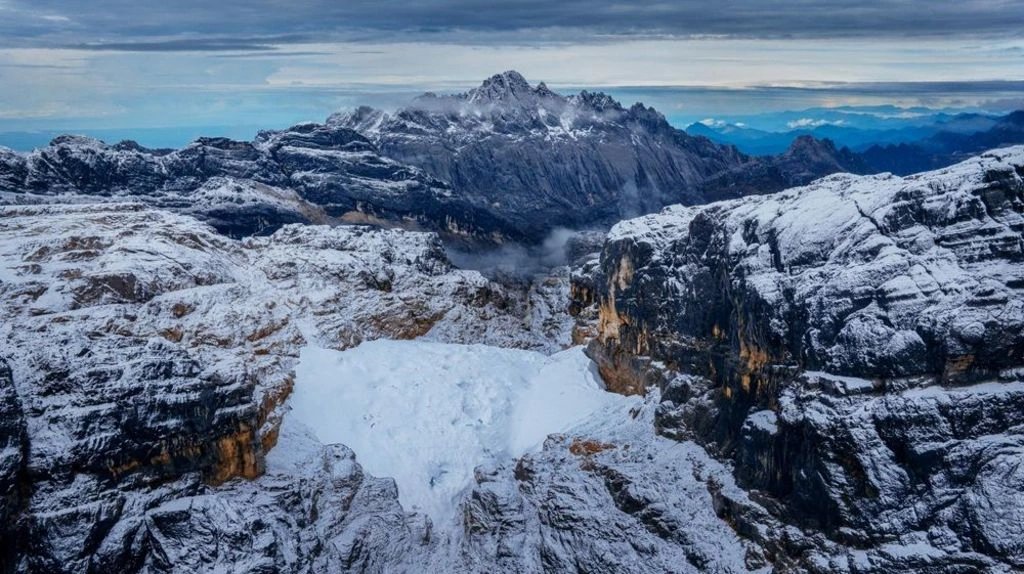
The last tropical glaciers between the Andes and Himalayas, on Indonesia's Puncak Jaya, are projected to disappear entirely within one to two years. Glacier cover has shrunk from nearly 1,900 hectares in the 19th century to about 16 hectares today. Scientists warn the ice holds a unique climate archive that is vanishing before it can be fully studied.
Key Facts
- Glacier cover around Puncak Jaya has shrunk from nearly 1,900 hectares in the 19th century to about 16 hectares today.
- The remaining snow patches on Puncak Jaya are expected to disappear entirely within one to two years.
- Papua's tropical glaciers are the last remaining tropical ice between the Andes and Himalayas, separated from other glacier systems by thousands of kilometres.
- Czech glacier ecologist Marie Šabacká travelled to Puncak Jaya in March to study the glaciers before they vanish.
Glacier Retreat
A century ago, the 300km Sudirman Range had snow and permanent ice on all four of its major peaks. Today only small areas around Puncak Jaya, also known as Carstensz Pyramid, retain any snow. The remaining snow cover is expected to disappear entirely in a year or two. Almost entire glaciers have vanished within a human lifetime.
Climate Archive
Ice cores taken from the slopes of Puncak Jaya preserve a record of climate history. Scientists can use the cores to obtain information about atmospheric conditions in the region and understand changes in the tropical Pacific and Western Pacific Warm pool. This archive is disappearing before scientists have had time to fully study it.
Warming Drivers
The retreat of Papua's glaciers is driven by a warming atmosphere caused by human activity, including the burning of fossil fuels. As temperatures rise, the freezing point moves higher up mountains, so more precipitation falls as rain instead of snow. El Niño events can accelerate this process, while local factors such as cloud cover, snowfall and mountain topography influence its pace. The mountains in Papua are just 450km south of the equator, where permanent ice can survive only at very high altitudes and within a narrow range of climatic conditions.
1 source
Time · lag behind first