
Nepal debris flow killed over 1,200, scientists warn of global mountain risks
This digest was compiled by AI from multiple sources — links to the originals are below.
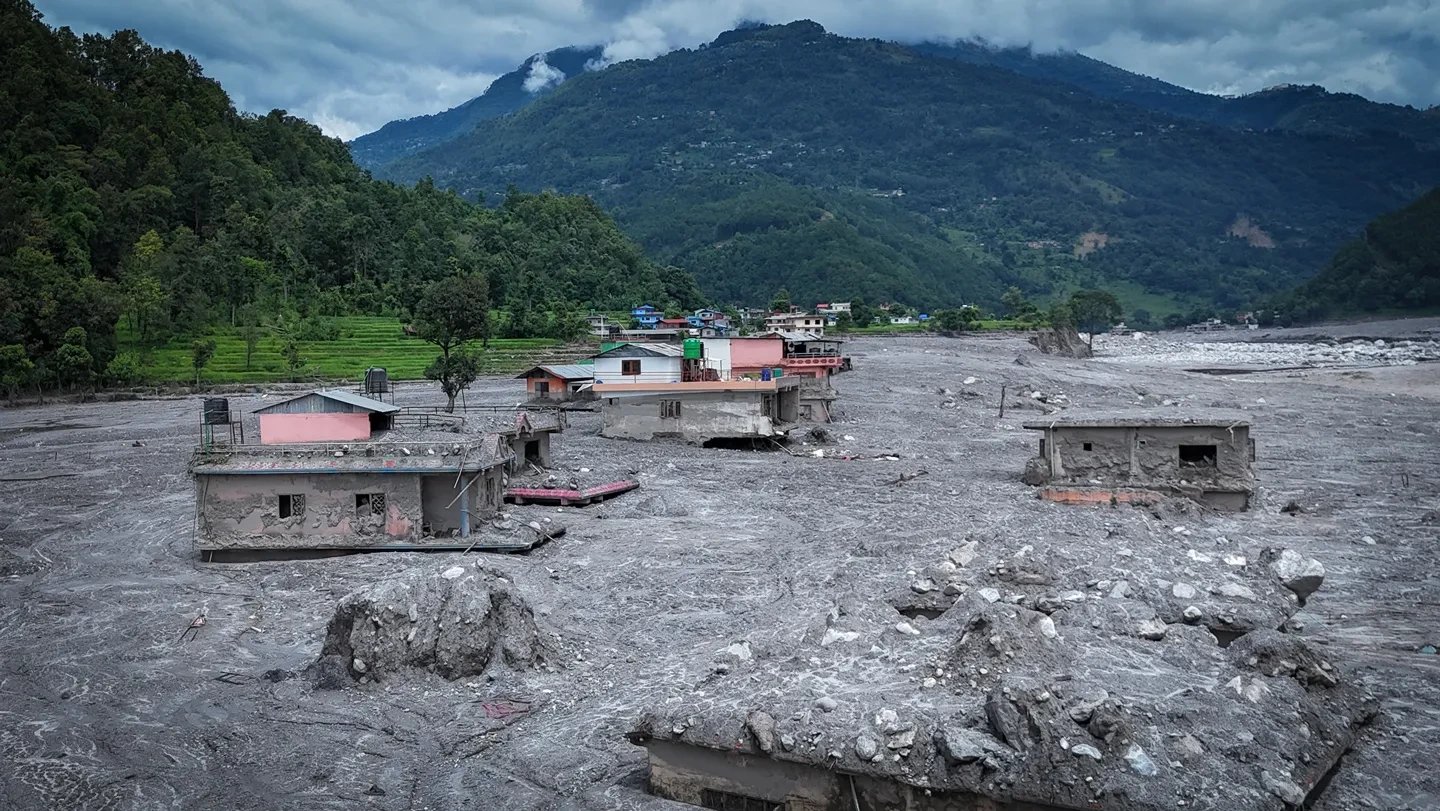
A massive debris flow in northern Nepal on August 26 killed more than 1,200 people and left thousands missing. Scientists say a 2.2-square-kilometer slab of bedrock and ice detached from Langtang Lirung, triggering a torrent that reached speeds over 160 kilometers per hour. The disaster underscores the growing threat of climate-driven mountain collapse in high-altitude regions worldwide.
Key Facts
- The August 26 debris flow in northern Nepal killed more than 1,200 people and left thousands missing.
- A slab of bedrock roughly 2.2 square kilometers wide detached from Langtang Lirung at an elevation of about 5,150 meters.
- The detached rock and ice volume is estimated at around 110 million cubic meters, roughly 40 times the volume of the Great Pyramid of Giza.
- The debris flow reached speeds over 160 kilometers per hour and destroyed villages along its path toward India.
- Scientists warn that human-caused climate warming is melting mountain ice and increasing the risk of similar catastrophes globally.
The Debris Flow
On August 26, an immense flow of rock, mud, and water barreled through northern Nepal, killing more than 1,200 people and leaving thousands missing. Satellite imagery showed that an enormous slab of bedrock and ice fell from Langtang Lirung, spawning a debris flow that hurtled downstream toward India. The dense torrent reached speeds over 160 kilometers per hour and destroyed villages along its path. Geological engineer Ranjan Dahal of Tribhuvan University, who has studied Himalayan geohazards for nearly 30 years, said the magnitude of the event caught even experts off guard.
Cause and Scale
Early speculation suggested a collapsing glacier caused the debris flow, but satellite images taken soon after the event revealed a freshly exposed, uniform slope on Langtang Lirung's north face at an elevation of around 5,150 meters. A slab of bedrock roughly 2.2 square kilometers wide had detached from the mountain, carrying the overlying ice down into the valley below. Scientists estimate the detached chunk of glacier and bedrock amounted to a volume of around 110 million cubic meters, roughly 40 times the volume of the Great Pyramid of Giza. Mountain geographer Alton Byers of the University of Colorado Boulder said he has never seen anything remotely as large as this event.
Climate and Global Risk
Human-caused climate warming is melting the ice that holds high mountains together, according to glaciologist Ulyana Peña of the University of Colorado Boulder. Peña said the phenomenon is not limited to Nepal, stating that mountains are crumbling globally. Researchers say the insights from the Nepal disaster underscore the potential threat to other high mountain regions and how the risk of catastrophe may increase over time.
1 source
Time · lag behind first