
Warming glaciers raise flood risk in Nepal and Tibet
This digest was compiled by AI from multiple sources — links to the originals are below.
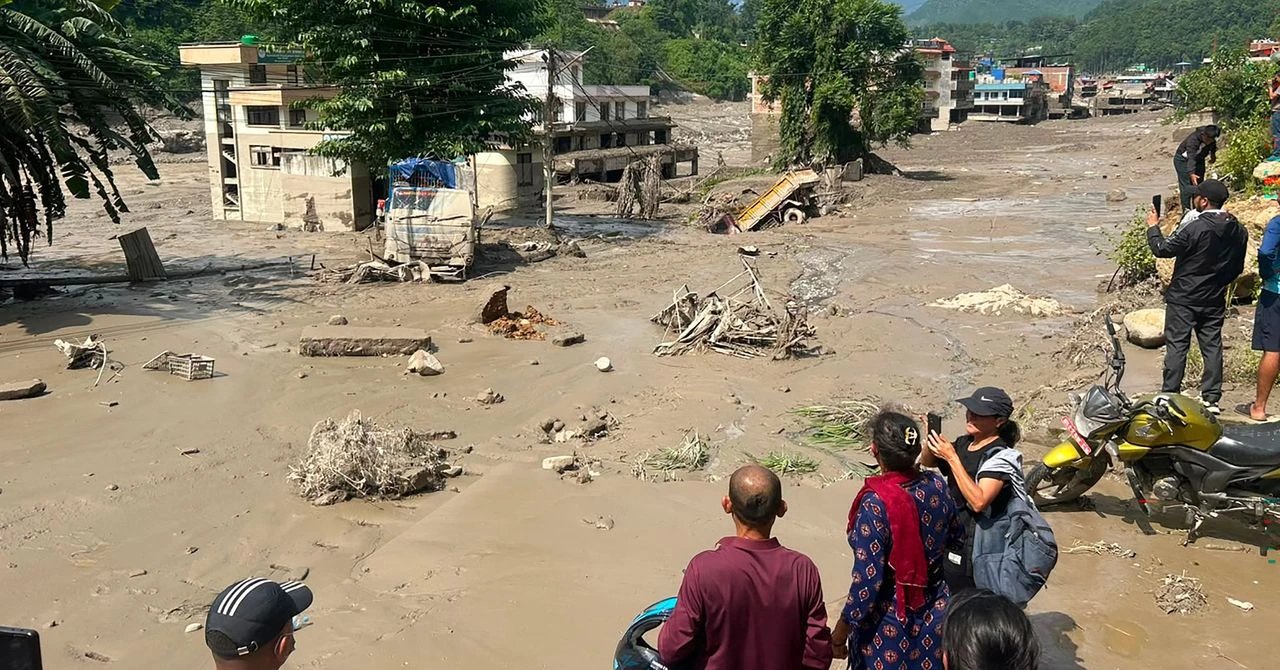
Flash floods on the Nepal-Tibet border killed roughly 160 people and left hundreds missing, including dozens of international tourists. Initial analysis suggests a glacier collapse triggered a landslide that sent a wall of water through the region. The disaster underscores how rising temperatures are destabilizing Himalayan glaciers.
Key Facts
- Roughly 160 people died and hundreds more, including dozens of international tourists, are missing after flash floods hit the Nepal-Tibet border region on Wednesday.
- Satellite imagery suggests a 2,000-foot-wide piece of ice fell almost 4,000 feet, pulverizing into water with enough force to register as a magnitude 5.2 seismic event.
- Nepal's glaciers lost nearly a quarter of their area between 1970 and 2010, and more than 160 smaller glaciers in the country have vanished entirely.
- Two glacial lake outburst floods hit Nepal last year, and research shows millions of people worldwide live in harm's way from such events.
Glacier Collapse Trigger
Initial analysis of satellite imagery and Nepalese government reports indicates the flooding was likely triggered by a landslide caused after a piece of a glacier fell hundreds of feet. Daniel Shugar, a geologist at the University of Calgary, told The New York Times that satellite imagery suggested a 2,000-foot-wide piece of ice may have fallen almost 4,000 feet, pulverizing the ice into water with the force of its fall. Shugar noted to Reuters that snow present on the glacier earlier in the week may have melted due to warm temperatures, though he emphasized it was still too early to make conclusive statements about the cause. The collapse and debris flow were so large and forceful that they registered as a magnitude 5.2 seismic event, according to the US Geological Survey.
Warming and Glacier Retreat
Joseph Shea, an associate professor of geography at the University of Northern British Columbia, said the glaciers in the region are definitely in retreat, with thinning and retreating observed. Since 2000, the world's glaciers have lost 5 percent of their ice, with much more drastic impacts in certain regions. Nepal's glaciers lost nearly a quarter of their area between 1970 and 2010, and more than 160 smaller glaciers in the country have vanished entirely. A recent study finds that 40 percent of the world's glacial ice could disappear if the world does not keep warming under 1.5 degrees Celsius.
Cascading Hazards
Shea points out that retreating glaciers can help trigger landslides as they get smaller and can no longer hold back sediment. As these glaciers retreat, many are leaving large, dammed lakes at higher elevations, and a landslide into a lake can cause overtopping of the dam and catastrophic collapse. Known as glacial lake outburst floods, two of these events hit Nepal last year, and research shows millions of people are living in harm's way around the world. Glaciers elsewhere have broken apart with destructive results, including the collapse of a Swiss glacier last year that buried a town and a glacier collapse in Italy in 2022 that killed 11 mountaineers, both linked with rising temperatures.
1 source
Time · lag behind first