
Gravitational tug-of-war inside Earth explains millisecond shifts in day length
This digest was compiled by AI from multiple sources — links to the originals are below.
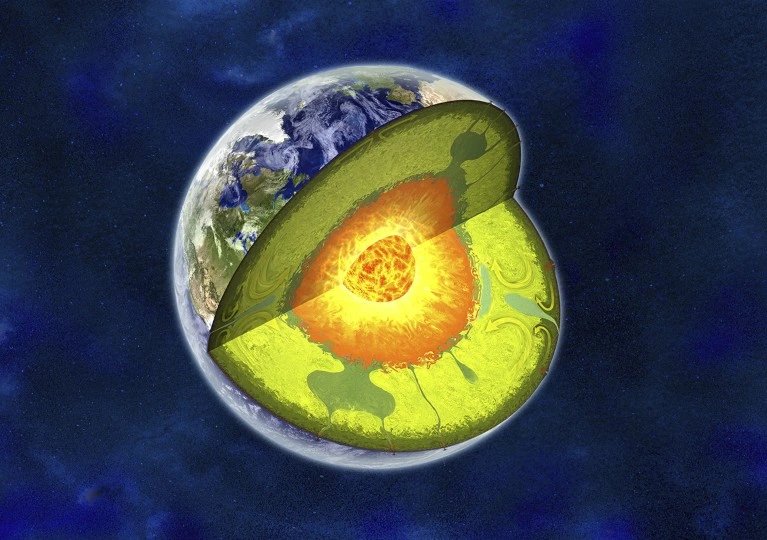
A new model suggests that gravitational forces between Earth's inner core and mantle are the main driver of small fluctuations in the length of a day. The study, published in Nature, found that gravitational torque best matches observed changes in Earth's rotation over decades. The findings could help geophysicists understand mysterious structures deep inside the planet.
Key Facts
- The study was published in Nature on 23 September 2026.
- Day length variations are on the order of a few milliseconds over decades.
- The inner core began rotating more slowly relative to the rest of the planet around 2010.
- The model was developed by Mathieu Dumberry and Huifeng Zhang at the University of Alberta in Edmonton, Canada.
Core-Mantle Coupling Forces
Researchers have proposed three ways the core can couple with the mantle to alter Earth's rotation. Mechanical torque arises from the flow of the molten outer core pushing against bumps at the core-mantle boundary. Electromagnetic torque is generated by the magnetic field attracting iron-rich parts of the mantle. Gravitational torque pulls dense regions of the inner core towards anomalously dense regions of the mantle.
Model Findings
Dumberry and Zhang developed a model to test how combinations of these forces alter day length. The model incorporated seismic data from a 2023 study that measured inner core rotation since the 1960s. The model best matched observed day length changes when gravitational torque was the dominant force.
1 source
Time · lag behind first