
Study finds hydrogen concentration gradient in Earth's core from 16% to 9%
This digest was compiled by AI from multiple sources — links to the originals are below.
A study published in the Proceedings of the National Academy of Sciences finds hydrogen concentration in Earth's core declines from 16% near the boundary to 9% at the center. The gradient arises from thermodynamic equilibrium under extreme pressures and temperatures, according to quantum-mechanical simulations. The results help clarify how lighter elements are distributed, even as previous models yielded conflicting results.
Superionic State
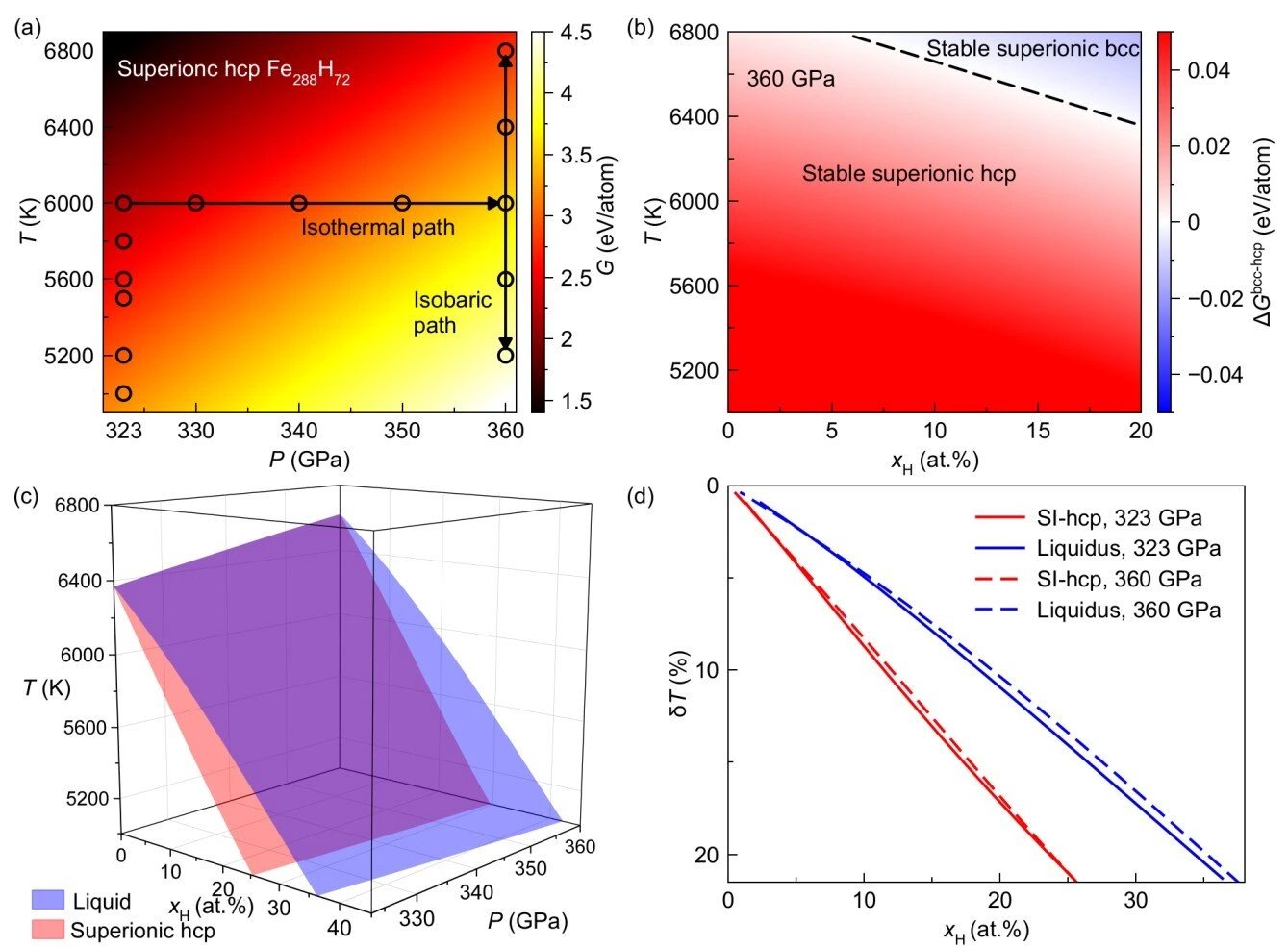
Hydrogen atoms can become superionic in Earth's inner core, diffusing through the solid iron lattice almost like a liquid under extreme pressures and temperatures. The study examined both hexagonal close-packed and body-centered cubic iron phases, finding that hydrogen stabilizes in a superionic state at core conditions around 5,500 Kelvin. This superionic behavior significantly affects the thermodynamic properties of iron-hydrogen mixtures.
Radial Concentration Profile
At a representative core temperature of 5,500 K, hydrogen concentration falls from about 16 atomic percent at the inner-core boundary to roughly 9 percent at the planet's center, the models show. This gradient emerges from thermodynamic equilibrium, not random distribution, and aligns with seismic observations suggesting compositional changes with depth. The findings provide the first quantitative estimate of hydrogen's radial distribution in the core.
Resolving Model Discrepancies
The study reconciles conflicting results from earlier attempts to model iron-hydrogen mixtures, which used different machine-learning potentials and protocols. The new approach directly computes free energies from quantum mechanics, producing a consistent phase diagram that accurately captures solid, superionic, and liquid states. This resolves inconsistencies that had hindered development of compositional models for multicomponent iron‑light‑element alloys.
1 source
Time · lag behind first