
NASA's Perseverance ballasts create 5 Mars craters, challenge crater scaling laws
This digest was compiled by AI from multiple sources — links to the originals are below.
NASA's Perseverance mission dropped two 77-kg tungsten ballasts during Mars entry, creating five craters about 70 km northwest of Jezero Crater. Scientists used the known impact parameters to calibrate crater models, finding soil cohesion of about 7 kPa. The results show standard crater scaling laws may err by an order of magnitude for high-density, low-angle impacts.
Key Facts
- The Perseverance entry vehicle released two 77-kg tungsten ballasts at an altitude of about 1,300 km and a speed of 4.7 km/s relative to Mars.
- The ballasts and cruise stage fragments, totaling nearly 540 kg, struck the surface at about a 10-degree angle and created five craters.
- The craters are located 70 km northwest of the rim of Jezero Crater, the landing site of Perseverance.
- Analysis using Mars Reconnaissance Orbiter images and 3D impact modeling yielded a soil cohesive strength of about 7 kPa, similar to slightly damp sand.
- The measured soil strength is significantly lower than predicted by standard crater scaling laws, which may be off by an order of magnitude for high-density, low-angle impacts.
Impact Experiment
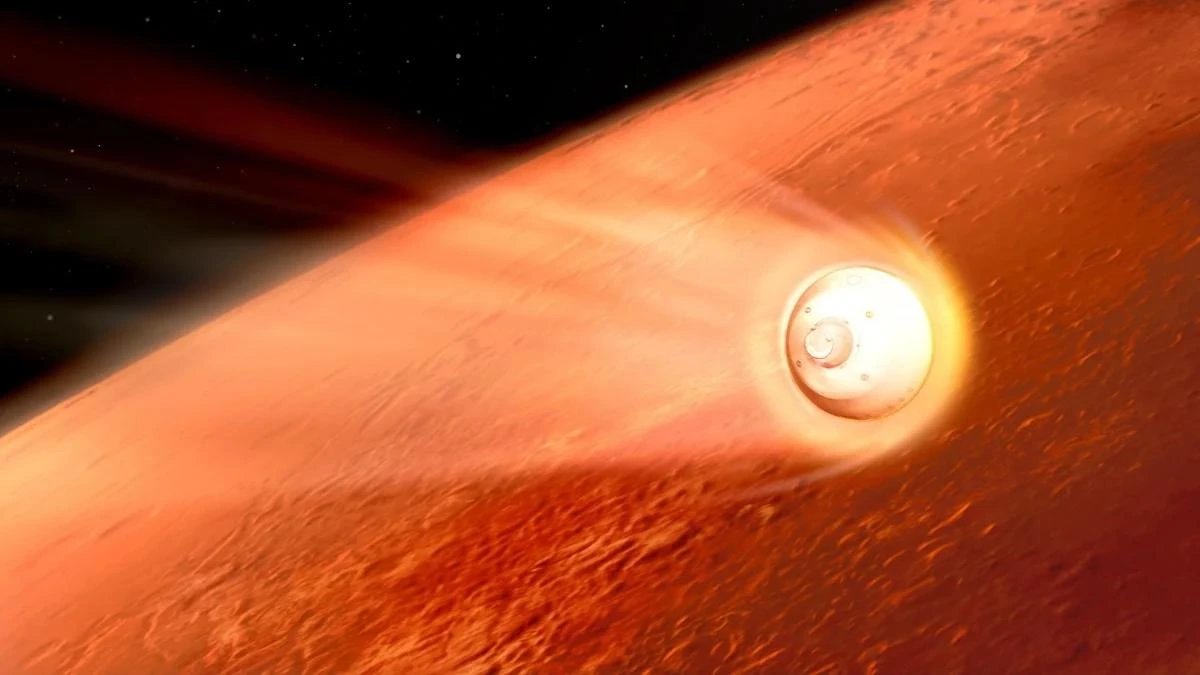
During Mars 2020 entry, the spacecraft jettisoned two 77-kg tungsten Cruise Ballast Mass Devices at an altitude of about 1,300 km and a velocity of 4.7 km/s relative to the planet. These ballasts, along with fragments of the cruise stage totaling nearly 540 kg, impacted the surface at an angle of approximately 10 degrees. The impacts created five craters located 70 km northwest of the rim of Jezero Crater, where Perseverance later landed. NASA engineers treated the debris as a spontaneous experiment, leveraging precisely known impactor mass, velocity, and angle.
Crater Analysis
Fresh craters were identified in images from two cameras on the Mars Reconnaissance Orbiter, showing sharp rims and distinctive reflectivity. Image analysis and three-dimensional shock-wave modeling determined a soil cohesive strength of about 7 kPa, comparable to slightly damp sand. This value matches previous data from the InSight mission's thermal probe. However, it is significantly lower than values predicted by standard crater scaling laws, which may be off by an order of magnitude for high-density projectiles striking low-density surfaces at shallow angles.
1 source
Time · lag behind first