
NASA's Ingenuity helicopter proved powered flight possible in Mars' thin atmosphere
This digest was compiled by AI from multiple sources — links to the originals are below.
NASA's 1.8-kilogram Ingenuity helicopter achieved the first powered, controlled flight on another planet on April 19, 2021, rising about three meters above Jezero Crater. The aircraft's coaxial rotors spun at 2,400 revolutions per minute to generate lift in Martian air less than one percent as dense as Earth's. Ingenuity ultimately completed 72 flights over nearly three years, far exceeding its five-flight design goal.
Key Facts
- Ingenuity's first flight on April 19, 2021, reached an altitude of about three meters above Jezero Crater.
- The helicopter's two coaxial rotors, each 1.2 meters in diameter, spun at 2,400 revolutions per minute.
- Martian surface gravity is about 38 percent of Earth's, reducing Ingenuity's effective weight to roughly 0.68 kilograms.
- Ingenuity was designed for five flights over 30 Martian days but completed 72 flights over nearly three years.
The Flight Challenge
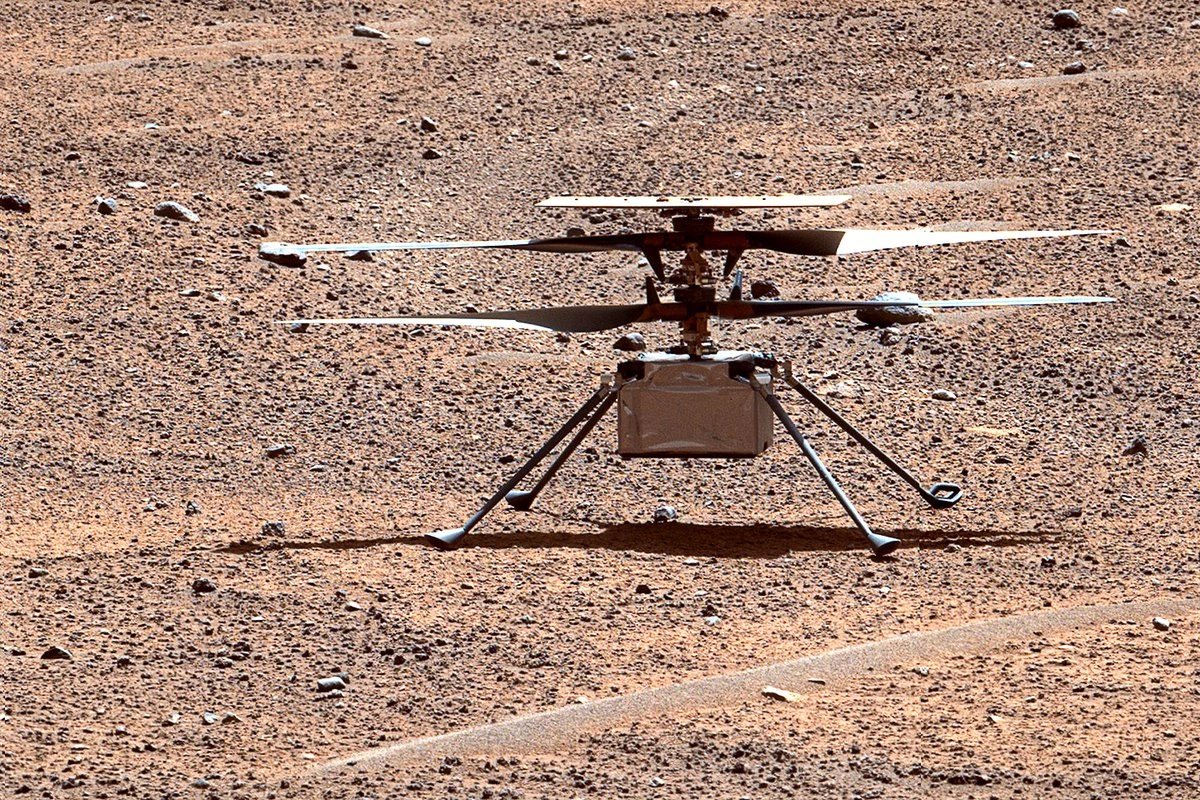
On Mars, the atmosphere is less than one percent as dense as Earth's, so a rotor blade has almost no air to push against. Ingenuity compensated with four carbon-fiber blades arranged in two counter-rotating coaxial rotors, each about 1.2 meters in diameter. The rotors spun at 2,400 revolutions per minute, completing 40 revolutions every second. This coaxial design canceled reaction torques and eliminated the need for a tail rotor, saving weight.
Aerodynamic Principles
Lift depends on air density, blade area, aerodynamic shape, and the square of blade speed. Reducing air density to one hundredth of Earth's removes almost all lift from an unchanged rotor. Mars' lower gravity—about 38 percent of Earth's—reduced Ingenuity's weight to roughly 0.68 kilograms, but this did not offset the atmospheric penalty. The helicopter needed much larger rotor area and higher blade speed than an Earth aircraft of comparable mass.
1 source
Time · lag behind first