
NASA's Perseverance landing debris reveals Mars soil cohesion of 7 kPa
This digest was compiled by AI from multiple sources — links to the originals are below.
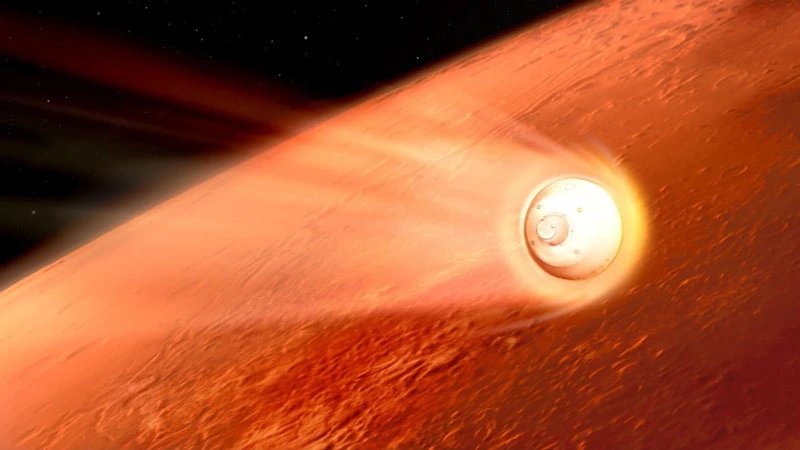
NASA's Perseverance rover landing in 2021 accidentally bombarded Mars with tungsten ballast and rocket stage fragments, creating five craters northwest of Jezero Crater. Analysis of these craters by the Mars Reconnaissance Orbiter yielded an unexpected estimate of Martian soil cohesion at about 7 kPa. The finding suggests the soil is roughly half as dense as previous models indicated.
Key Facts
- Two tungsten ballast masses of 77 kg each were jettisoned from the descent vehicle at an altitude of about 1,300 km during the approach to Mars.
- The impacts created five distinct craters approximately 70 km northwest of Jezero Crater.
- The craters were identified in images from two cameras aboard the Mars Reconnaissance Orbiter and were absent in earlier images of the same areas.
- Analysis and 3D modeling indicate the Martian soil cohesion is approximately 7 kPa, consistent with loose, sand-like material.
- The estimated soil density is about half that predicted by previous models.
Impact Crater Formation
During the approach to Mars, the descent vehicle released two tungsten ballast masses of 77 kg each from an altitude of about 1,300 km. Fragments of the cruise stage, totaling about 540 kg, later fell to the surface. The objects struck at a velocity of about 4.7 km/s and a shallow entry angle of roughly 10 degrees. The impacts produced five well-defined craters about 70 km northwest of Jezero Crater.
Crater Identification and Attribution
Researchers located the craters in images from two cameras on the Mars Reconnaissance Orbiter. The craters were confidently linked to the Perseverance landing because earlier images of the same areas showed no damage. Based on crater size, ejecta characteristics, and computer modeling, two craters designated CBMD-c and CBMD-e were most likely formed by the tungsten spheres. The remaining three craters are attributed to fragments of the cruise stage, though the exact distribution of impacts remains somewhat uncertain.
Soil Cohesion Estimate
Image analysis combined with 3D impact modeling yielded a soil cohesion estimate of approximately 7 kPa. This value corresponds to a loose, sand-like material that can flow through fingers. The estimate is consistent with previous observations from the InSight lander. The shallow impact angle may introduce significant uncertainty into the calculations. The result indicates the Martian soil is about half as dense as earlier models suggested, surprising the researchers.
1 source
Time · lag behind first