
Rochester team unveils solar desalination that extracts lithium
This digest was compiled by AI from multiple sources — links to the originals are below.
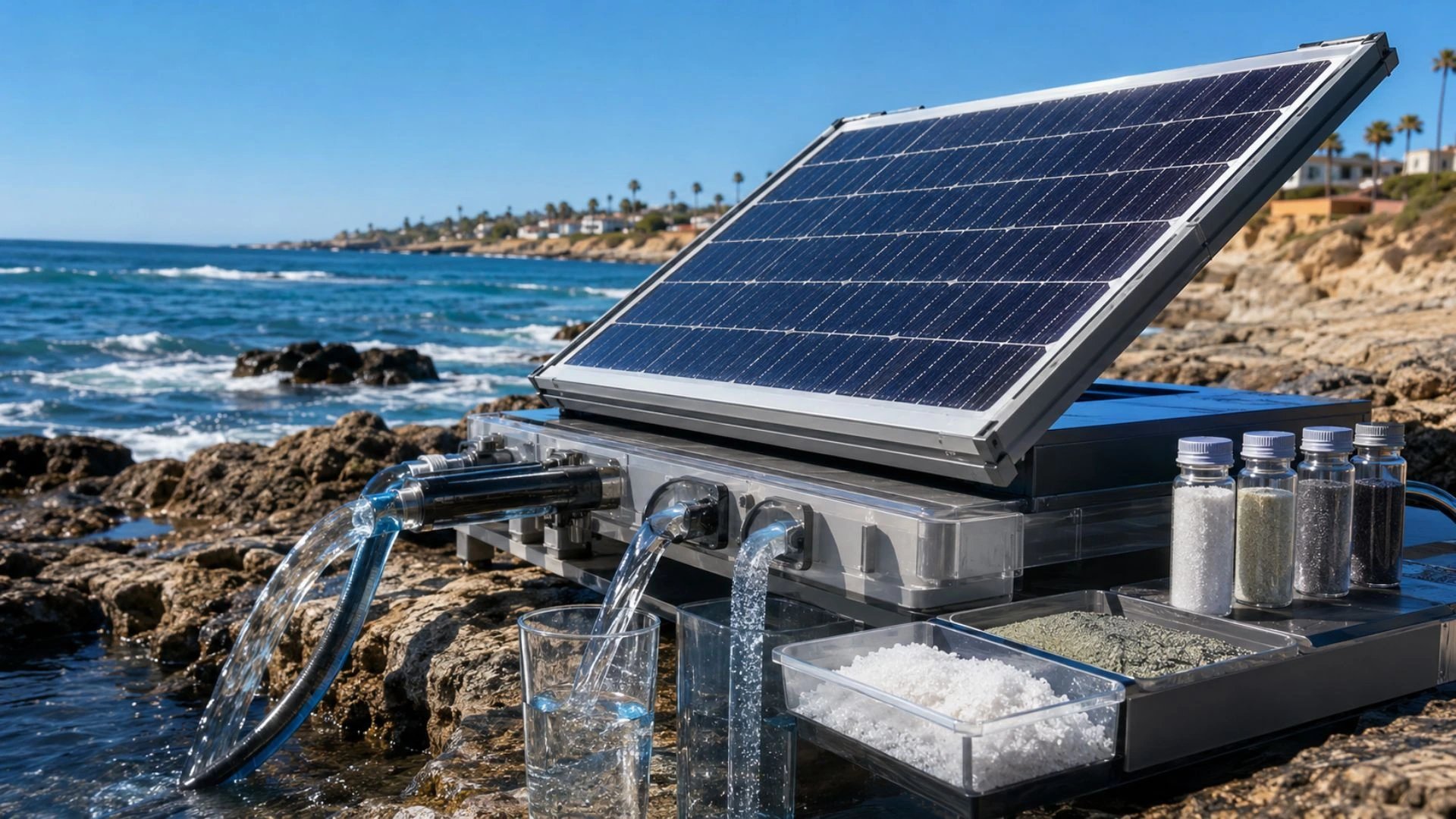
University of Rochester researchers have developed a solar desalination system that produces fresh water from seawater without liquid brine. The system captures dissolved salts and minerals in solid form, and the team demonstrated lithium extraction from the collected material.
Key Facts
- The system was tested on real seawater from the Pacific, Atlantic, and Indian Oceans.
- Nearly 100% of dissolved salts are recovered in solid form rather than as liquid brine.
- Lithium extraction was demonstrated using hydrotitanate nanoparticles added to microscopic grooves on the metal surface.
- The metal panels were treated with a femtosecond laser to create a microstructure that absorbs almost all sunlight.
Solar Desalination Design
The system uses metal panels whose surfaces were treated with a femtosecond laser. The resulting microstructure absorbs nearly all sunlight and spreads water into a thin layer. During heating, water evaporates while salts migrate to untreated edge areas, preventing buildup in the working zone. This design avoids the formation of dense salt scale that typically reduces efficiency.
Real Seawater Testing
The team tested the system on seawater collected from the Pacific, Atlantic, and Indian Oceans. The water contained not only sodium chloride but also magnesium, calcium, and other compounds. The panels continued to operate without dense salt deposits, and nearly 100% of dissolved salts were extracted in solid form. This solid extraction eliminates the need to dispose of or discharge liquid brine into the environment.
Lithium Recovery
Researchers demonstrated the ability to obtain lithium from the collected solid material. Hydrotitanate nanoparticles were added to microscopic grooves on the metal surface. These nanoparticles selectively separate lithium from other minerals.
1 source
Time · lag behind first