
Singapore scientists develop solar leaf producing hydrogen from polluted seawater
This digest was compiled by AI from multiple sources — links to the originals are below.
Researchers at Nanyang Technological University in Singapore have developed an artificial leaf that produces hydrogen from seawater while removing the toxic pollutant hydrazine. The device operates solely on sunlight and requires no external power source. It maintained stable operation for over 72 hours under simulated sunlight.
Key Facts
- The artificial leaf achieved a photocurrent density of 25 mA/cm² in tests with artificial and real seawater.
- Under illumination equivalent to clear-day sunlight, the device produced hydrogen at a rate of 466 µmol/(cm²·h) and remained stable for over 72 hours.
- Hydrazine concentration dropped from 0.5 mol (about 1.6% by mass) to 0.5 parts per billion within 30 hours, more than 20 times below the US EPA limit of 10 ppb.
- The photocathode is based on lead-containing halide perovskite, protected by titanium foil and a conductive epoxy composite with silver and copper particles.
- The anode used an iron-cobalt-chromium catalyst resistant to corrosion, suppressing toxic chlorine compound formation.
Device Design
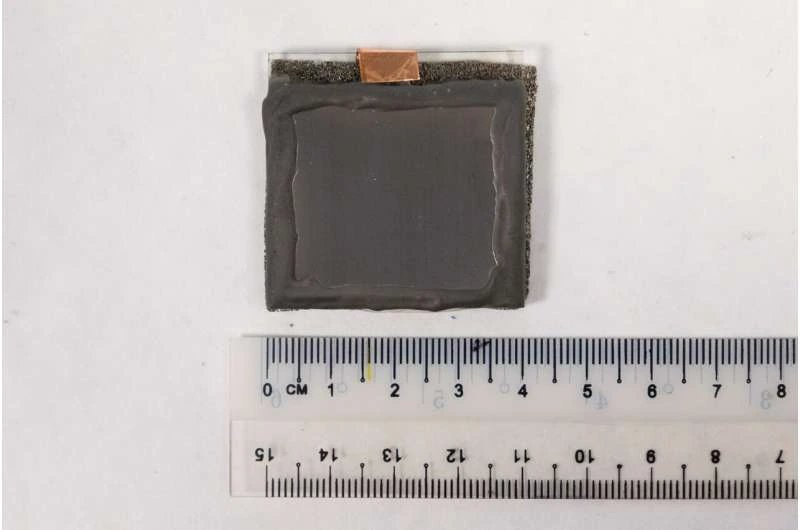
The artificial leaf is a photoelectrochemical device that simultaneously produces hydrogen from seawater and removes hydrazine, a toxic industrial pollutant. Unlike conventional electrolysis, where oxygen forms at the anode, the device's anode reaction decomposes hydrazine into hydrogen and nitrogen, requiring less energy and yielding additional hydrogen. The photocathode uses lead-containing halide perovskite to convert sunlight into electric current, coated with titanium foil and a conductive epoxy composite containing silver and copper particles for protection in seawater. The anode contains an iron-cobalt-chromium catalyst that resists corrosion and suppresses the formation of toxic chlorine compounds, a major challenge in direct seawater electrolysis.
Performance Results
In experiments with artificial and real seawater, the photocathode achieved a photocurrent density of 25 mA/cm². Under illumination matching clear-day sunlight intensity at Earth's surface, the device operated stably for more than 72 hours and produced hydrogen at 466 µmol/(cm²·h). Hydrazine concentration fell from 0.5 mol (about 1.6% by mass) to 0.5 parts per billion in 30 hours, more than 20 times below the US Environmental Protection Agency limit of 10 ppb.
Future Development
The researchers plan to develop catalysts for removing other pollutants and converting waste into useful products such as fuel and industrial feedstock.
1 source
Time · lag behind first