
Stickney Crater gravity data may reveal Phobos origin
This digest was compiled by AI from multiple sources — links to the originals are below.
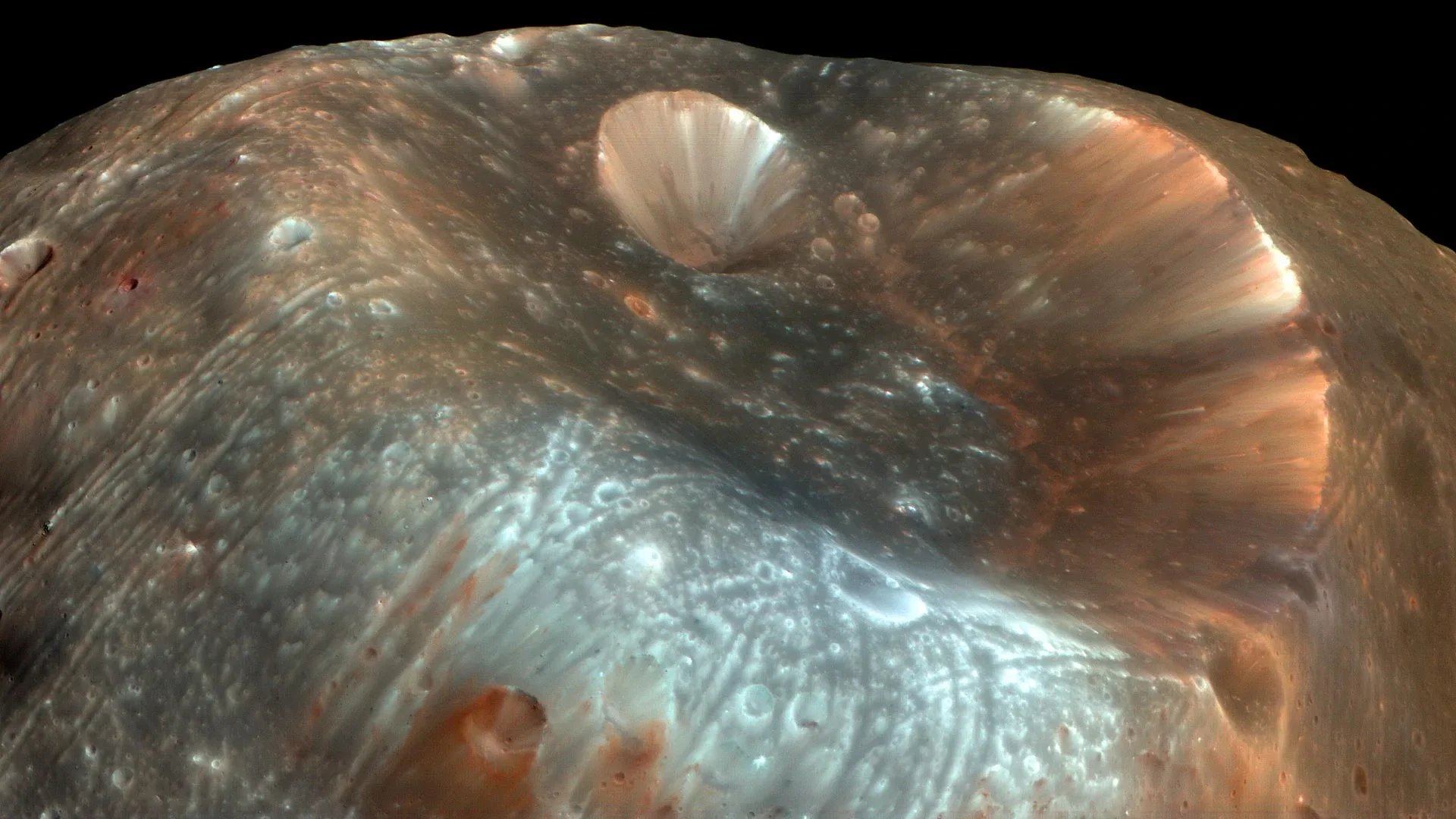
Researchers modeling Phobos' gravity and motion presented findings at the European Geosciences Union assembly in Vienna. The work focuses on Stickney Crater, a 9 km impact feature central to the debate over the moon's origin. The crater's age may distinguish between a giant-impact formation 4.2 billion years ago and asteroid capture 2.6 billion years ago.
Key Facts
- Stickney Crater has a diameter of 9 km (5.6 miles) and may have formed 4.2 billion years ago if Phobos originated from a giant impact on Mars.
- If Phobos was captured as an asteroid, the Stickney impact could have occurred around 2.6 billion years ago.
- Phobos has a mean diameter of 22.2 km (13.8 miles) and orbits Mars once every 7 hours and 39 minutes.
- Benjamin Haser and Thomas Andert published a 2026 paper in The Monthly Notices of the Royal Astronomical Society suggesting Phobos has a porous interior that may contain water ice.
Stickney Crater
The Stickney Crater is central to the debate over Phobos' history. If Phobos formed from debris created by a giant impact on Mars, the collision that produced the crater may have occurred roughly 4.2 billion years ago. If Phobos was instead captured as an asteroid, the Stickney impact could have happened much later, around 2.6 billion years ago. Researchers are particularly interested in whether the Stickney impact created a concentrated region of denser material beneath the crater.
Origin Hypotheses
Under one scenario, a giant object struck Mars and blasted material into orbit, eventually forming a disc that produced Phobos and Deimos. The competing idea is that the moons began as asteroids and were later captured by Mars' gravity. Spectral properties and models of asteroid capture provide support for the capture possibility, according to Haser and Andert. Understanding Phobos' gravitational field is a critical step toward learning how mass is distributed inside the moon and determining how it formed.
1 source
Time · lag behind first