
Oxford researchers find evidence of vast magma system beneath Mars
This digest was compiled by AI from multiple sources — links to the originals are below.
University of Oxford researchers have found evidence that Mars once hosted enormous Earth-like magmatic systems deep below its surface. The findings, published in Nature Astronomy, challenge the assumption that Mars's crust formed simply due to the absence of plate tectonics. The discovery points to new possibilities for how rocky planets evolve and potentially support habitability.
Key Facts
- The study, published in Nature Astronomy, analyzed seismic data from NASA's InSight mission.
- Researchers identified an unexplained boundary roughly 24 kilometers beneath the Martian surface.
- Rocks below the 24 km boundary were best explained by ultramafic material, while rocks above were more consistent with mafic rocks.
- Lead author Dr. Tobermory Mackay-Champion was at the University of Oxford during the study and is now at the University of Bristol.
Seismic Boundary Discovery
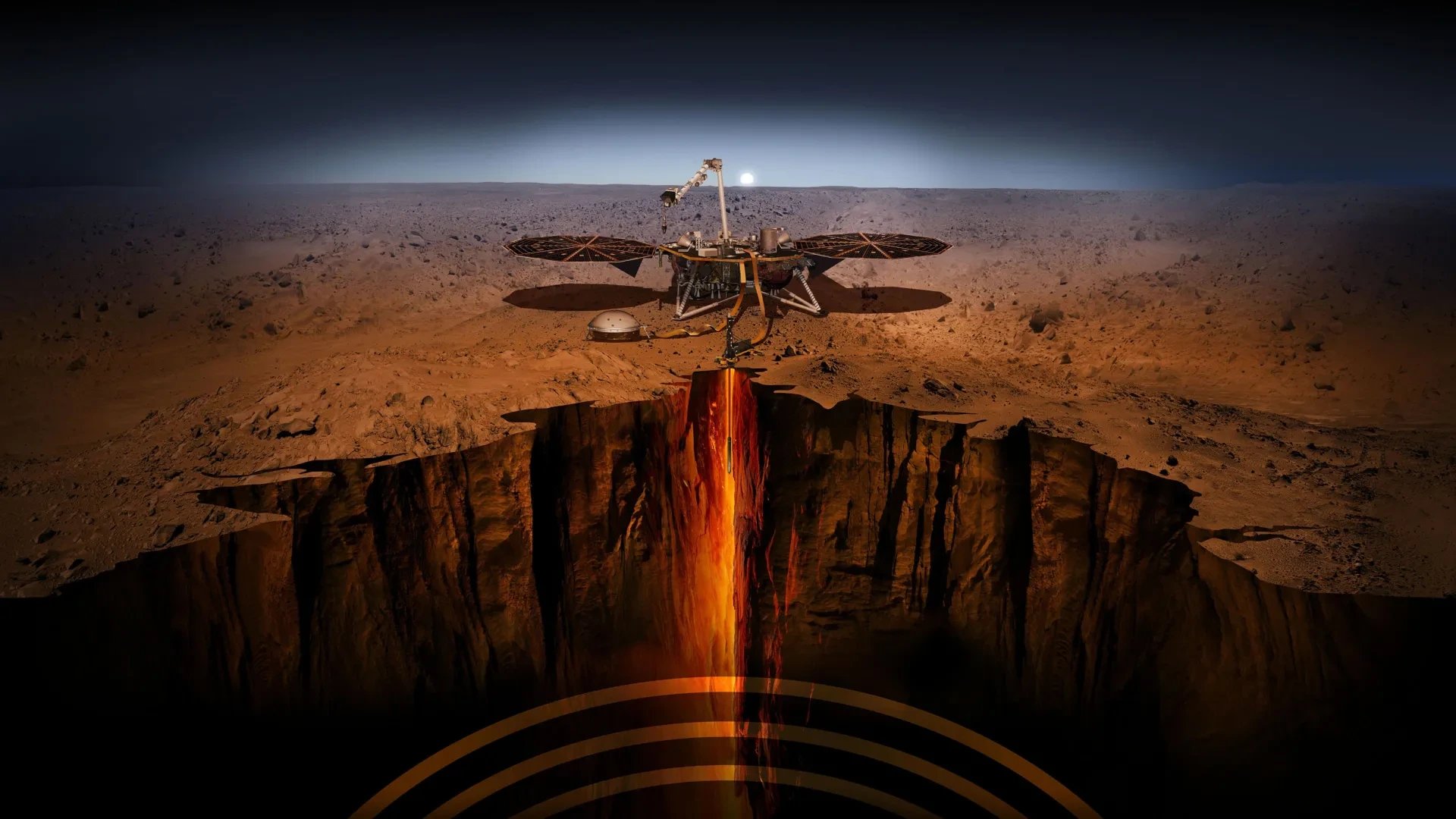
Researchers from the University of Oxford analyzed seismic data collected by NASA's InSight mission, focusing on waves generated by meteoroid impacts and marsquakes. The team studied an unexplained boundary roughly 24 kilometers beneath the Martian surface that had been identified in earlier research. They compared seismic observations with hundreds of possible rock compositions using thermodynamic modeling and statistical methods. The analysis showed that rocks beneath the 24 km boundary were best explained by ultramafic material, rich in iron and magnesium but low in silica. Above the boundary, seismic properties were more consistent with mafic rocks containing a higher proportion of silica.
Magma System Implications
The researchers think the buried layer formed when molten rock accumulated deep underground and gradually separated into different materials. In this process, dense crystals settled near the bottom of the crust while lighter and more chemically evolved melts moved upward. On Earth, similar processes occur beneath volcanic arcs and are associated with the formation of continents. Lead author Dr. Tobermory Mackay-Champion said the discovery suggests Mars could sustain large, long-lived systems where molten rock evolved and reprocessed itself throughout the entire crust.
1 source
Time · lag behind first