
JAXA to launch MMX probe to collect first samples from Martian moon Phobos
This digest was compiled by AI from multiple sources — links to the originals are below.
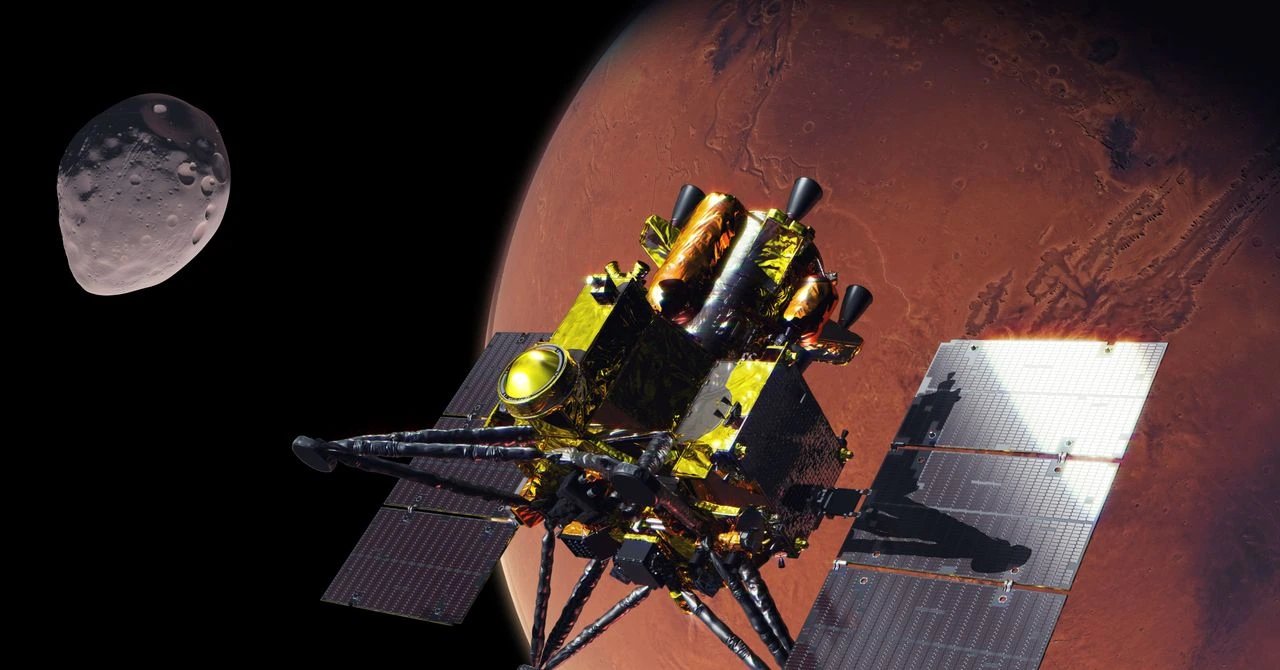
The Japan Aerospace Exploration Agency (JAXA) launched the Martian Moons eXploration (MMX) probe to collect at least 10 grams of samples from Phobos, a moon of Mars. The spacecraft will take about one year to reach Mars, conduct three years of operations, and return samples to Earth in 2031 if successful. The mission aims to determine whether Phobos and Deimos formed from a giant impact or are captured asteroids.
Key Facts
- The MMX probe will collect at least 10 grams of samples from Phobos, the first rocks from a Martian moon ever brought to Earth.
- The spacecraft will take approximately one year to reach Mars, followed by three years of operations and another year for the return journey.
- Scientists expect to receive the moon rocks in 2031 if the mission succeeds.
- At launch, the spacecraft has a mass of 4,480 kilograms, with more than half of that weight being fuel.
- Phobos has an approximate radius of 11 kilometers, compared to Earth's moon radius of over 1,700 kilometers.
Mission Objectives
The MMX mission aims to answer how Mars' moons Phobos and Deimos formed. Two main hypotheses exist: the moons condensed from material ejected during a massive collision with Mars, or they are asteroids captured by Mars' gravity. The moons' dark color and light-reflecting properties resemble water- and carbon-rich asteroids, but their nearly circular orbits along Mars' equatorial plane support the giant impact hypothesis. Comparing samples from Mars' moons to those from the Martian surface could help settle this debate.
Technical Challenges
The spacecraft, designed by Mitsubishi Electric, will land on Phobos, a delicate procedure given the moon's small size. Phobos' gravity is about 300 times weaker than Earth's moon, but approximately 50 times stronger than the asteroid Ryugu, where JAXA previously landed probes. Landing on Ryugu involved prolonged hovering, but this method is not feasible for MMX because it would consume too much fuel given Phobos' greater gravitational pull. The probe is equipped with high-precision autonomous navigation to handle a radio signal delay of up to 20 minutes between Earth and MMX.
1 source
Time · lag behind first