
Hunga Tonga eruption cloud destroyed methane at rate of 2 million cows daily
This digest was compiled by AI from multiple sources — links to the originals are below.
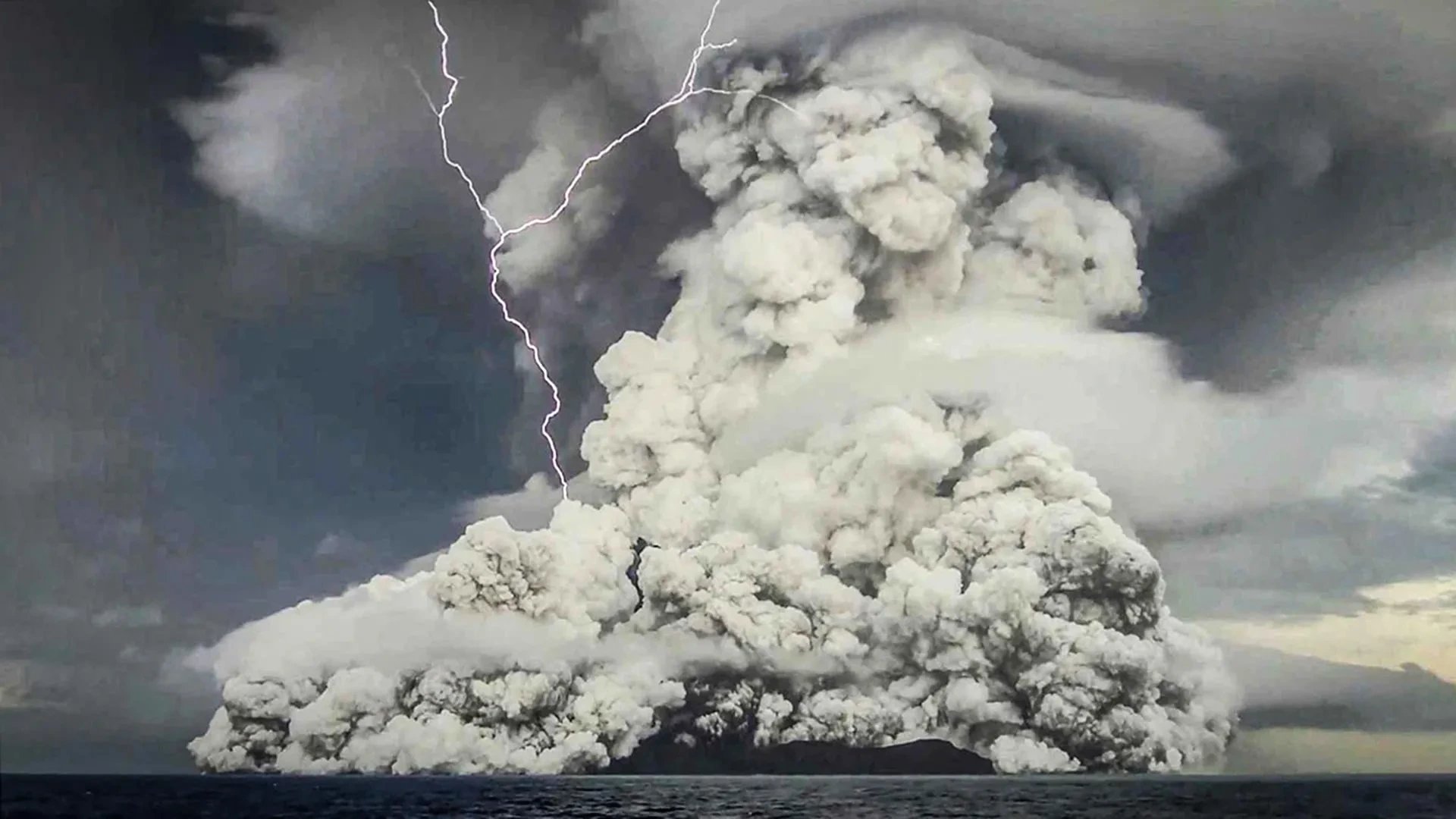
The January 2022 Hunga Tonga-Hunga Ha'apai eruption released about 300 gigagrams of methane, but its volcanic cloud removed roughly 900 megagrams of methane per day, according to a study published in Nature Communications. Researchers tracked a record-high formaldehyde signal in the plume for 10 days to South America, indicating continuous methane destruction for over a week. The finding suggests volcanic ash mixed with seawater and sunlight can partially clean up methane pollution from eruptions.
Key Facts
- The Hunga Tonga-Hunga Ha'apai eruption released around 300 gigagrams of methane, equivalent to the annual emissions of more than two million cows.
- The volcanic plume removed approximately 900 megagrams of methane per day, comparable to the daily emissions of two million cows.
- Researchers detected record-high formaldehyde concentrations in the plume, a chemical fingerprint of methane destruction, and tracked the cloud for 10 days to South America.
- The study was published in Nature Communications, with Dr. Maarten van Herpen from Acacia Impact Innovation BV as first author.
- The methane-destroying chemistry involves volcanic ash, seawater, and sunlight forming iron salt aerosols, a process first identified in 2023 with Saharan dust over the Atlantic.
Methane Destruction Mechanism
Satellite observations of the eruption plume revealed exceptionally high levels of formaldehyde, a short-lived chemical produced when methane breaks down in the atmosphere. Dr. Maarten van Herpen of Acacia Impact Innovation BV stated that the cloud's record-high formaldehyde concentration, tracked for 10 days to South America, indicated continuous methane destruction for over a week. The researchers attribute the process to a combination of volcanic ash, seawater, and sunlight that forms iron salt aerosols, similar to a mechanism identified in 2023 involving Saharan dust and sea salt over the Atlantic Ocean.
Climate Implications
Methane is a major contributor to global warming and disappears from the atmosphere much faster than carbon dioxide, making its removal a focus for near-term climate strategies. The study suggests that natural processes involving volcanic ash could accelerate methane destruction, offering insights for developing methods to reduce atmospheric methane. The eruption's methane release of 300 gigagrams was partially offset by the plume's removal of 900 megagrams per day, demonstrating a natural cleanup mechanism.
1 source
Time · lag behind first