
Denisova 11 genome shows Neanderthal mother and Denisovan father
This digest was compiled by AI from multiple sources — links to the originals are below.
A bone fragment from Denisova Cave in Siberia belonged to a girl, Denisova 11, who lived around 90,000 years ago. Her genome, sequenced at the Max Planck Institute, shows she had a Neanderthal mother and a Denisovan father. The finding reveals direct interbreeding between the two archaic human groups.
Key Facts
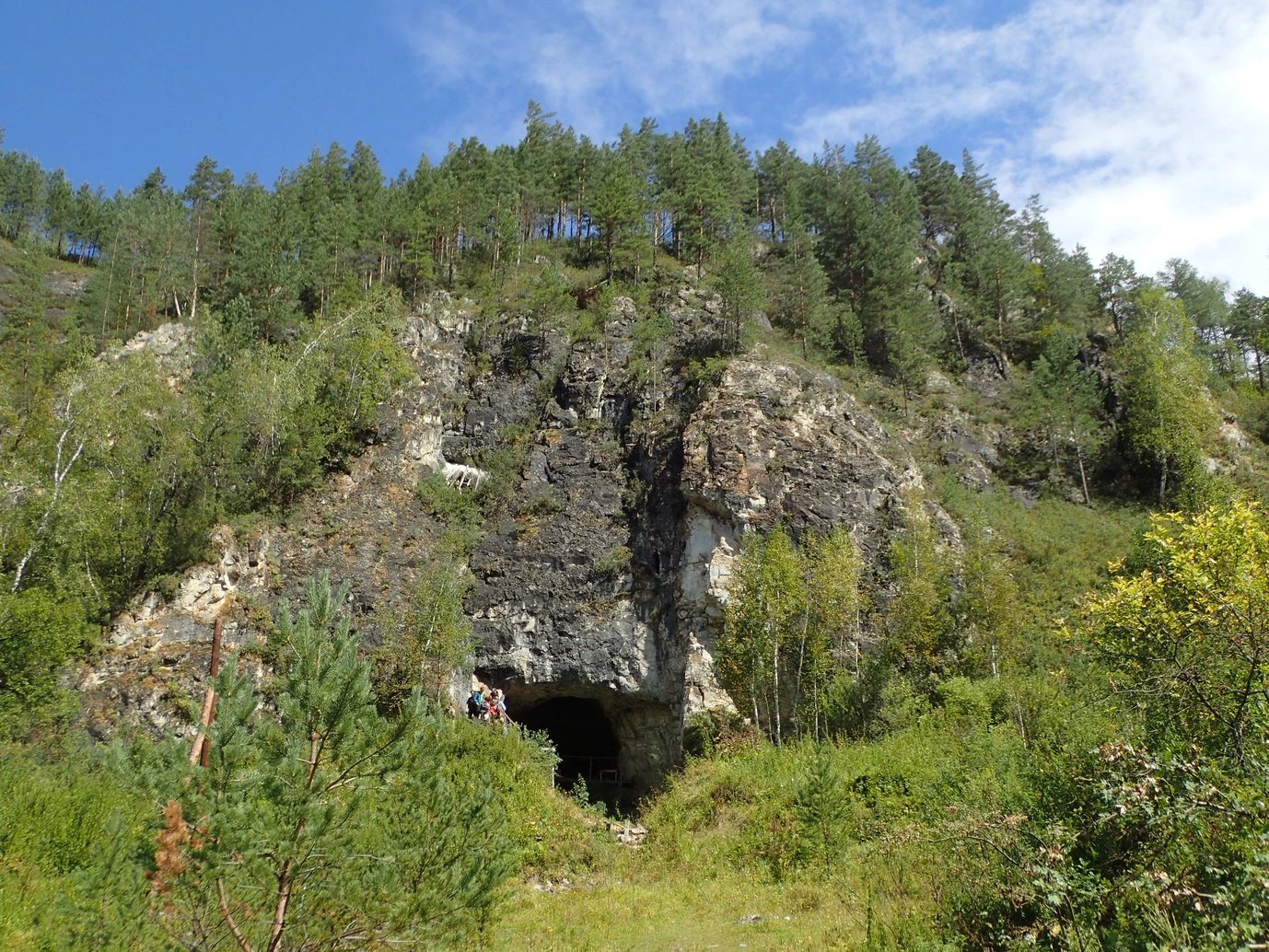
- The bone fragment, catalogued as Denisova 11, was excavated in 2012 at Denisova Cave in Siberia's Altai Mountains.
- Collagen peptide mass fingerprinting identified the fragment as human among more than 2,000 tested by Samantha Brown at Oxford.
- The genome, published in Nature in 2018, shows roughly half Neanderthal and half Denisovan ancestry.
- Her mitochondrial DNA, inherited maternally, is Neanderthal, indicating her mother was Neanderthal and her father Denisovan.
- A 2019 Bayesian model dates the bone to between 80,000 and 140,000 years ago, with about 90,000 years as a common estimate.
Discovery and Identification
The fragment was excavated in 2012 at Denisova Cave in Siberia's Altai Mountains. Samantha Brown, then at Oxford, screened more than 2,000 bone fragments using collagen peptide mass fingerprinting. Only one fragment, later named Denisova 11, was identified as human. The fragment was sent to the Max Planck Institute for Evolutionary Anthropology in Leipzig for genetic analysis.
Genomic Analysis
Viviane Slon, Svante Pääbo and colleagues sequenced the genome and published results in Nature in 2018. Roughly half of her genetic variants matched Neanderthals and half matched Denisovans. The clustering of variants across chromosomes indicated she had one parent from each group. Her mitochondrial DNA, inherited from her mother, is Neanderthal, confirming her mother was Neanderthal and her father Denisovan. Bence Viola of the University of Toronto estimated from bone thickness that she was at least 13 years old at death.
Dating and Ancestry
Radiocarbon dating placed the bone at more than 50,000 years old, beyond the method's reliable range. A 2019 Bayesian model by Katerina Douka and Tom Higham dated the bone to between 80,000 and 140,000 years ago. Most summaries use about 90,000 years as a shorthand for the age. The father's genome shows traces of Neanderthal ancestry from 300 to 600 generations before him, indicating earlier mixing.
1 source
Time · lag behind first