
Harvard researchers use sound waves to protect quantum memory
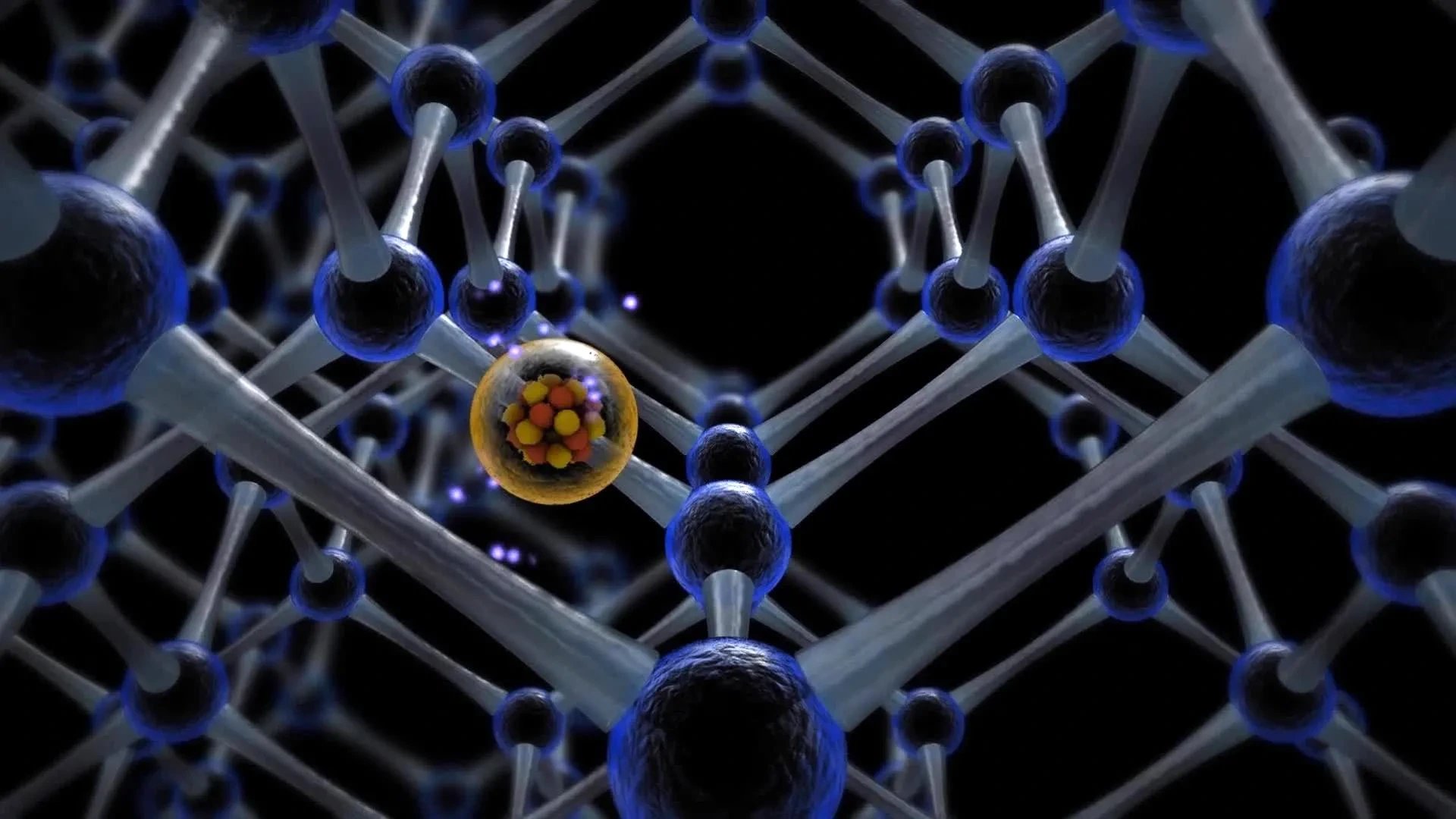
This digest was compiled by AI from multiple sources — links to the originals are below.
Harvard researchers demonstrated a new method to protect quantum information using mechanical vibrations, or phonons, in a diamond-based qubit. The technique, published in Nature Physics, could enable compact quantum networks and hybrid quantum systems. The advance addresses a key challenge in quantum computing: preserving quantum memory while maintaining strong phonon interactions.
Key Facts
- The Harvard John A. Paulson School of Engineering and Applied Sciences team demonstrated all-mechanical coherence protection for a silicon-vacancy spin in diamond.
- The findings were published in Nature Physics, with experiments led by Eliza Cornell and Zhujing Xu.
- Phonons have much shorter wavelengths than light at the same frequency, enabling smaller and more densely packed quantum components.
- The technique uses a continuous mechanical driving field made from phonons instead of conventional microwave pulses.
Phonon-Based Quantum Networks
The Lončar lab at Harvard SEAS has developed a phononic cavity that traps mechanical vibrations to enhance interaction with electron spins in qubits. Phonons interact readily with solid-state spins and electromagnetic fields, making them attractive for hybrid quantum technologies. The approach could support compact quantum networks built directly onto chips.
Coherence Protection Mechanism
Qubits inside phononic cavities suffer from poor coherence when protected by conventional microwave pulse techniques. The Harvard team applied a continuous mechanical driving field made from phonons to a silicon-vacancy spin in diamond. This all-mechanical method decouples the qubit from environmental noise while preserving strong phonon interaction.
1 source
Time · lag behind first