
ISTA physicists entangle distant qubits using autonomous quantum bath
This digest was compiled by AI from multiple sources — links to the originals are below.
Physicists at the Institute of Science and Technology Austria demonstrated fully autonomous entanglement of two separated qubits using a quantum bath of correlated light particles. The experiment, published in Physical Review X, realizes a theoretical proposal from over 20 years ago. The method requires no active control or repeated measurements, unlike previous approaches.
Key Facts
- The experiment was published in Physical Review X.
- The approach realizes a theoretical proposal made more than 20 years ago.
- The system uses a quantum bath to automatically synchronize distant qubits without active control or measurement.
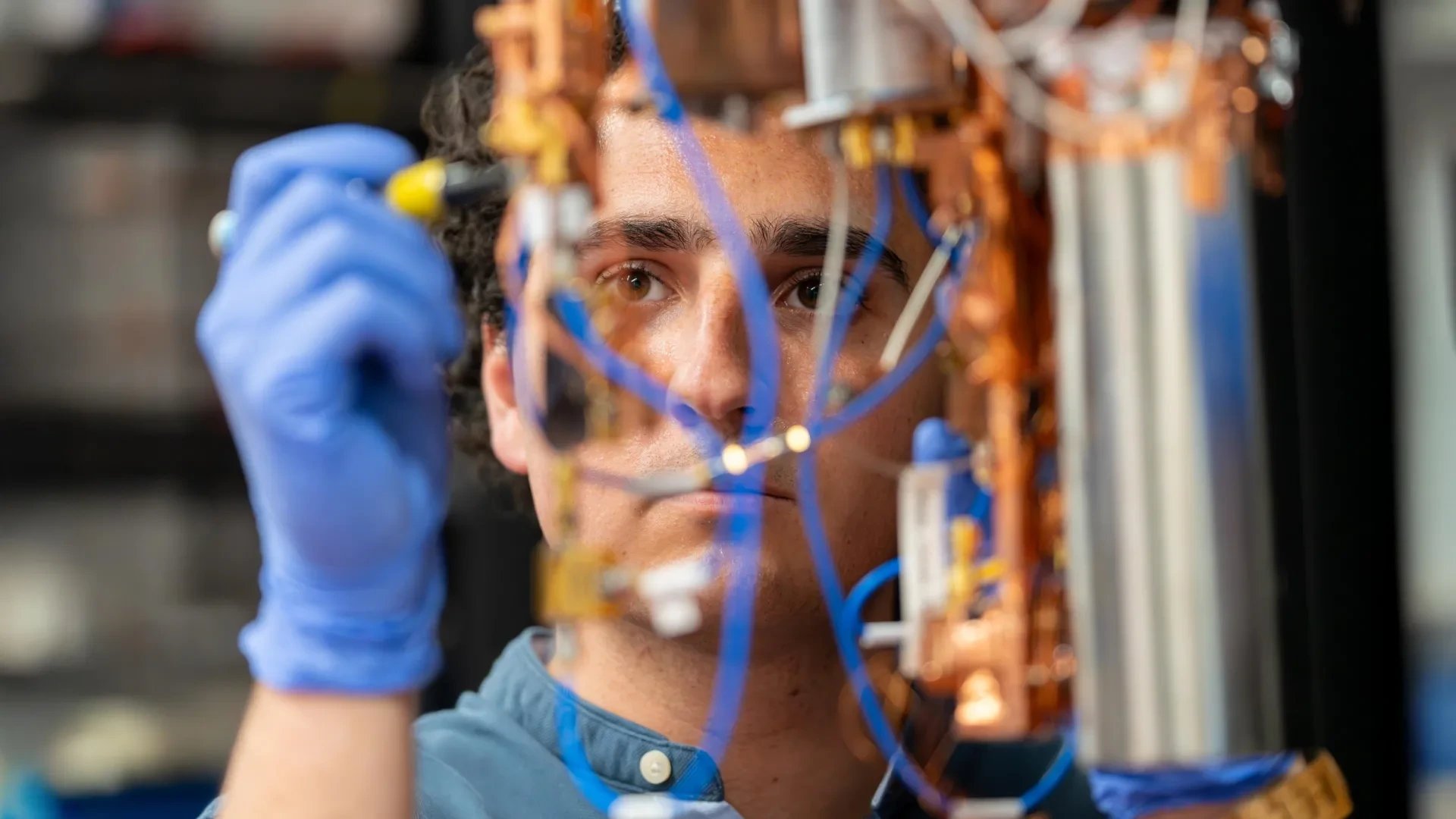
- PhD student Alejandro Andrés-Juanes and professor Johannes Fink led the work at ISTA with international collaborators.
Autonomous Entanglement Method
The ISTA team used a shared source of correlated light particles to entangle two separated qubits in a prototype device. The quantum bath automatically brings distant qubits into synchronization, eliminating the need for active control or repeated measurements. Previous methods either sent a single actively controlled photon between qubits or relied on post-selection of photon pairs, a strategy recognized by the 2022 Nobel Prize in Physics. The new approach stabilizes entangled states remotely, making the process fully autonomous.
Continuous vs Discrete Variables
Continuous-variable entangled states are produced efficiently but are less suited for stationary qubits, which require discrete-variable entanglement. The ISTA experiment bridges the mismatch between readily available continuous entanglement and the discrete forms needed for practical quantum technologies. Andrés-Juanes stated that stabilizing entangled states remotely overcomes this mismatch without active control or measurement.
1 source
Time · lag behind first