
Astronomers map Quipu, largest known cosmic superstructure spanning 1.4 billion light-years
This digest was compiled by AI from multiple sources — links to the originals are below.
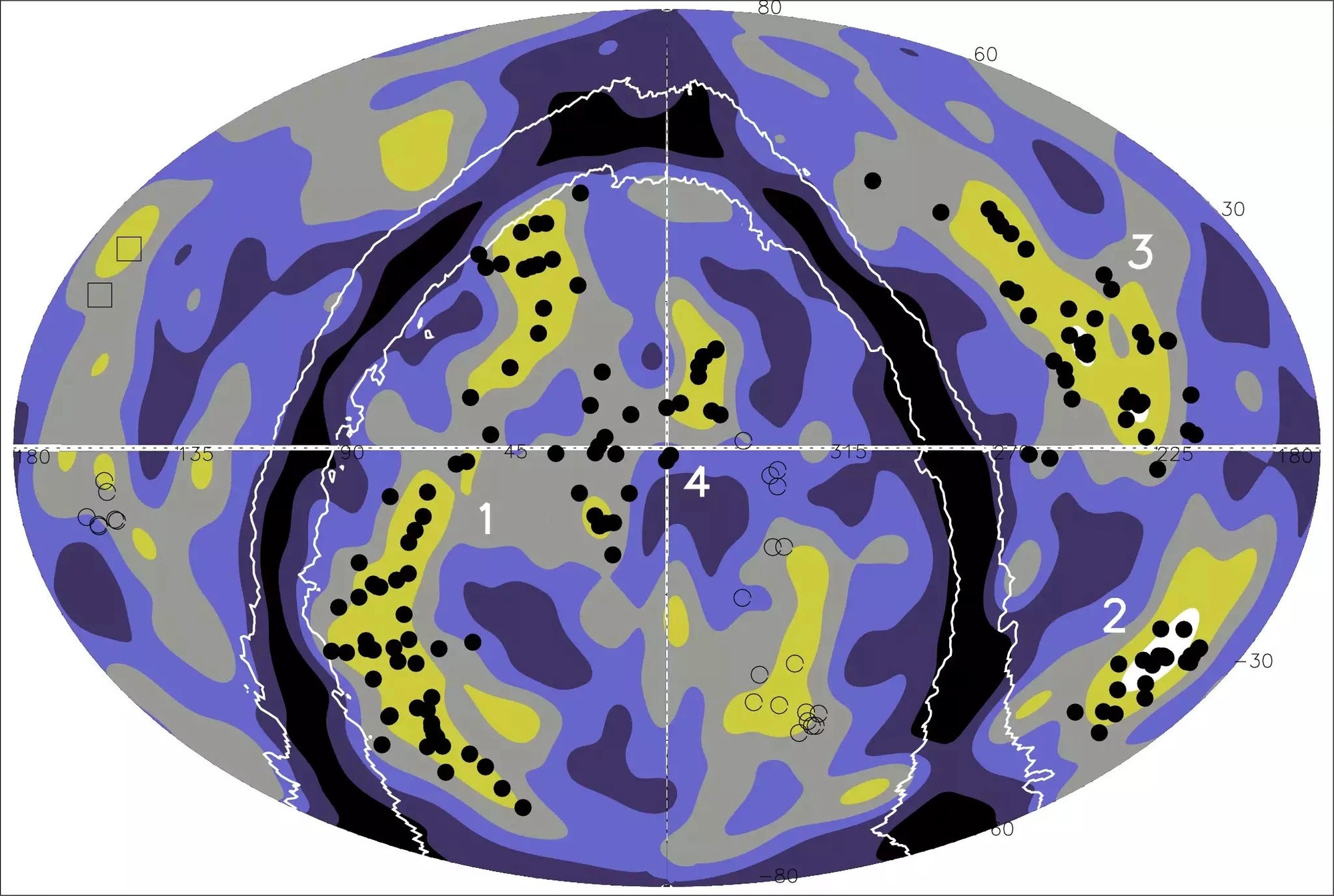
Astronomers have mapped Quipu, the largest reliably identified cosmic superstructure, extending about 1.4 billion light-years. The structure contains an estimated mass of 200 quadrillion Suns and was identified using X-ray cluster data from the CLASSIX catalogue. The finding was published in a 2025 Astronomy & Astrophysics paper.
Key Facts
- Quipu extends roughly 1.4 billion light-years, about 13,000 times the diameter of the Milky Way's stellar disc.
- Its estimated mass is around 200 quadrillion Suns.
- The structure was identified using the CLASSIX galaxy-cluster catalogue, which covers about 86 percent of the sky.
- The study examined a shell at redshifts between 0.03 and 0.06, corresponding to distances from 416 million to 826 million light-years.
- The finding was published in a 2025 Astronomy & Astrophysics paper by Hans Böhringer, Gayoung Chon, Joachim Trümper, Renee Kraan-Korteweg and Norbert Schartel.
The Discovery
Quipu is a branching concentration of galaxy clusters, galaxies, gas and mostly unseen matter woven through the nearby cosmic web. The structure extends for roughly 1.4 billion light-years, about 13,000 times the familiar diameter of the Milky Way's stellar disc. Its estimated mass is around 200 quadrillion Suns. The researchers used a well-characterised X-ray cluster survey to map a three-dimensional shell around Earth and defined a reproducible way to connect its densest knots. They checked the resulting structures against an independent distribution of galaxies and cosmological simulations.
Survey Method
The study examined a shell at redshifts between 0.03 and 0.06, corresponding roughly to distances from 416 million to 826 million light-years. The researchers used the CLASSIX galaxy-cluster catalogue, which combines the northern NORAS and southern REFLEX surveys. CLASSIX is rooted in the first all-sky X-ray map made by the German-led ROSAT satellite, with extensive spectroscopic follow-up to measure cluster distances. It covers about 86 percent of the sky and is more than 90 percent complete away from the most heavily obscured band of the Milky Way. Any claim about an unusually large structure is only as trustworthy as the map from which it was selected.
Scientific Significance
The result was the largest cosmic superstructure yet reliably characterised, with the word 'reliably' carrying much of the scientific weight. Quipu does not surround the Milky Way like a shell, and the Milky Way is not one of its member galaxies. The structure runs from high northern celestial latitudes toward the far southern sky, crossing a wide range of distances as its filament bends. Most ordinary matter in a rich galaxy cluster is not locked inside its galaxies.
1 source
Time · lag behind first