
Hubble finds 104,000-mile-wide decagon storm at Saturn's south pole
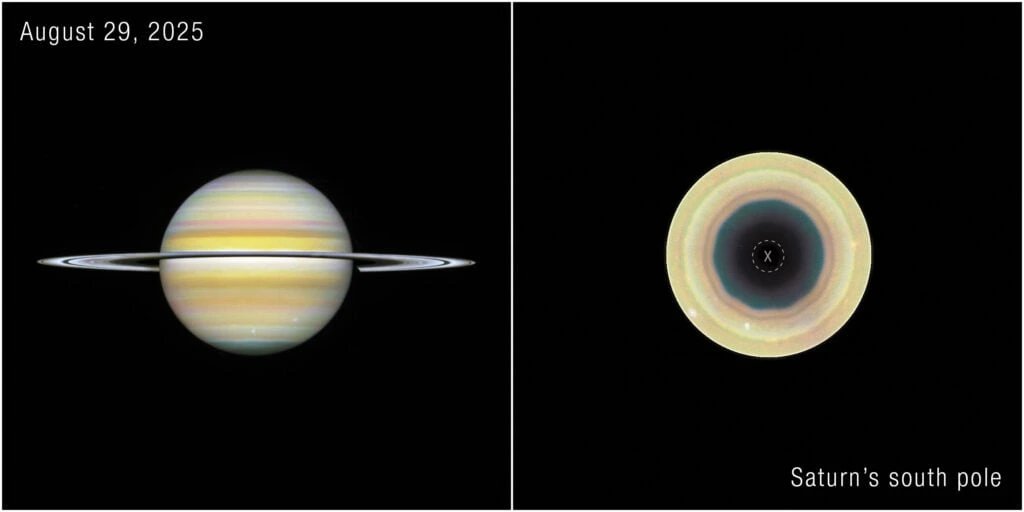
This digest was compiled by AI from multiple sources — links to the originals are below.
Astronomers using the NASA/ESA Hubble Space Telescope have identified a ten-sided wave, roughly 104,000 miles across, encircling Saturn's south pole. The decagon, described in a paper published in Science Advances in early September, was led by Agustín Sánchez-Lavega of the University of the Basque Country. The pattern appears to have been strengthening rather than fading.
Key Facts
- The decagon is roughly 104,250 miles (167,820 km) across, with each side about 10,425 miles (16,782 km) long.
- The structure sits centered near 63 degrees south latitude and rides a fast circumpolar jet.
- The pattern was already faintly present in Hubble imagery from 2023 and became more pronounced in subsequent years.
- The study was led by Agustín Sánchez-Lavega of the University of the Basque Country, with colleagues including Amy Simon of NASA Goddard and Mike Wong of UC Berkeley.
The Discovery
Astronomers working with the NASA/ESA Hubble Space Telescope report a ten-sided wave encircling Saturn's south pole. The decagon is roughly 104,000 miles across, with each straight-looking side running on the order of 10,000 miles. It is the geometric counterpart, though not the duplicate, of the six-sided jet that has ringed Saturn's north pole since Voyager spotted it more than forty years ago. The finding was led by Agustín Sánchez-Lavega of the University of the Basque Country in Bilbao, Spain, with colleagues including Amy Simon of NASA's Goddard Space Flight Center and Mike Wong of the University of California, Berkeley.
Observational History
Saturn's axial tilt and long orbit mean each pole hides for years at a stretch; from Earth, the south pole was effectively out of useful view from roughly 2012 to 2023. The Cassini mission, which orbited Saturn from 2004 to 2017, recorded a warm polar vortex and a cyclone at the south pole, but no long-lived polygonal jet to match the northern hexagon. Ground-based images contributed by observers including Trevor Barry in Australia and Jean-Paul Oger showed suggestive structure at the south pole across 2024 and 2025. Going back through Hubble's archive, the team found the pattern already faintly present in 2023 imagery, and more pronounced in the years that followed.
Hubble's OPAL Program
The Hubble frames come from OPAL, the Outer Planet Atmospheres Legacy program, which Amy Simon leads. OPAL provides a yearly, consistently calibrated portrait of Jupiter, Saturn, Uranus, and Neptune taken with Wide Field Camera 3, in the same filters, year after year. A decade of matched images is what turns 'there seems to be something at the pole' into a measurable wave with a countable number of sides.
1 source
Time · lag behind first