
Hubble reveals 10-sided cloud structure at Saturn's south pole
This digest was compiled by AI from multiple sources — links to the originals are below.
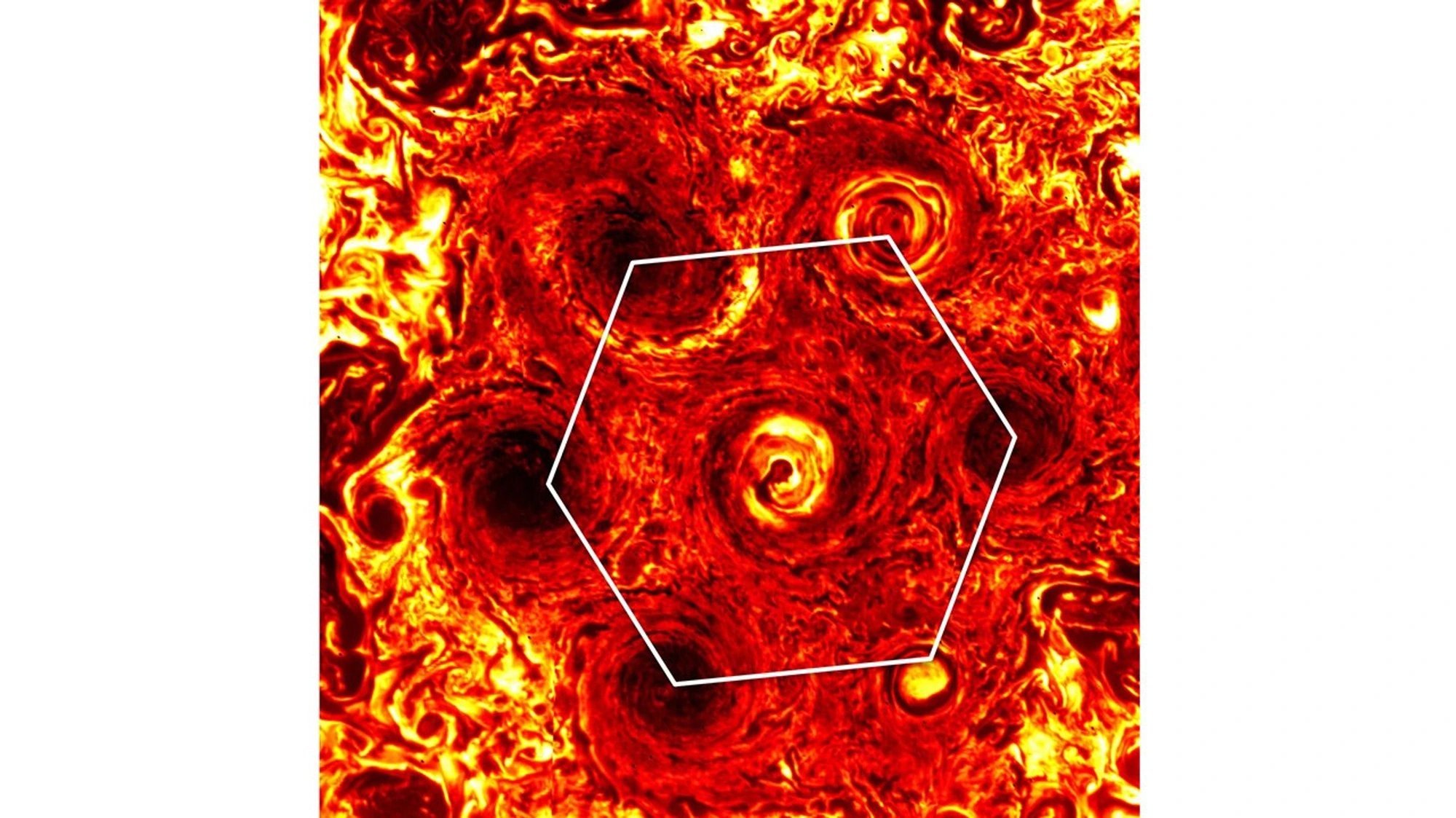
Astronomers have identified a 10-sided cloud structure at Saturn's south pole, spanning about 167,820 kilometers. The decagon, revealed in Hubble Space Telescope data, is far larger than the planet's long-known northern hexagon. Its appearance follows a period when Saturn's southern hemisphere was tilted away from Earth between 2012 and 2023.
Key Facts
- The decagon spans about 167,820 kilometers, with each side roughly 16,780 kilometers long.
- Saturn's northern hexagon measures about 32,000 kilometers across, making the new southern structure more than five times wider.
- The structure was identified using Hubble Space Telescope data, after Saturn's southern hemisphere became visible again from Earth in 2023.
- Archival Hubble images indicate the decagon began forming in 2023, while the northern hexagon has been observed for over 40 years.
- Researchers plan to monitor the decagon until 2032, when solar radiation in the region reaches its peak.
Discovery and Observations
The decagon was found in data recorded by NASA's Hubble Space Telescope. Saturn's axial tilt kept the southern hemisphere hidden from Earth between 2012 and 2023. When the viewing angle improved, astronomers obtained images showing the previously unseen symmetric cloud pattern. Archival Hubble images show the structure began forming in 2023.
Structure and Evolution
Computer simulations and atmospheric flow experiments suggest the decagon arises from waves trapped in a meandering atmospheric jet stream. Unlike the northern hexagon, which has maintained its shape and color for decades, the decagon's edges show variable brightness and darkness. Researchers say this variability indicates the structure is still dynamically evolving. The northern hexagon has been observed on Saturn for more than 40 years.
Future Monitoring
Astronomers plan to track the decagon until 2032, when solar radiation in the region peaks. They will examine whether the structure stabilizes or dissipates over that period. The findings are expected to advance understanding of planetary meteorology and atmospheric dynamics of giant gas bodies.
2 sources
Time · lag behind first