
Astronomers confirm TOI-1752 system with lava world and habitable-zone planet
This digest was compiled by AI from multiple sources — links to the originals are below.
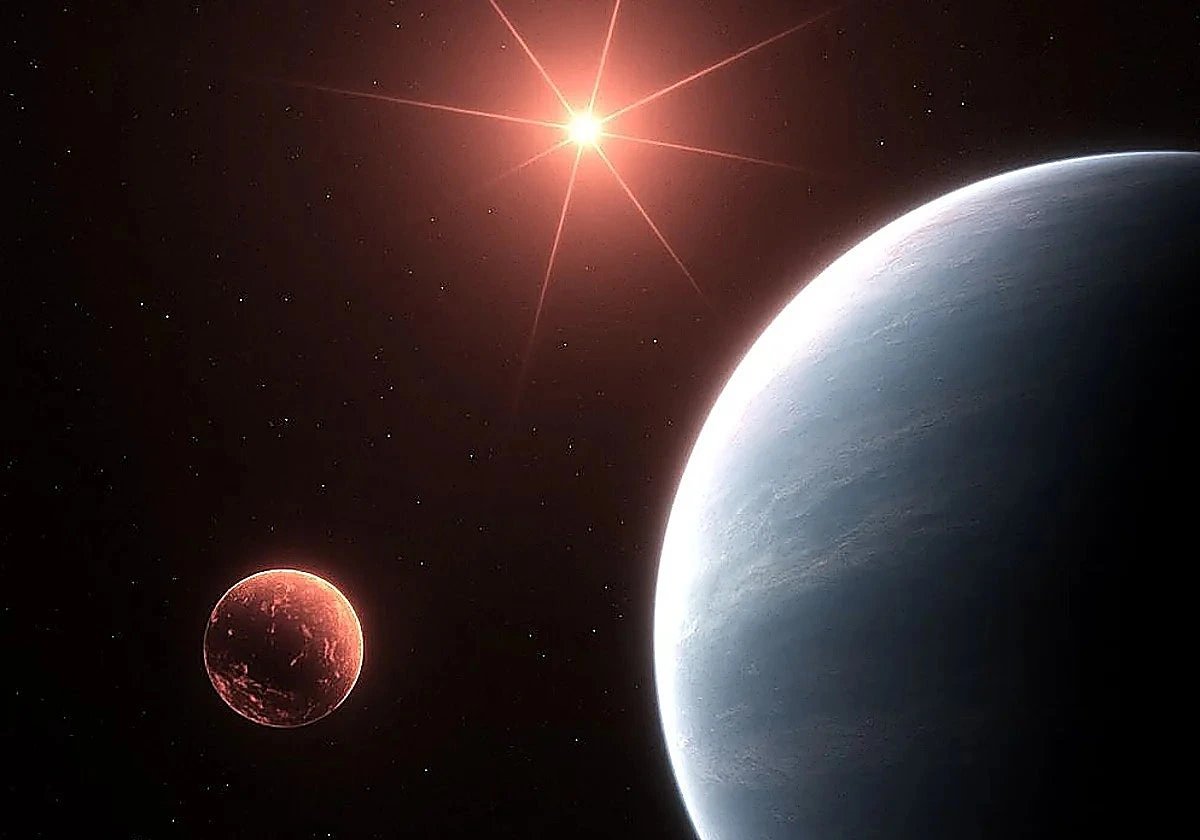
The Instituto de Astrofísica de Andalucía confirmed the TOI-1752 system on 31 August 2026, 337 light-years from Earth. The system contains a lava world, TOI-1752 b, orbiting in 0.94 days, and a larger planet, TOI-1752 c, in the habitable zone with a 32.7-day orbit. Both planets are high-priority targets for atmospheric spectroscopy with the James Webb Space Telescope.
Key Facts
- TOI-1752 b orbits its host star every 0.94 days and has a radius of 1.69 Earth radii, with a rocky composition.
- TOI-1752 c has an orbital period of 32.7 days and a radius of 2.0 Earth radii, placing it in the habitable zone.
- The confirmation was announced on 31 August 2026 by the Instituto de Astrofísica de Andalucía (IAA-CSIC) in Granada, Spain.
- The peer-reviewed analysis was published in the Monthly Notices of the Royal Astronomical Society.
- TOI-1752 b scores 8 on the emission spectroscopy metric, ranking it among the top lava-world candidates for study by the James Webb Space Telescope.
System Confirmation
The confirmation was announced on 31 August 2026 by the Instituto de Astrofísica de Andalucía (IAA-CSIC) in Granada, Spain. The underlying peer-reviewed analysis was published earlier in the year in the Monthly Notices of the Royal Astronomical Society. Lead author Alberto Peláez Torres is an IAA-CSIC researcher working under Spain’s Severo Ochoa research programme. The team collaborated with the Instituto de Astrofísica de Canarias, MIT’s Department of Earth, Atmospheric and Planetary Sciences, the University of Tokyo, and roughly a dozen other institutions. Data came from NASA’s TESS satellite and multi-color transit photometry from ground-based observatories in Tenerife, Hawaii, and the mainland United States.
Planetary Characteristics
TOI-1752 b orbits the host star in just 0.94 days, approximately 22 hours and 25 minutes. Its measured radius is 1.69 Earth radii, with a mass and density profile consistent with a rocky composition. Stellar radiation keeps the star-facing hemisphere at temperatures hot enough to maintain molten rock. TOI-1752 c has an orbital period of 32.7 days and a radius of 2.0 Earth radii. The outer planet sits in the habitable zone, cool enough to potentially retain liquid water somewhere on its surface.
1 source
Time · lag behind first