
Voyager 2's 1986 Uranus flyby occurred during rare solar wind, study finds
This digest was compiled by AI from multiple sources — links to the originals are below.
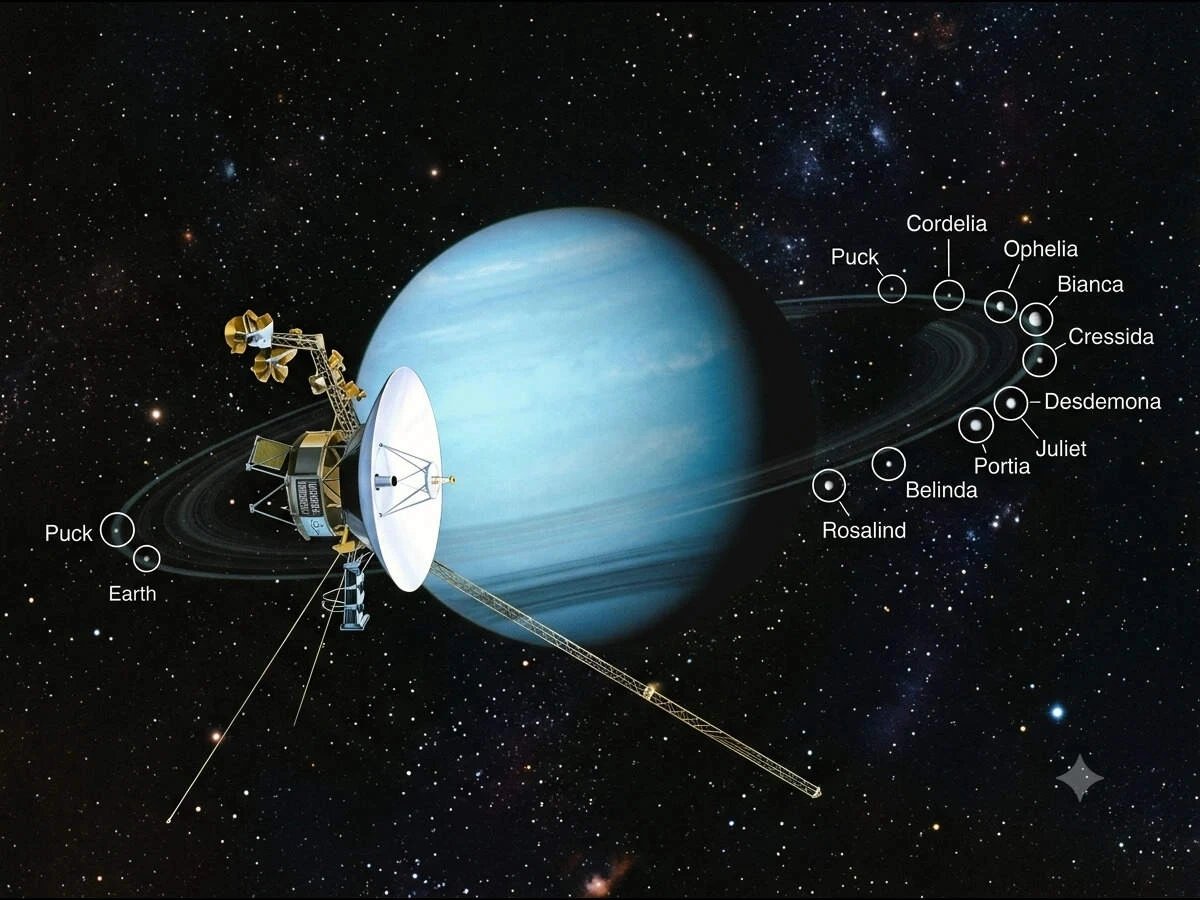
Voyager 2's 1986 Uranus flyby, the only spacecraft to visit the planet, occurred during unusually strong solar wind conditions seen just 4% of the time. The rare compression likely distorted the planet's magnetosphere, leading scientists to misinterpret its normal state for decades. The finding challenges long-held assumptions about Uranus's magnetic environment.
Key Facts
- Voyager 2 reached Uranus on 24 January 1986 and remains the only spacecraft to have visited the planet.
- A reanalysis published on 11 November 2024 found that Voyager arrived while an unusually forceful solar wind was compressing the dayside magnetosphere.
- Conditions producing a boundary as close to the planet as Voyager observed are estimated to occur only about 4% of the time.
- NASA's current Uranus guide describes a magnetic axis tilted nearly 60 degrees from the rotation axis and offset from the planet's centre by about one-third of its radius.
- Eight days before the flyby, the solar wind dynamic pressure was about 0.001 nanopascals, rising to about 0.018 nanopascals near the inbound crossing.
Rare Solar Wind Conditions
Jamie Jasinski of NASA's Jet Propulsion Laboratory and colleagues revisited the plasma measurements taken as Voyager approached Uranus. Their open-access paper in Nature Astronomy followed the solar-wind dynamic pressure through the days around the encounter instead of treating the few hours immediately upstream as ordinary background conditions. Eight days before the flyby, the dynamic pressure was about 0.001 nanopascals. It reached a minimum of 0.00078 nanopascals, then climbed sharply. Near Voyager's inbound crossing it was about 0.018 nanopascals, roughly 18 to 23 times the values measured during the quieter interval. By the outbound crossing, it was higher still, around 0.028 nanopascals.
Magnetosphere Misinterpretation
The result does not make the encounter mistaken or useless; Voyager measured what was there. The problem is one of typicality: a rare, heavily compressed state may have been interpreted for nearly four decades as Uranus's normal magnetic environment. Before Voyager 2, nobody knew whether Uranus possessed an internally generated magnetic field. The flyby established that it did, and that its geometry was unlike the relatively orderly arrangement familiar at Earth. NASA's current Uranus guide describes a magnetic axis tilted nearly 60 degrees from the rotation axis and offset from the planet's centre by about one-third of its radius. The field strength consequently varies sharply around the planet. Combined with Uranus's sideways rotation, that geometry twists the distant magnetotail and continually changes which part of the field faces the solar wind.
Radiation Belts and Plasma Depletion
Voyager also found a puzzling combination: Uranus had electron radiation belts of extraordinary intensity, second only to Jupiter's in the NASA account, yet much of the magnetosphere seemed almost empty of plasma. The five large moons inside the magnetic bubble should have released water-derived ions from their icy surfaces, as moons do elsewhere. Their apparent absence helped build a picture of geologically inactive moons inside a strangely depleted system. The 2024 reanalysis concerns the state of the surrounding magnetosphere during the encounter, not whether the underlying field is tilted or off-centre. Those structural findings remain.
1 source
Time · lag behind first